


In this guide, Dr. Cengizhan Ekizceli — one of the world’s most experienced forehead reduction surgeons, with around 1,000 procedures performed since 2019 and a PubMed-indexed study of 820 consecutive cases — explains how to choose between the two.
Quick answer: If you have a naturally high forehead, thick hair, and a stable hairline, forehead reduction gives you an immediate result of up to 2–4 cm in a single surgery. If your hairline is receding due to hair loss (male or female pattern), a hair transplant is usually the safer long-term choice. In some cases, the best result comes from combining both.
What Is Forehead Reduction Surgery?
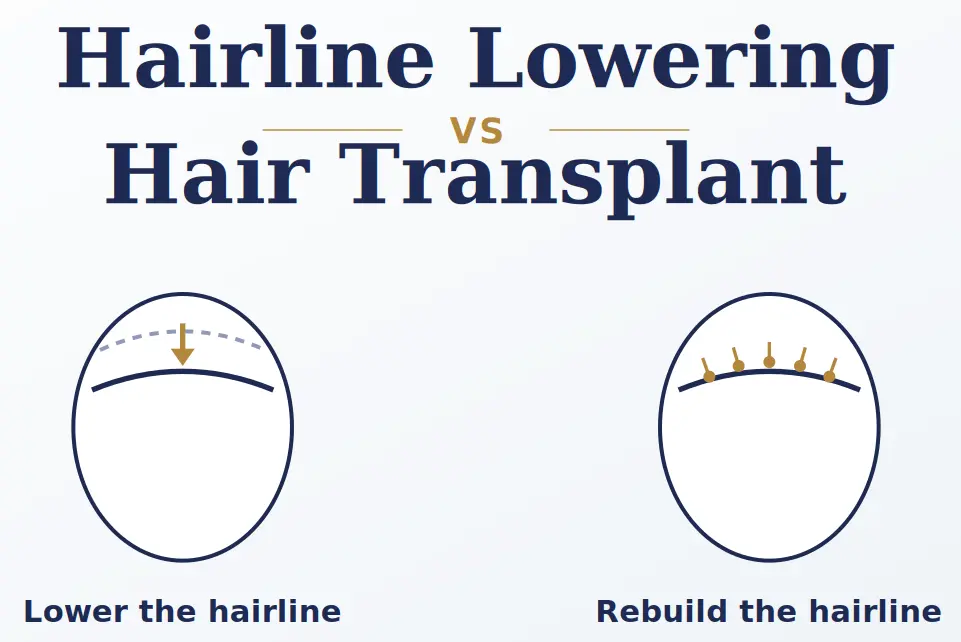
Forehead reduction surgery surgically moves the entire hairline forward. The surgeon removes a strip of hairless forehead skin just below the hairline (a pretrichial incision) and advances the scalp downward, instantly shortening the forehead.
Key facts about the procedure:
- Advancement: typically 1.5–4 cm in a single session
- Duration: around 2 hours under general anesthesia
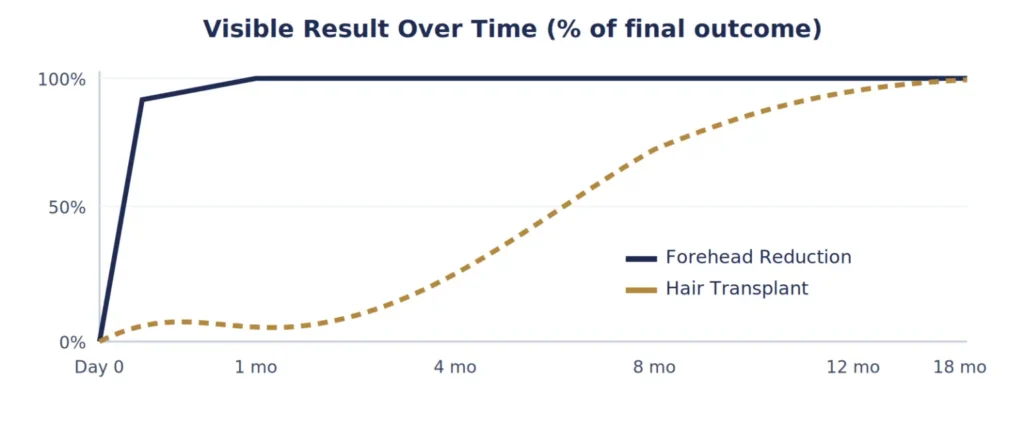
- Result: visible immediately — you leave surgery with a lower hairline
- Density: your natural, existing hair — full density from day one
- Scar: a fine line along the hairline; with Dr. Cengizhan’s signature “C Reduction” technique (zigzag incision, 45-degree cutting angle, and five-layer suturing), hair grows through the scar, camouflaging it
You can see real patient outcomes on our forehead reduction before and after gallery. If you’re not sure whether your forehead is actually large, start with our guide on what is considered a big forehead.
What Is a Hair Transplant?
A hair transplant does not move the hairline — it builds a new one. Individual hair follicles are harvested from the donor area (usually the back of the head) and implanted along a newly designed, lower hairline using FUE or DHI techniques.
Key facts about the procedure:
- Advancement: the new hairline is drawn wherever grafts are placed — but density is limited by your donor supply
- Duration: 6–8 hours under local anesthesia
- Result: gradual — transplanted hairs shed, then regrow; final result at 12–18 months
- Density: usually lower than natural frontal density; large foreheads may need a second session
- Scar: no linear scar with FUE — only micro-dots in the donor area
Forehead Reduction vs Hair Transplant: Side-by-Side Comparison
Results Timeline: Immediate vs Gradual
The single biggest practical difference is when you see your result. Forehead reduction is immediate; a hair transplant matures over more than a year:
Which Is Right for You?
Choose forehead reduction if…
- You have a congenitally high forehead (often 7 cm or more from brows to hairline)
- Your hairline is stable — no progressive male-pattern hair loss
- You want immediate, full-density results in a single surgery
- You have good scalp laxity (your surgeon will test this at consultation)
- You want to lower the hairline by 2 cm or more — which would require thousands of grafts to fake with a transplant
Most forehead reduction patients are women, but men with stable hairlines are also excellent candidates. For very large foreheads over 9–10 cm, Dr. Cengizhan offers a two-step reduction or a balloon-assisted (tissue expander) technique.
Choose a hair transplant if…
- Your high forehead is caused by a receding hairline or ongoing pattern hair loss
- You want to rebuild temples or fill in an M-shaped hairline
- You prefer a procedure under local anesthesia with no linear incision
- Your scalp laxity is too tight for a meaningful surgical advancement
- You only need subtle refinement (under ~1.5 cm) rather than a major lowering
Why hair loss matters: if you undergo forehead reduction while your hairline is still receding, the hair behind the scar can thin over time and expose the incision line. That’s why an honest assessment of your hair-loss pattern is the most important step in choosing between hairline lowering vs hair transplant.
When combining both gives the best result
The two procedures are not rivals — they’re often teammates:
- Forehead reduction first to achieve the major lowering with natural density
- A small hair transplant later (if needed) to soften the frontal edge, rebuild rounded temples, or camouflage the scar line
This combination is especially powerful for patients who want both a lower hairline and a softer, more feminine hairline shape.
Cost Comparison: Turkey vs the US & UK
Both procedures cost a fraction in Istanbul of what they cost in the US, UK, or EU — with no compromise on surgical standards.
Prices vary with the extent of surgery, technique, and whether procedures are combined. For current, detailed pricing, see our full breakdown of forehead reduction surgery cost in Turkey, or contact the clinic for a personalized quote.
Safety, Scars and Recovery
Every surgery carries risks, and choosing an experienced, specialized surgeon is the biggest factor in minimizing them. Forehead reduction risks include visible scarring, temporary numbness of the scalp, and — in inexperienced hands — hairline distortion. Hair transplant risks include poor graft survival, unnatural hairline design, and overharvested donor areas.
We’ve published a full, honest guide on this topic: Is forehead reduction safe? Risks and complications explained.
With the “C Reduction” technique — zigzag incision, follicle-preserving 45° cutting angle, and five-layer closure — hair grows through the incision line, and most patients can wear their hair pulled back within a few months.
Not Sure Which One You Need? Ask the Surgeon Directly
The right choice depends on your hairline stability, scalp laxity, forehead height, and goals – things that can be assessed in minutes with a few photos.
FAQs
Is forehead reduction better than a hair transplant?
Neither is universally “better.” Forehead reduction is better for naturally high, stable hairlines that need significant lowering with instant full density. A hair transplant is better when the high forehead is caused by hair loss, or when only subtle refinement is needed.
Can a hair transplant lower my hairline by 3 cm?
Technically yes, but covering a 3 cm strip across the whole forehead at natural density can require 3,000+ grafts, often over two sessions, and the density still won’t match native frontal hair. Forehead reduction achieves the same lowering in one 2-hour surgery with your own natural density.
Will the forehead reduction scar be visible?
With a pretrichial zigzag incision and follicle-preserving technique, hair grows through and in front of the scar. Most patients find it very hard to detect once healed. See real healed results in our before and after gallery.
Can men get forehead reduction surgery?
Yes — but only men with a stable hairline and no significant risk of future male-pattern baldness. For men with active recession, a hair transplant (sometimes with medication to stabilize loss) is usually the safer route.
How much does hairline lowering surgery cost in Turkey?
Significantly less than in the US or UK — typically a 50–70% saving, including hospital stay. Exact pricing depends on the advancement needed and any combined procedures; see our Turkey price guide or request a free quote.
Can I have a hair transplant after forehead reduction?
Yes. Many patients add a small refinement transplant 12+ months later to soften the hairline edge or rebuild temples. Dr. Cengizhan offers both procedures in one clinic, so your plan can be designed as a whole from day one.