



What Is a DHI Hair Transplant?
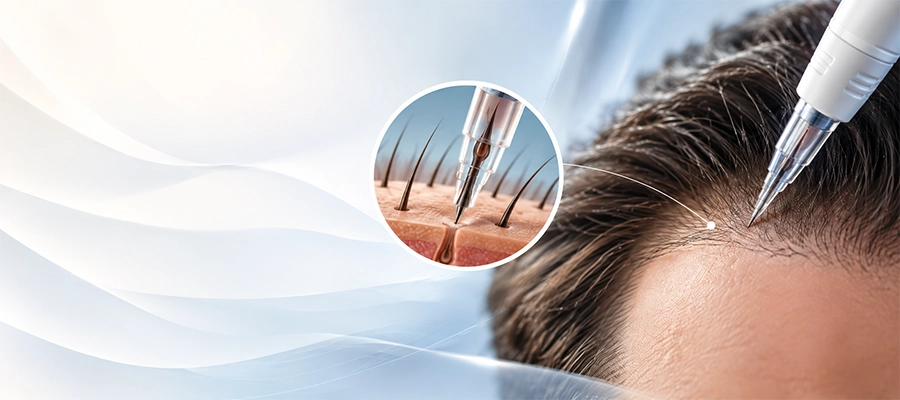
Among these approaches, a DHI hair transplant uses a specialized implanter pen to place harvested follicular units directly into the recipient area. The method is commonly associated with Direct Hair Implantation and is designed to combine recipient-site creation and graft placement into a single implantation movement.
Unlike a completely separate follicle-harvesting technique, DHI generally relies on follicular unit extraction, or FUE, to obtain grafts from the donor area. Its main distinction concerns the way these grafts are implanted.
The technique may offer practical advantages in selected patients, particularly when working around existing hair. However, successful results depend on surgical planning, careful graft handling, and the experience of the medical team rather than the implantation instrument alone.
How Does DHI Hair Transplantation Work?
DHI transplantation involves extracting healthy follicular units from a donor area and implanting them into regions affected by hair loss.
The donor area is usually located at the back or sides of the scalp, where follicles may be more resistant to androgen-related hair thinning.
After extraction, the grafts are examined and prepared for implantation.
A specialized implanter pen is then used to insert the follicles into the recipient area.
The instrument allows the operator to create a small opening and position the graft during the same movement.
However, the quality of the result still depends on appropriate depth, angle, direction, and spacing.
What Is the Direct Hair Implantation (DHI) Technique?
Direct Hair Implantation is a method of placing follicular units into the scalp using a dedicated implantation instrument.
The term describes the implantation stage rather than an entirely different approach to graft harvesting.
In many DHI procedures, individual follicles are collected through standard FUE extraction.
The harvested grafts are then loaded into an implanter pen before being inserted into the scalp.
This approach differs from techniques that prepare recipient channels before placing grafts with forceps.
However, DHI is not automatically more effective than other implantation methods, and clinical outcomes depend on multiple surgical factors.
How Is a DHI Hair Transplant Performed Step by Step?
The procedure begins with a consultation to assess the patient’s hair loss pattern, scalp health, and available donor hair.
The surgeon then designs the intended hairline and determines the distribution of grafts across the recipient area.
Local anesthesia is administered before individual follicular units are extracted using specialized punches.
The harvested grafts are examined, sorted when necessary, and protected from drying or unnecessary handling.
Each graft is carefully loaded into an implanter pen, which is used to position it within the recipient area.
After implantation, the scalp is checked and the patient receives instructions for washing, sleeping, physical activity, and follow-up care.
Who Is a Good Candidate for a DHI Hair Transplant?
Adults with permanent hair loss and sufficient donor hair may be suitable candidates for DHI transplantation.
The technique is commonly considered for individuals with androgenetic alopecia, also known as pattern hair loss.
Patients who require carefully distributed graft placement among existing hair may also be evaluated for this approach.
However, adequate donor density and a realistic assessment of future hair loss remain essential.
Active scalp infections, uncontrolled inflammatory conditions, and certain scarring alopecias may make transplantation inappropriate until the underlying disease is controlled.
A medical assessment is necessary to determine whether DHI is suitable or whether another transplantation approach would be more appropriate.
What Are the Benefits of DHI Hair Transplantation?
One potential advantage of DHI is the ability to create a recipient opening and place a graft using the same instrument.
This can provide the surgical team with a controlled approach to graft positioning.
The technique may be useful when transplanting hair between existing follicles, depending on the recipient area’s characteristics.
Selected patients may also undergo implantation without shaving the entire scalp.
Because grafts are usually harvested through FUE, the procedure avoids the long linear donor scar associated with strip harvesting.
However, these features do not guarantee better graft survival, greater density, or faster healing compared with other well-performed techniques.
What Are the Disadvantages of a DHI Hair Transplant?
DHI requires careful coordination during graft loading and implantation, which can make the procedure technically demanding.
Improper handling may damage follicles or reduce their ability to grow.
The implantation process can also be time-consuming, particularly when a large number of grafts is required.
As with other hair transplantation methods, bleeding, swelling, infection, temporary numbness, and scarring are possible.
Incorrect graft placement may produce unnatural hair direction or uneven density.
The technique also cannot prevent future genetic hair loss in untreated areas.
What Is the Difference Between DHI and FUE Hair Transplantation?
FUE refers primarily to the extraction of individual follicular units from the donor area.
DHI describes a particular approach to implanting those grafts into the recipient area.
Therefore, the two terms do not represent completely separate stages of hair transplantation.
Many DHI procedures use FUE harvesting before implantation with an implanter pen.
In conventional FUE procedures, the surgeon may create recipient channels first and then insert the grafts using forceps.
The most important difference is generally the implantation instrument and workflow, not the source of the harvested follicles.
DHI vs. Sapphire FUE: What Are the Key Differences?
Both DHI and sapphire FUE commonly involve harvesting follicular units through FUE extraction.
The difference lies mainly in how the recipient area is prepared and how the grafts are placed.
Sapphire FUE generally uses sapphire blades to create channels before implantation.
DHI typically uses an implanter pen to create an opening and insert a graft during the same movement.
Both techniques can produce natural-looking results when performed with appropriate planning and surgical skill.
Current evidence does not consistently establish that either approach provides superior long-term graft survival or cosmetic outcomes for every patient.
How Does the Choi Implanter Pen Work in DHI Hair Transplantation?
The Choi implanter pen is a specialized instrument designed to assist with follicular unit implantation.
It generally consists of a hollow needle and a mechanism that advances the graft into the scalp.
A prepared follicular unit is carefully loaded into the instrument, usually with attention to the position of the hair shaft and follicle.
The operator places the needle at the intended angle and depth within the recipient area.
The instrument’s mechanism then releases the graft into the prepared opening.
Correct loading and placement are essential because excessive pressure or improper positioning can damage delicate follicles.
How Long Does a DHI Hair Transplant Procedure Take?
The duration depends on the number of grafts, the recipient area’s size, and the complexity of the procedure.
Many DHI sessions take approximately six to eight hours, although extensive cases may require more time.
The process includes anesthesia, graft extraction, preparation, loading, and implantation.
Because grafts are individually loaded into implanter pens, the implantation stage may be time-consuming.
Some patients require more than one session to achieve the planned coverage.
The procedure should be organized around graft quality and patient safety rather than speed alone.
Is DHI Hair Transplantation Painful?
Local anesthesia is typically used to reduce pain during follicle extraction and implantation.
Patients may feel temporary stinging or pressure while the anesthetic is administered.
Once the scalp is numb, significant pain is generally not expected, although some sensations may remain.
Mild tenderness, tightness, or discomfort can develop after the procedure.
These symptoms usually improve during the early healing period.
Severe or worsening pain, particularly with fever, increasing redness, or discharge, requires prompt medical evaluation.
How Many Grafts Can Be Transplanted Using the DHI Method?
The number of grafts depends on the size of the recipient area, donor hair availability, and the patient’s hair characteristics.
Some patients require relatively small sessions, while others may need several thousand grafts.
However, the maximum safe number is not determined by the DHI technique alone.
Donor density, graft quality, and the risk of overharvesting must be considered.
Implanting too many grafts into a limited area can also compromise tissue conditions and graft survival.
A personalized surgical plan is necessary to establish a realistic graft count.
Can DHI Hair Transplantation Be Performed Without Shaving?
Selected DHI procedures can be performed without shaving the entire scalp.
This approach may be considered for patients who want to maintain their existing hairstyle during the early recovery period.
However, limited trimming or shaving of the donor area may still be necessary for accurate extraction.
Long surrounding hair can also make graft placement and postoperative care more challenging.
Unshaven procedures may take longer and are not suitable for every graft requirement.
The decision depends on donor accessibility, recipient density, and the surgical team’s assessment.
DHI Hair Transplant Turkey Prices 2026
In 2026, DHI hair transplant prices vary according to the number of grafts, the complexity of implantation, and the medical team’s experience.
Frequently Asked Questions
Is DHI Hair Transplantation Better Than FUE?
DHI is not necessarily better than FUE because the terms describe different aspects of hair transplantation. FUE usually refers to graft harvesting, while DHI describes an implantation method. The most appropriate approach depends on the patient’s hair characteristics and the surgical team’s expertise.
Is DHI Hair Transplantation Better Than Sapphire FUE?
Neither technique has been consistently proven superior for every patient. DHI uses an implanter pen, while sapphire FUE generally uses sapphire blades to prepare recipient channels. Both methods can provide satisfactory results when graft placement and surgical planning are performed correctly.
How Many Grafts Are Needed for a DHI Hair Transplant?
The required number depends on the extent of hair loss, the desired coverage, and donor hair availability. Small areas may require fewer grafts, while extensive thinning may require several thousand. The final graft count should be determined through a scalp examination.
What Is the Success Rate of DHI Hair Transplantation?
There is no single reliable success rate that applies to every DHI procedure. Graft survival depends on donor hair quality, extraction technique, handling, implantation, and postoperative healing. Clinics may report different figures, but these should not be interpreted as guaranteed outcomes.
Does Shock Loss Occur After a DHI Hair Transplant?
Yes, temporary shedding can occur after DHI transplantation. Transplanted hair shafts often shed during the first several weeks before new growth begins, and nearby existing hair may also shed temporarily. The extent of shock loss varies between patients.
When Can You Wash Your Hair After a DHI Hair Transplant?
Gentle washing is often introduced within the first few days, depending on the surgeon’s instructions. Patients should avoid scratching, rubbing, or directing strong water pressure onto the transplanted area. The specific washing schedule should follow the surgical team’s postoperative protocol.
When Can You Return to Work After a DHI Hair Transplant?
Many patients with desk-based jobs can return to work within a few days, depending on swelling and comfort. Some prefer to wait approximately one to two weeks until visible crusting has improved. Physically demanding work may require a longer recovery period.
When Can You Exercise After a DHI Hair Transplant?
Light walking may be possible relatively soon after the procedure if it does not cause excessive sweating or discomfort. Strenuous exercise and heavy lifting are commonly restricted for approximately one to two weeks, depending on healing. Contact sports and activities involving scalp trauma may require additional time.
Is DHI Hair Transplantation Suitable for Women?
Yes, selected women with permanent hair loss and sufficient donor density may be candidates. However, diffuse thinning can affect the donor area and reduce suitability for transplantation. A dermatological assessment is important to identify the cause of hair loss before surgery.