



What Is Sapphire FUE Hair Transplant?
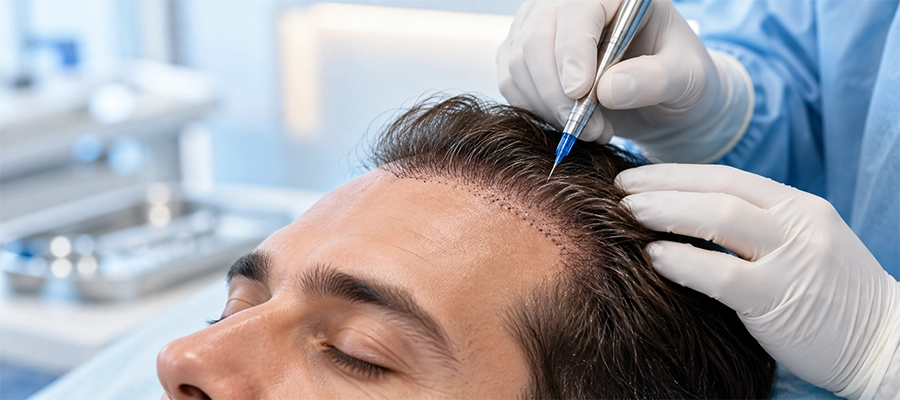
Within modern hair restoration surgery, Sapphire FUE hair transplant refers to a variation of follicular unit extraction in which synthetic sapphire blades are used to create recipient channels. Individual hair follicle units are harvested from the donor area and placed into these channels to restore coverage in areas affected by hair loss.
The sapphire component describes the blade material rather than a separate follicle extraction method. Although sapphire blades offer certain technical characteristics, their use does not automatically guarantee greater hair density, faster healing, or better graft survival.
Successful transplantation depends primarily on accurate diagnosis, responsible donor management, surgical planning, and careful handling of the harvested follicles.
How Does Sapphire FUE Hair Transplantation Work?
The procedure involves transferring healthy follicular units from a donor region to areas experiencing permanent hair thinning or loss.
The donor area is usually located at the back and sides of the scalp, where follicles may be relatively resistant to androgen-related hair loss.
After local anesthesia, individual follicular units are extracted using specialized punches.
The surgeon then prepares small recipient channels with sapphire blades, taking the intended hair direction, angle, and distribution into account.
The harvested grafts are carefully inserted into the prepared openings.
Over time, surviving follicles begin producing new hair, although the visible growth process takes several months.
Who Is a Good Candidate for Sapphire FUE Hair Transplantation?
Adults with stable hair loss and sufficient healthy donor follicles may be suitable candidates.
The procedure is commonly considered for individuals with androgenetic alopecia, also known as male or female pattern hair loss.
A good candidate should have enough donor hair to provide useful coverage without creating excessive thinning in the extraction area.
Scalp health, hair shaft characteristics, and the likely progression of hair loss must also be evaluated.
Patients with active scalp infections or uncontrolled inflammatory conditions may need treatment before surgery.
Realistic expectations are important because transplantation redistributes existing follicles rather than increasing the total number of hair follicles.
What Hair Loss Conditions Can Sapphire FUE Treat?
Sapphire FUE is primarily used to restore coverage in areas affected by stable, permanent hair loss.
Androgenetic alopecia is one of the most common reasons for undergoing the procedure.
Selected patients with stable scars from injuries or previous surgery may also be considered for transplantation.
However, scar tissue can have a different blood supply and may require a modified surgical approach.
Active alopecia areata and uncontrolled scarring alopecias are generally unsuitable conditions for routine transplantation.
Temporary shedding caused by stress, illness, or nutritional deficiencies usually requires treatment of the underlying cause rather than surgery.
What Are Sapphire Blades and How Are They Used?
Sapphire blades are surgical instruments made from synthetic sapphire, a crystalline form of aluminum oxide.
They are manufactured in different shapes and sizes for creating small openings in the recipient area.
During transplantation, the surgeon uses the blade to prepare channels at planned angles and depths.
The dimensions of these openings should correspond to the characteristics of the grafts being implanted.
Appropriate channel design helps the surgeon control hair direction and distribution.
However, the blade material alone does not determine surgical precision, and incorrect use can still damage surrounding tissue.
What Are the Benefits of Sapphire FUE Hair Transplantation?
One potential benefit is the availability of sapphire blades with specific shapes and dimensions for recipient-channel preparation.
These instruments can help surgeons create openings suited to the planned graft placement.
The technique also uses individual follicular unit extraction, avoiding the long linear donor incision associated with strip harvesting.
When performed correctly, the procedure can produce natural-looking hair direction and distribution.
It may be used for frontal hairline restoration, crown coverage, or other selected areas.
However, these benefits are not exclusive to sapphire blades, and comparable outcomes may be achieved with other well-performed FUE techniques.
What Are the Limitations of Sapphire FUE?
The technique cannot create additional hair follicles or reverse the biological cause of genetic hair loss.
Its effectiveness depends on the quantity and quality of donor hair available.
Patients with extensive baldness may not have enough donor follicles to achieve their desired density.
The procedure also carries risks of scarring, graft loss, infection, and uneven hair growth.
Future thinning of existing hair may continue after transplantation.
Importantly, current evidence does not consistently demonstrate that sapphire blades provide superior long-term results compared with conventional recipient-site instruments.
Sapphire FUE vs. Traditional FUE: What Are the Differences?
Both approaches generally use the same principle of harvesting individual follicular units from the donor area.
The primary distinction is the instrument used to create recipient channels.
Sapphire FUE uses synthetic sapphire blades, while traditional FUE may use steel blades or other specialized instruments.
The choice of blade can influence how the surgeon prepares the recipient sites.
However, graft extraction, donor management, and the principles of natural hair placement remain similar.
Neither method guarantees better results solely because of the material used during channel creation.
Sapphire FUE vs. DHI: Which Method Is More Suitable?
Sapphire FUE and Direct Hair Implantation, or DHI, differ mainly in the implantation stage.
In sapphire FUE, recipient channels are usually prepared before the harvested grafts are inserted.
DHI typically uses an implanter pen that creates an opening and places the graft during the same movement.
Both methods commonly rely on FUE extraction to obtain donor follicles.
DHI may be considered for selected cases involving implantation among existing hair, while sapphire FUE can be used for a wide range of recipient areas.
The most suitable approach depends on the surgical plan, donor availability, hair characteristics, and the team’s experience.
How Do Sapphire Blades Compare to Steel Blades?
Sapphire and steel blades are both used to prepare recipient openings during hair transplantation.
Sapphire is a hard crystalline material, while surgical steel is a metal alloy manufactured for medical use.
Blade geometry, sharpness, size, and handling characteristics can differ between instruments.
These factors may influence the surgeon’s technique and the dimensions of the created channels.
However, a harder blade material does not necessarily produce less tissue damage or faster healing.
Clinical evidence has not established that sapphire blades are universally safer or more effective than appropriately selected steel blades.
How Is the Donor Area Evaluated for Sapphire FUE?
The donor area is examined to determine whether enough healthy follicles are available for transplantation.
The surgeon evaluates hair density, shaft thickness, distribution, and signs of thinning.
Trichoscopy may be used to examine the scalp and individual hair characteristics in greater detail.
The assessment also considers whether the donor region is likely to remain stable as hair loss progresses.
Excessive harvesting can create visible thinning and multiple small scars.
For this reason, graft extraction should be planned to preserve a natural appearance in the donor area.
How Many Grafts Can Be Transplanted with Sapphire FUE?
The appropriate graft number depends on the size of the recipient area, desired coverage, and available donor follicles.
Small hairline procedures may require fewer grafts than extensive crown or frontal restoration.
Some patients need several thousand grafts, while others are better suited to smaller sessions.
There is no universal maximum graft count that applies safely to every patient.
Excessive harvesting can permanently reduce donor density, and overly dense implantation may compromise graft survival.
A responsible treatment plan balances recipient coverage with long-term donor preservation.
How Is a Natural Hairline Designed with Sapphire FUE?
Hairline design begins with an assessment of facial proportions, age, existing hair distribution, and future hair loss.
The surgeon considers the natural transition between the forehead and scalp rather than creating an unnaturally straight border.
Single-hair follicular units are commonly preferred along the leading edge of the hairline.
Hair direction and angle are planned to resemble the surrounding natural growth pattern.
Sapphire blades may be used to create recipient channels according to this design.
However, a natural appearance depends on artistic planning and accurate graft placement, not the blade material alone.
How Should You Wash and Care for Your Hair After Sapphire FUE?
Postoperative care focuses on protecting newly implanted grafts and allowing the scalp to heal.
Gentle washing is often introduced within the first few days, according to the surgeon’s instructions.
Patients should avoid vigorous rubbing, scratching, and directing high-pressure water onto the transplanted area.
Small crusts around the grafts should be allowed to loosen naturally rather than being picked off.
Clean bedding, careful sleeping positions, and avoiding unnecessary scalp contact can help reduce irritation.
Increasing redness, severe pain, fever, or discharge should be assessed promptly because these symptoms may indicate a complication.
What Is Shock Loss After Sapphire FUE?
Shock loss refers to temporary hair shedding that may occur after transplantation.
Transplanted hair shafts commonly shed during the first several weeks as follicles transition through their growth cycle.
Some existing hairs near the recipient area may also shed temporarily following surgery.
This process does not necessarily indicate that the transplanted follicles have failed.
However, thinning of already weakened native hair may not always recover completely.
The extent of shock loss varies according to the patient’s hair condition and surgical factors.
When Does New Hair Start Growing After Sapphire FUE?
New hair growth usually begins to become noticeable approximately three to four months after transplantation.
Before this stage, many transplanted hair shafts shed temporarily.
The follicles that survive implantation remain beneath the skin and may begin producing new hair as they enter the growth phase.
Early growth can appear thin, uneven, or slower than expected.
Hair thickness and density generally improve over subsequent months.
The exact timing varies between individuals and should be assessed through regular postoperative follow-up.
How Long Does It Take to See Final Sapphire FUE Results?
Hair transplantation results develop gradually because transplanted follicles follow natural hair growth cycles.
Some visible improvement may appear within six months.
More substantial changes in density and hair length commonly develop between six and twelve months.
Crown-area transplantation may take longer to reach a mature appearance.
In some patients, the final cosmetic result continues developing for twelve to eighteen months.
Healing, graft survival, and individual hair characteristics influence the overall timeline.
What Are the Risks and Possible Complications of Sapphire FUE?
Sapphire FUE carries the general risks associated with surgical hair transplantation.
Temporary swelling, bleeding, discomfort, itching, and changes in scalp sensation may occur.
Infection, folliculitis, and delayed wound healing are less common but possible complications.
Excessive donor harvesting can cause visible thinning or patchy scarring.
Poor graft placement may result in unnatural hair direction, uneven density, or an irregular hairline.
Some grafts may fail to grow, and patients may continue losing untreated native hair after surgery.
How Long Do Sapphire FUE Hair Transplant Results Last?
Transplanted follicles taken from relatively androgen-resistant donor areas can continue producing hair for many years.
However, their long-term survival is not guaranteed in every patient.
The transplanted follicles retain many characteristics of their original donor location.
Existing native hair in the recipient area may continue thinning because transplantation does not stop androgenetic alopecia.
Some patients benefit from ongoing medical treatment to preserve surrounding hair.
Future transplantation may be considered in selected cases, provided sufficient donor hair remains available.
Sapphire FUE Hair Transplant Turkey Prices 2026
In 2026, Sapphire FUE hair transplant prices vary according to the number of grafts, the complexity of the hairline design, and the experience of the surgical team.
Frequently Asked Questions
Is Sapphire FUE Better Than Traditional FUE?
Sapphire FUE has not been consistently proven superior to traditional FUE in long-term clinical outcomes. The primary difference concerns the material used to prepare recipient channels. Surgical planning, graft handling, and the team’s experience have a greater influence on the final result.
Is Sapphire FUE Better Than DHI?
Neither technique is universally better for every patient. Sapphire FUE usually involves creating recipient channels before implantation, while DHI uses an implanter pen to place grafts. The choice depends on the recipient area, hair characteristics, and the surgeon’s preferred approach.
Is Sapphire FUE a Different Hair Extraction Method?
No, sapphire FUE generally uses the same follicular unit extraction principles as conventional FUE. Individual grafts are harvested using specialized punches. The sapphire component refers to the blade used for recipient-channel preparation.
Are Sapphire Blades Safer Than Steel Blades?
There is insufficient clinical evidence to conclude that sapphire blades are universally safer than steel blades. Both can be used effectively when selected and handled appropriately. The risk of tissue injury depends on blade design, surgical technique, and the patient’s scalp characteristics.
Is Sapphire FUE Hair Transplantation Painful?
Local anesthesia is typically used to reduce pain during graft extraction and implantation. Patients may experience brief discomfort during anesthetic administration and mild tenderness afterward. Severe or worsening pain should be evaluated by a medical professional.
Is Sapphire FUE Suitable for Advanced Hair Loss?
Some patients with advanced hair loss may be candidates if they have sufficient donor follicles. However, extensive baldness can limit the amount of achievable coverage. A detailed donor assessment is essential to avoid overharvesting and unrealistic density expectations.
Can Sapphire FUE Be Performed Without Shaving the Head?
Selected procedures can be performed without shaving the entire scalp. However, trimming or shaving part of the donor area may still be necessary for safe and accurate extraction. Unshaven procedures can be more time-consuming and may not be suitable for extensive graft requirements.