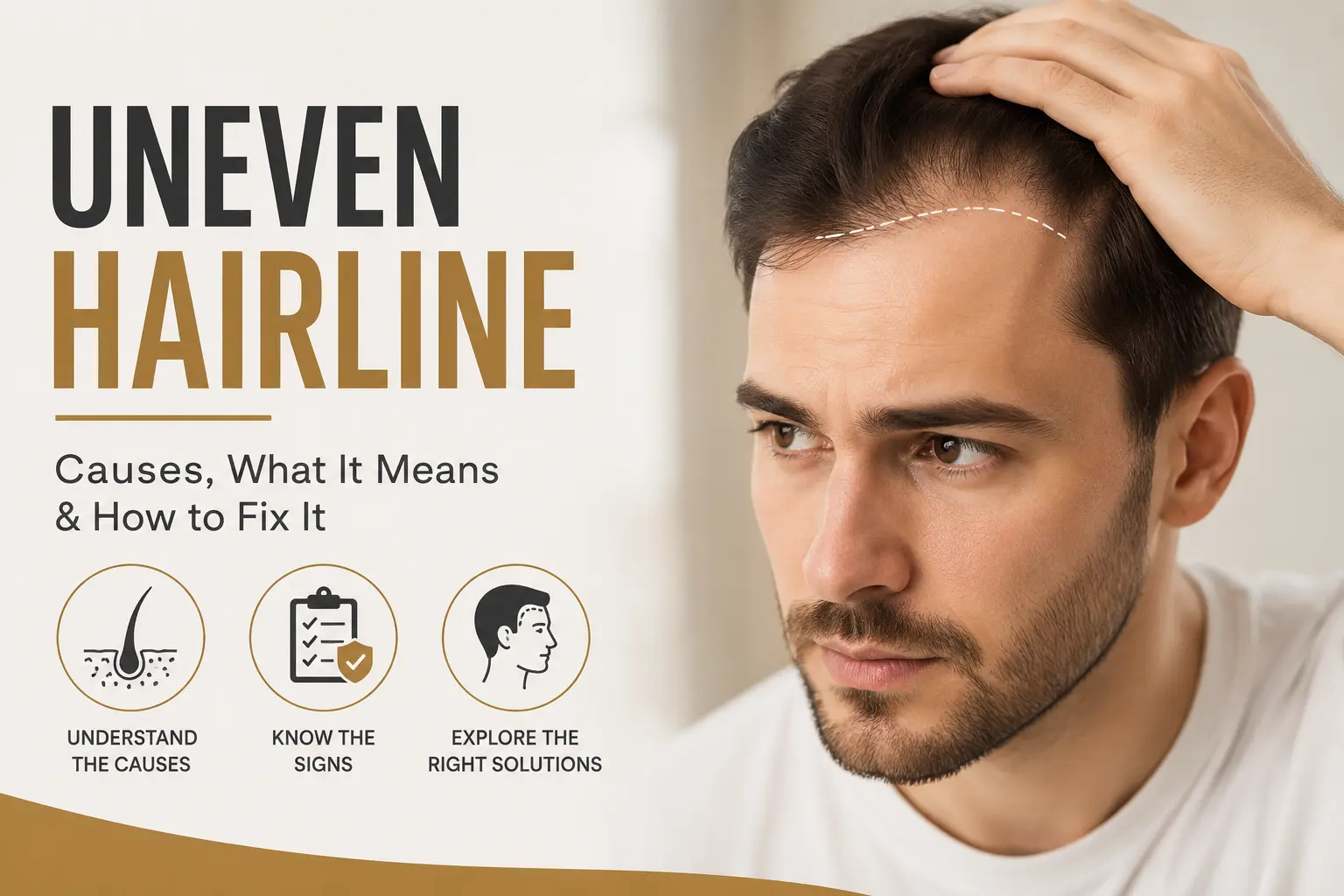


Your face represents you and defines your expression, so the proportions of its features are crucial. When these proportions are off, your self-confidence and sense of self can suffer. Advanced treatments are available to help you restore your true appearance.
If you’re Interested in forehead reduction at our clinic, you can contact us for a free consultation about this procedure, including its affordable pricing in Turkey. If you’d like to know more, keep reading to learn about the ideal candidates, the process, outcomes, and available options.
Forehead Reduction in Turkey: At a Glance
Procedure
Forehead Reduction
Also Known As
Hairline Lowering
Duration
Approx. 2 Hours
Anesthesia
General
Hairline Lowering
Up to Approx. 4 cm
Hospital Stay
Typically 1 Night
Recovery
About 7–10 Days
Scar Location
Along the Hairline
Final Result
Approx. 6 Months
Location
Istanbul, Turkey
Price in Turkey
From €2,800
See full 2026 pricing →
Exact hairline lowering, recovery and pricing vary according to anatomy
and your individual treatment plan.
Table of Contents
What Is Forehead Reduction Surgery?
Forehead reduction surgery, also known as hairline lowering surgery, is a surgical procedure designed to reduce the vertical height of the forehead by advancing the hair-bearing scalp forward.
The aim is to create a lower, more balanced hairline while preserving a natural transition between the forehead and scalp. The amount of lowering depends on factors such as scalp flexibility, hairline stability, hair density and individual anatomy.
Learn more about surgery for a large forehead →
Who Is a Good Candidate for Forehead Reduction?
If your forehead area exceeds a 1/3 ratio, you might be a suitable candidate for forehead reduction surgery, also known as a hairline-lowering procedure.
The forehead, nose, and mouth constitute the three fundamental parts of our face, and their proportions to each other are expected to be equal. Forehead reduction surgery involves removing hairless skin just below the hairline, typically up to 4 cm.
- Forehead region: Upper Horizontal ⅓ Area
- Nose region: Middle Horizontal ⅓ Area
- Mouth region: Lower Horizontal ⅓ Area
The average vertical length of a human face is approximately 17 cm. For the forehead area, the expected length is 1/3 of this, which means 5.7 cm. If the distance between the hairline and eyebrow region is longer than expected, you may be a suitable candidate for this surgery.
Individuals with a forehead longer than 5.7 cm are considered suitable candidates. Ideal candidates will meet the measurement requirements and have a low risk of hair loss.
01 High or Long Forehead
Patients who feel that the distance between their eyebrows and hairline is disproportionate to the rest of the face.
02 Stable Hairline
A stable frontal hairline is particularly important when there is a family history of progressive hair loss.
03 Good Scalp Flexibility
Adequate scalp mobility can influence how much the hairline can safely be advanced.
What is considered a big forehead? → Why is my forehead so big? →
Ideal Candidates
- Individuals with a wide forehead: those who have a forehead length of 5.7 cm or longer.
- Individuals with a low risk of hairline recession (hair loss), with females being particularly fortunate.
Low Suitability
- Men with severely receding hairlines, irregular hairlines, or those who may experience future hair loss are less suitable for surgery.
- Some women may experience male-pattern baldness. The most prominent feature of this type of baldness is the recession of the hairline from the temples backward. Surgery in individuals experiencing this type of baldness can be more challenging.
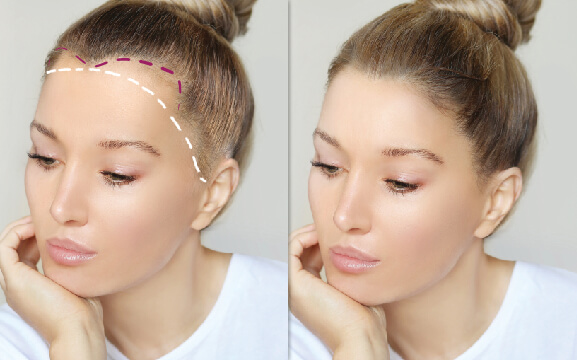
Male pattern baldness in women hair example
Forehead Reduction for Women: Why Women Choose Hairline Lowering?
Women may consider forehead reduction when they have a naturally high hairline, a long forehead or facial proportions that make the upper third of the face appear dominant.
-
- Naturally high hairline
- Stable frontal hair density
- No significant progressive hair loss
- Desire for a lower, softer hairline
Forehead Reduction for Men
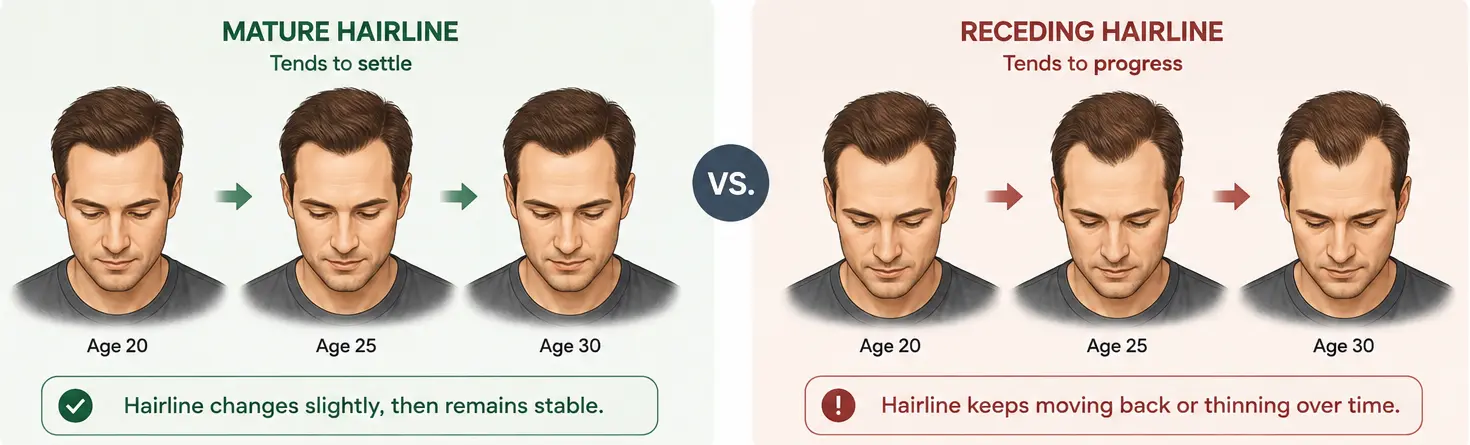
Male candidacy requires careful planning. Forehead reduction can also be considered for men, but hairline stability is especially important because future male-pattern hair loss can affect the long-term appearance of the result.
Read the complete male forehead reduction guide →
Important
Men with an actively receding hairline may be better suited to another treatment plan or a combination approach.
How Much Can the Hairline Be Lowered?
Up to ~4 cm in suitable patients during a standard procedure
The achievable amount varies from person to person. Scalp flexibility, tissue tension, hairline shape and previous procedures all influence how far the scalp can be safely advanced.
Patients seeking a larger change may require a staged treatment plan rather than a single operation.
Learn about 2-stage forehead reduction →
Forehead Reduction Procedure Steps
This is a simple procedure to improve the height of the forehead. While there will always be changes depending on your personal plan, these procedures will often follow these steps.
Step 1 Planning |
Before the surgery, measurements are taken to determine how much skin will be removed from the forehead. The golden ratio (an important measure in all aesthetic surgeries) is calculated for accurate markings. |
Step 2 Anesthesia |
The surgery is performed under general anesthesia and typically takes about two hours. |
Step 3 Incision |
The incision is made in a zigzag pattern (pretrichial line) from where the hair-bearing skin ends. |
Step 4 Scalp Advancement |
The skin is moved into the new position and carefully measured again before removal. |
Step 5 Excess Skin Removal |
Up to 4 cm of skin is removed from the area just below the hairline. |
Step 6 Closure |
After the marked skin section is removed, the skin is closed with aesthetic stitches. |
Procedures to Enhance Your Forehead Reduction Surgery
This surgery is often combined with other procedures to achieve high-quality, comprehensive results. In addition to the examples below, you may want to match your forehead reduction surgery in Turkey with other facial procedures.
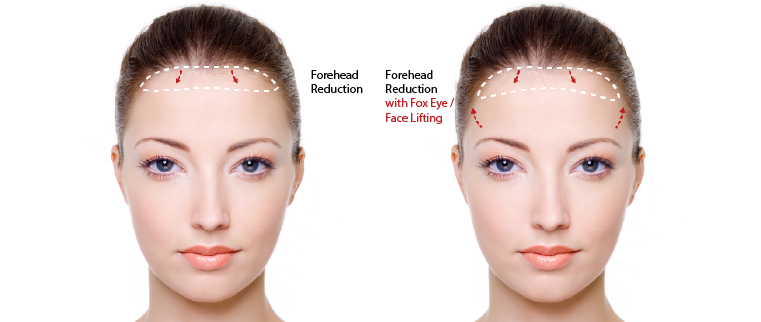
Forehead Reduction with Fox Eye SurgeryThe surgery can be combined with eyebrow lifting, fox eye, and mid-face lift procedures. If eyebrow lifting is performed alongside forehead reduction surgery, the incision area on the forehead can be slightly widened toward the sides. If no change in facial expression is desired, the forehead skin can be secured during stitching. The hair-bearing skin is pulled forward during stitching. |
|
Big Forehead SurgeryThe average length of the human forehead is about 5.7 cm. For example, a person with a forehead of 9 to 10 cm is considered to have a big forehead. Lowering the hairline by 2 to 3 cm may not be enough in those circumstances. There are two options to overcome this:
Big Forehead Reduction in Two OperationsIn the first operation, a 2.5 to 3 cm area is removed. One year later, a second operation is performed, and an additional 1.5 to 2 cm can be reduced. This way, a forehead reduction of approximately 5 to 7 cm can be achieved. Big Forehead Surgery Using the Balloon Technique (2 Steps)In the forehead reduction with the balloon technique, the patient undergoes two surgeries. In the first surgery, a balloon is placed under the hair-bearing skin, and the incision is closed without any reduction. |
|
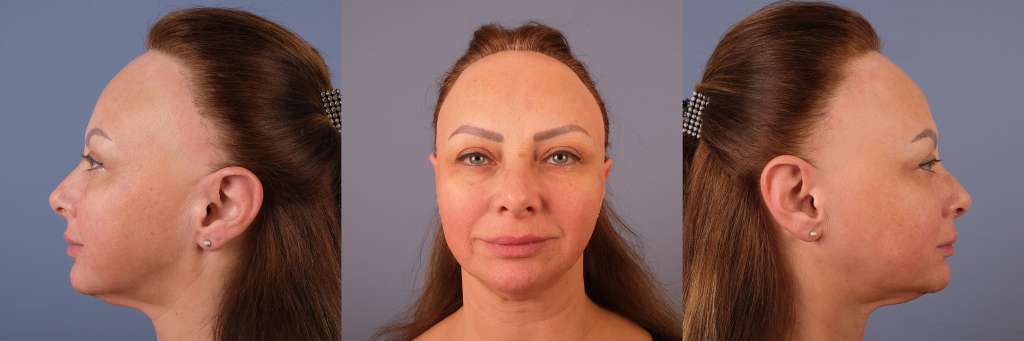 Before 2 step forehead surgery
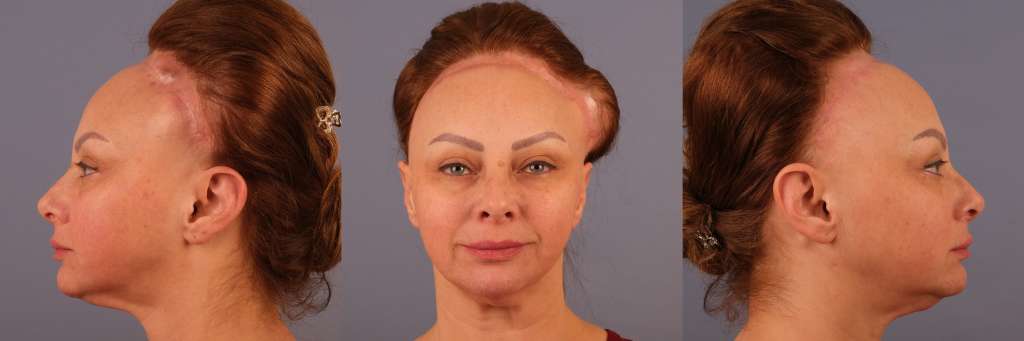 After implemented balloon period
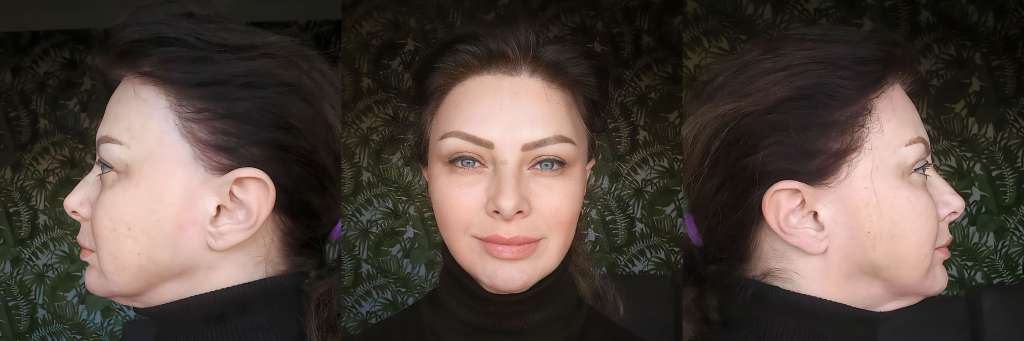 Results of 2-step forehead surgery
Request a free consultation to discuss how your forehead reduction can be improved with an eyebrow lift, facelift, or other procedure.
Learn the details of how two-staged balloon
forehead reduction
works!
Recovery Process After Forehead Reduction Surgery
The recovery process for forehead reduction surgery in Turkey is faster and more comfortable compared to other surgeries. Staying in the hospital for one day after the surgery is sufficient.
For the first two days of the recovery period after the surgery, a bandage and ice application are necessary. A shower can be taken from the second day onward, as long as the water is not too hot.
Swelling will significantly decrease over the next week. After one month, the visible scarring will become less noticeable. Complete resolution of all swelling is expected, and the final result will take about six months. The healing process is complete, and you can return to strenuous activity.
Sun protection is important for everyone, including after forehead reduction surgery. Keeping the hair partially combed backward, i.e., not exposing the forehead, also helps protect the surgical area.
See the complete recovery & aftercare timeline →
Techniques for Speeding Up Healing and Reducing Scars
Dr. Cengizhan Ekizceli can apply three types of recovery processes and scar-reducing treatments to patients who have undergone forehead reduction surgery, either individually or in combination.
PRP (Platelet Rich Plasma) Treatment
In this treatment, a sample of the patient’s blood is enriched with effective wound-healing enzymes by centrifugation, then injected into the surgical area. This treatment can be applied the day after surgery and repeated monthly to support tissue regeneration, reduce inflammation, and promote faster, healthier healing.
Stem Cell-Based Fat Injection
During this method, a portion of fat tissue rich in stem cells is taken during surgery, the stem cells are separated, and then applied to the operative area.
Stem cells are cells in our bodies that can transform into various types of cells. In this application, we benefit from stem cells’ ability to accelerate wound healing.
Hair Transplantation
If patients become bothered by the faint scar after surgery or notice a decrease in hair volume around the scar or on the sides of the forehead, hair transplantation can be performed in these areas to improve density. This approach helps camouflage scars and restore a more natural, uniform hairline appearance.
Forehead Reduction vs. Hair Transplant
Forehead Reduction Moves the Existing Hairline Forward
- Surgical scalp advancement
- Immediate change in hairline position
- Scar positioned along the hairline
- Requires suitable scalp anatomy
Hair Transplant Adds Hair in Front of the Existing Hairline
- Uses transplanted hair follicles
- New hair develops gradually
- No scalp advancement
- May suit different hair-loss patterns
Full forehead reduction vs hair transplant comparison → Reducing forehead size with a hair transplant →
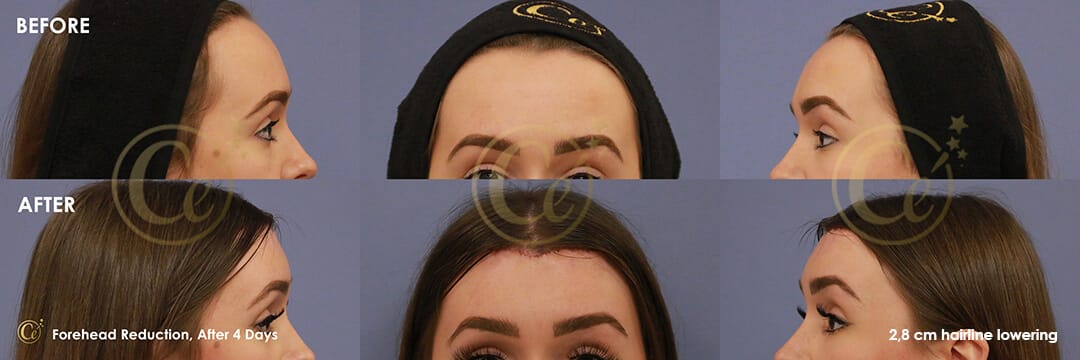
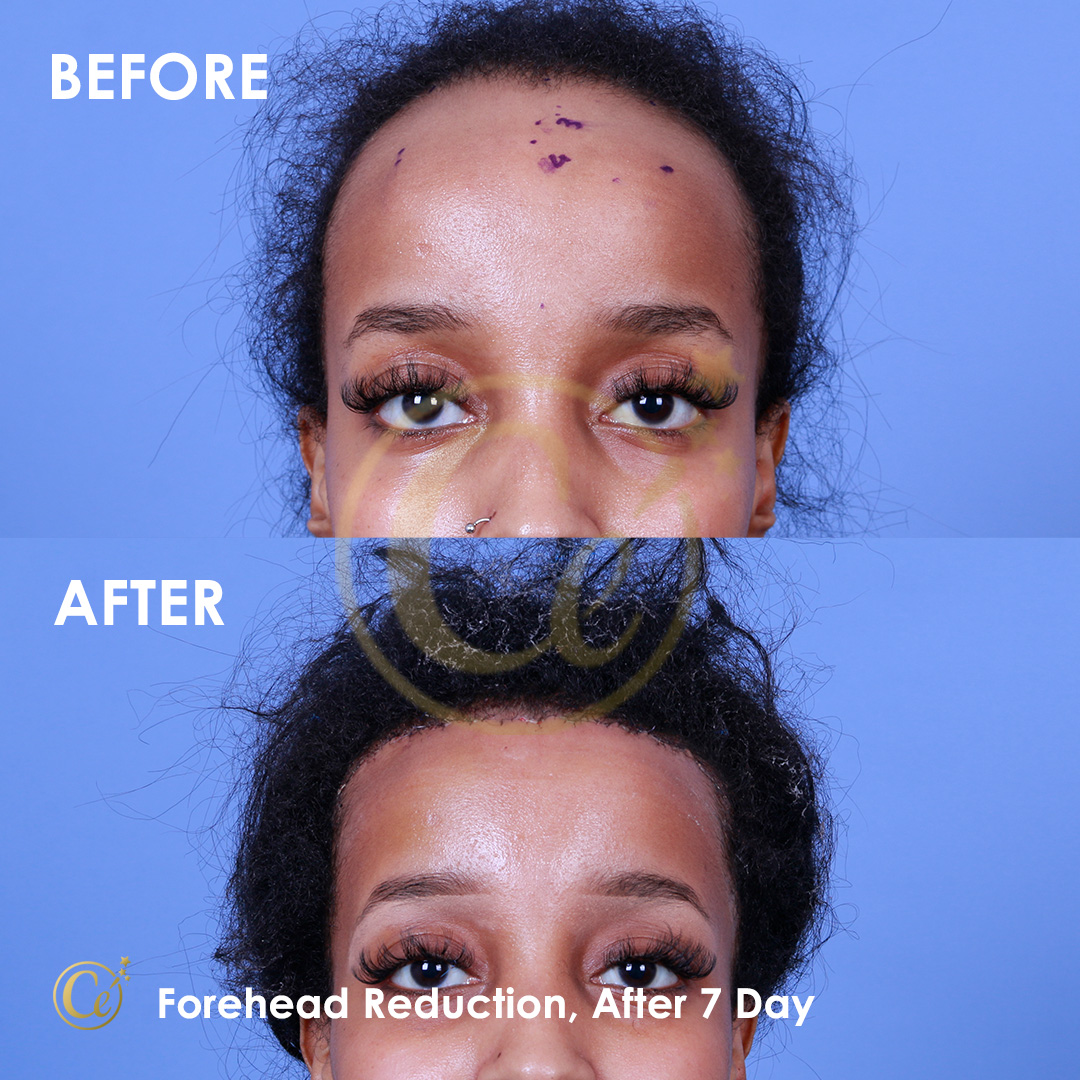
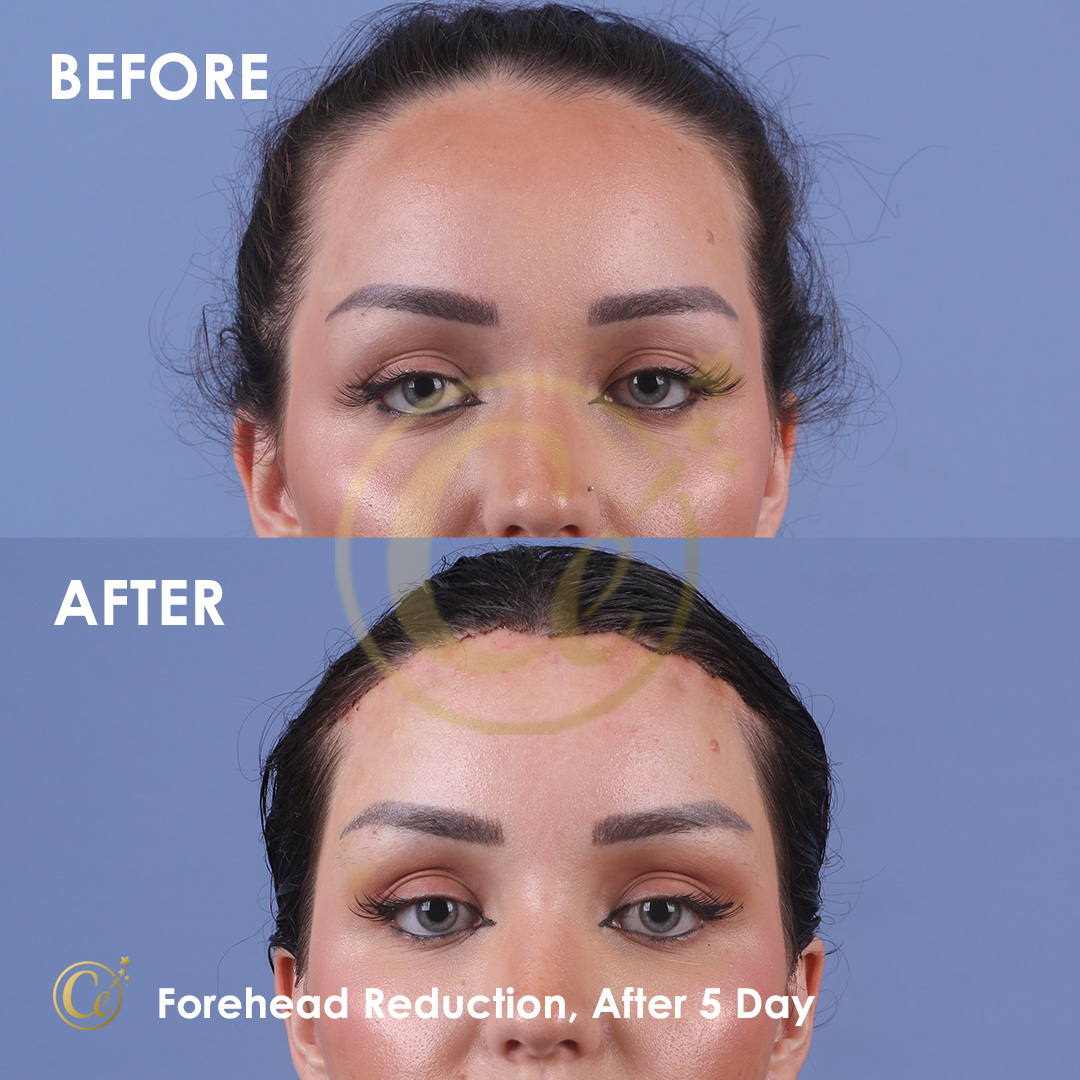
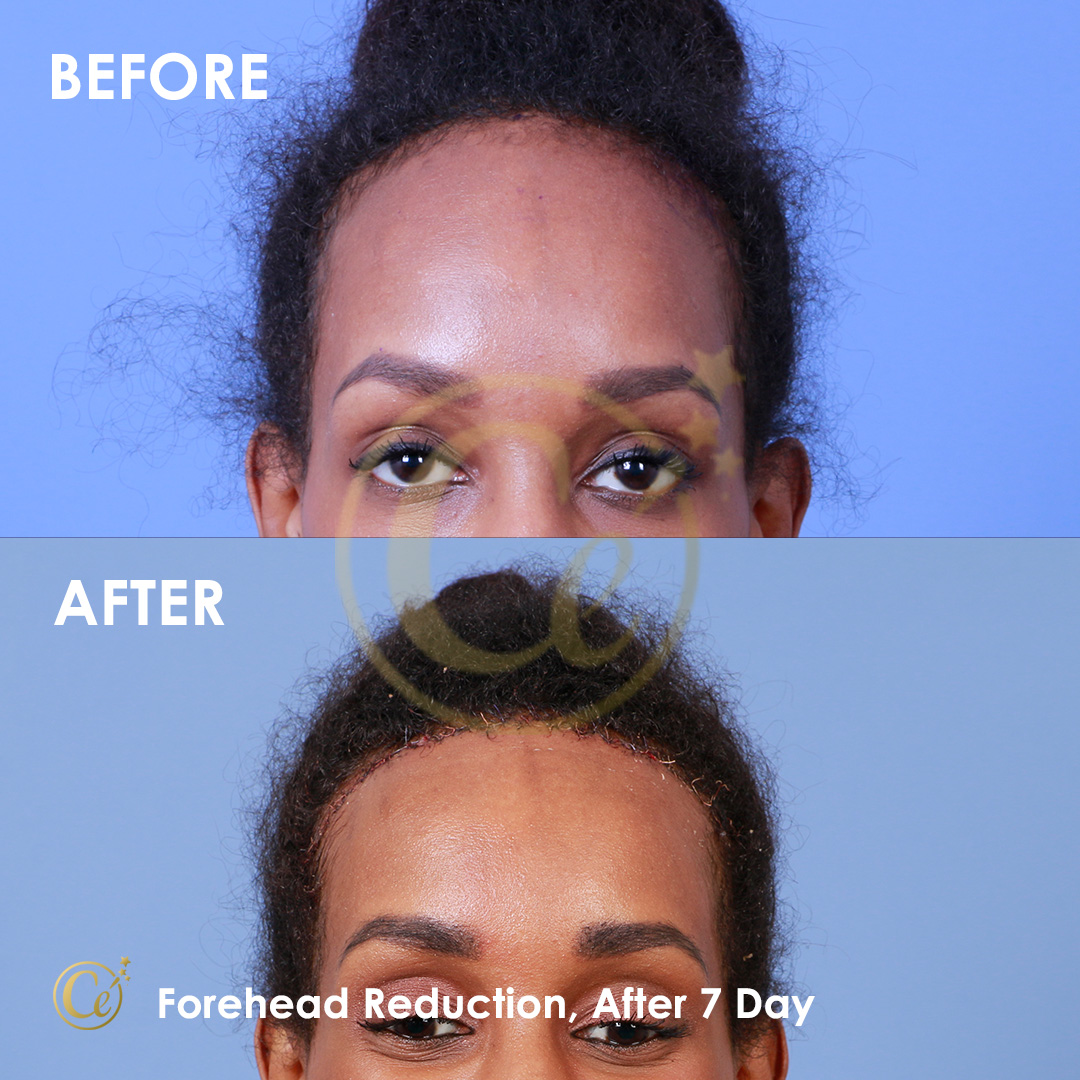
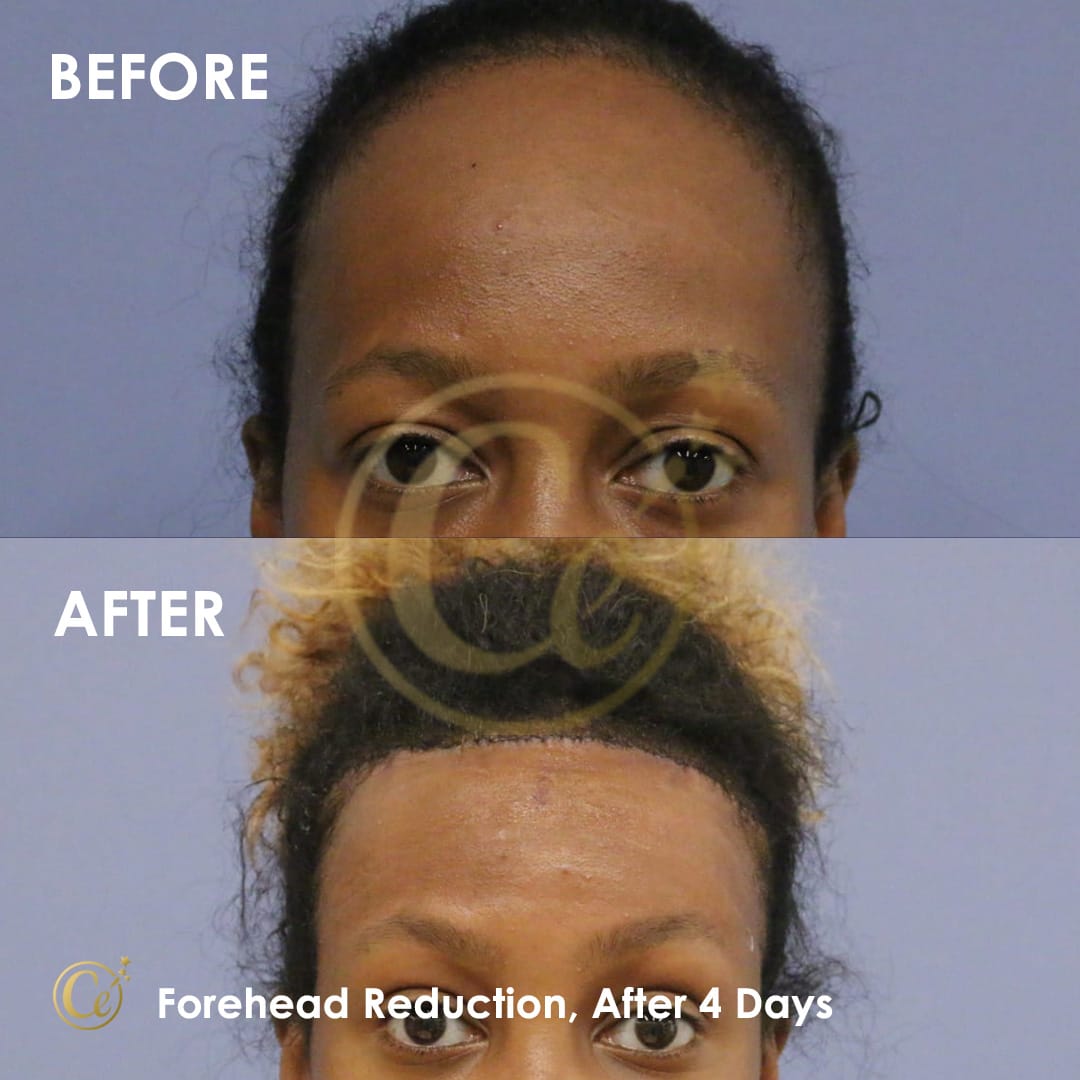
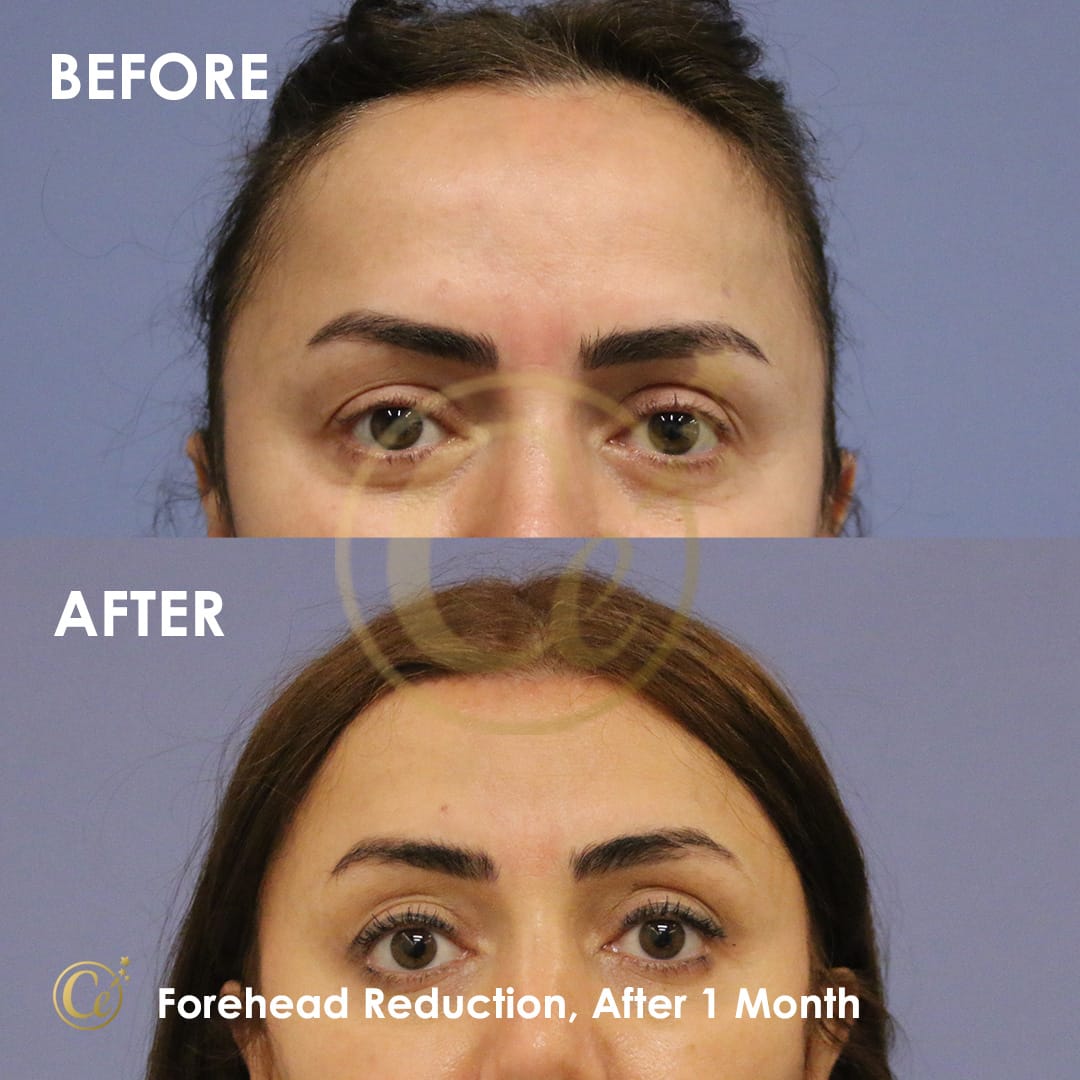
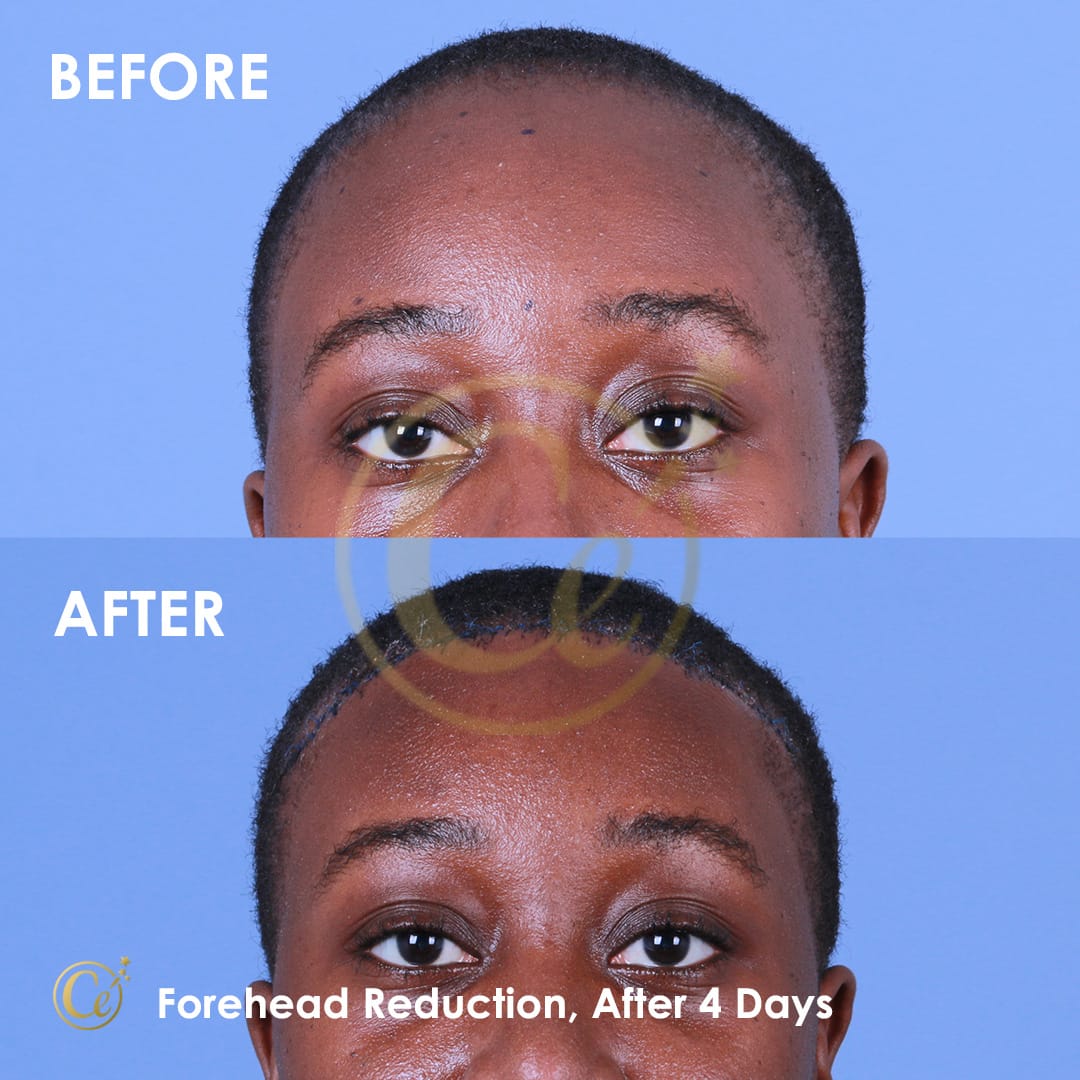
Forehead Reduction—Hairline Lowering in Turkey: Before and After (Frontal View)
The results of this procedure can be stunning from any angle. See some front-facing examples of what our clinic has done for patients with large foreheads.
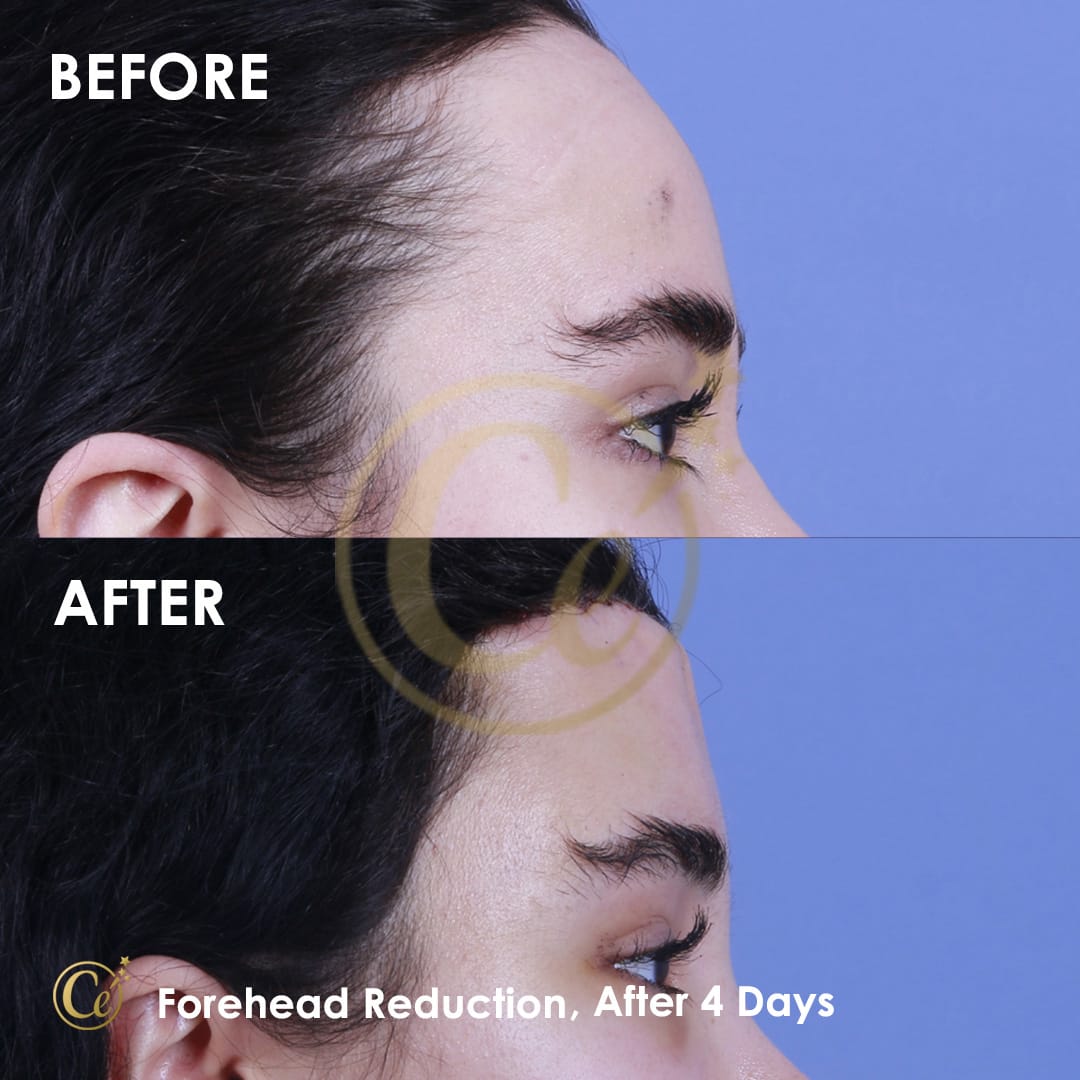
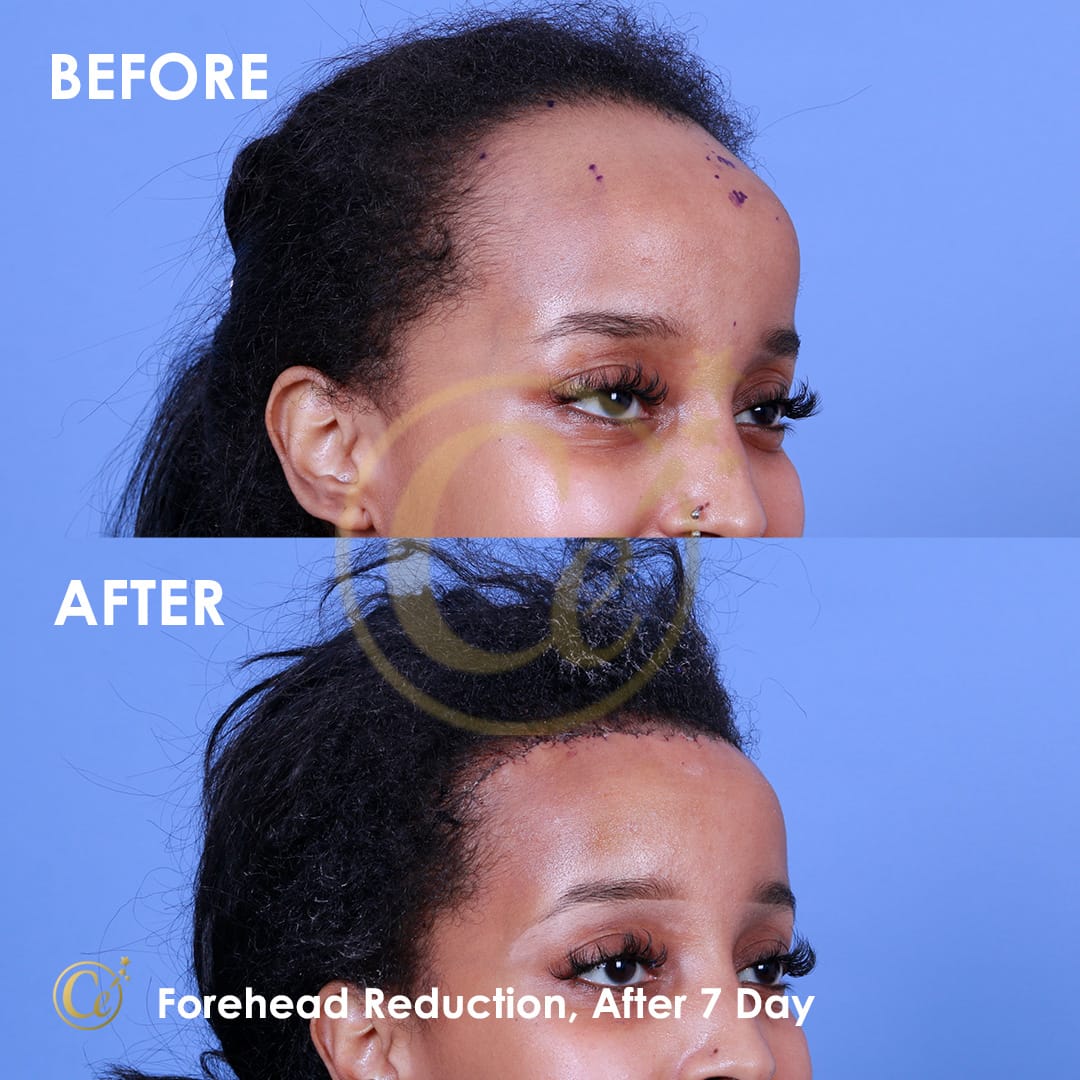
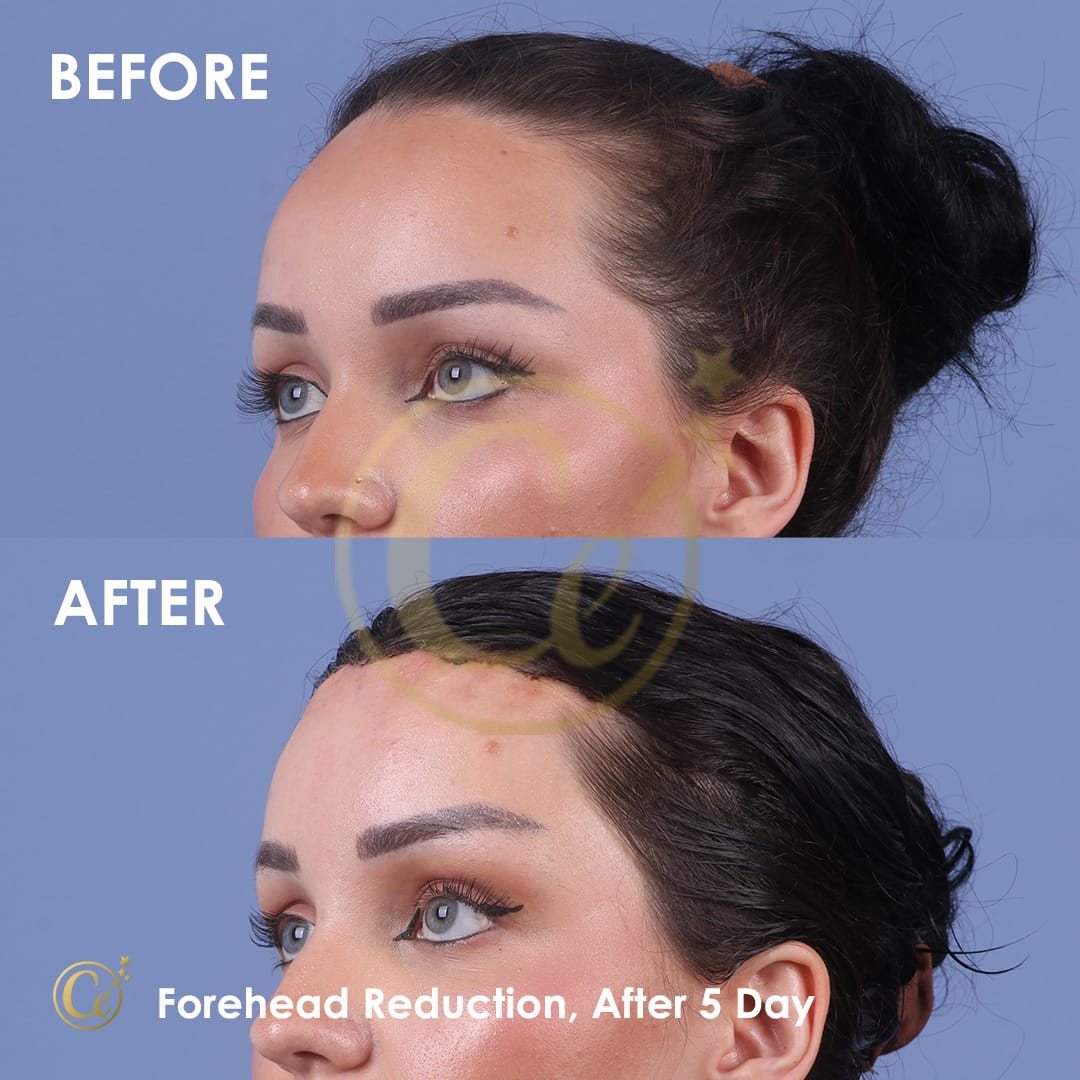
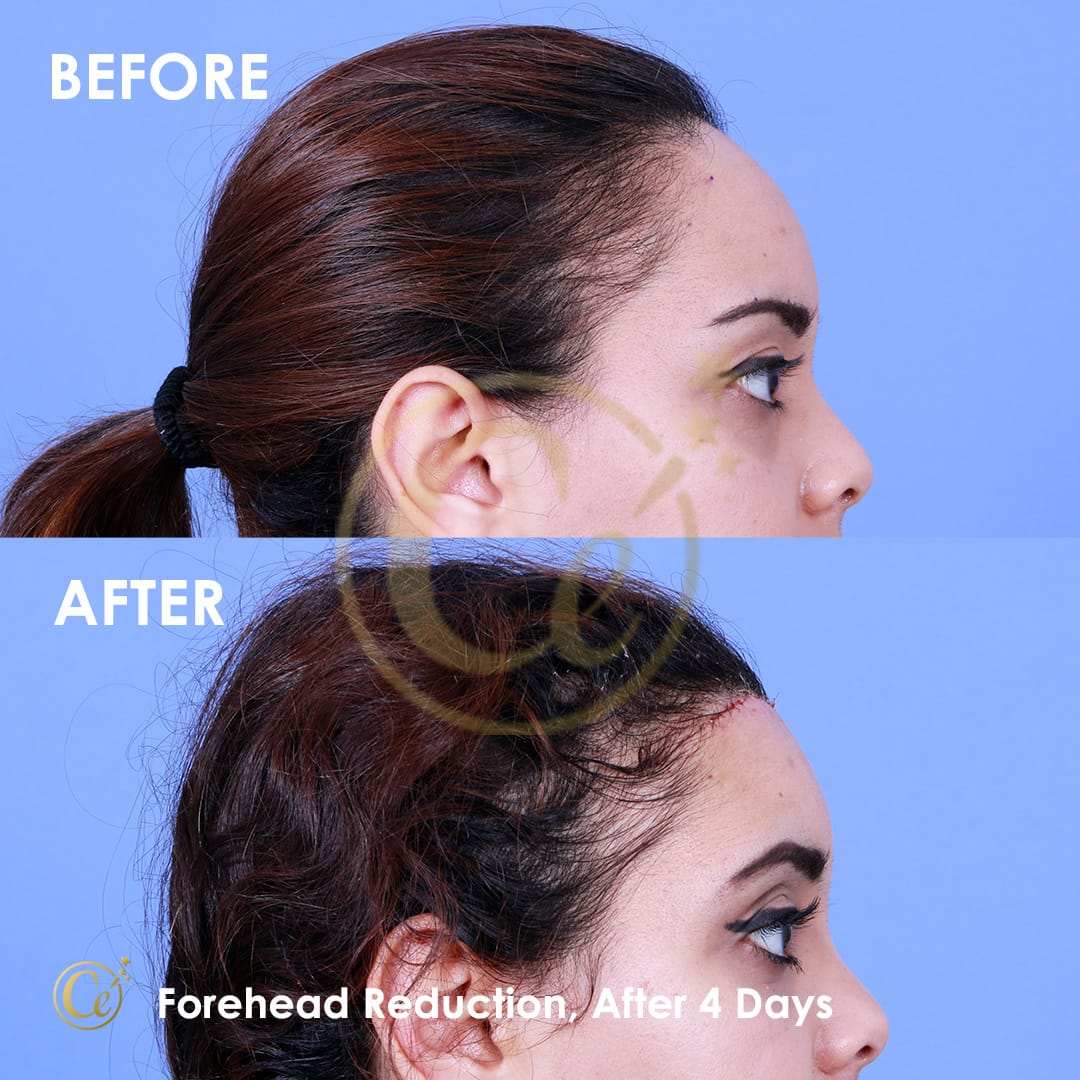
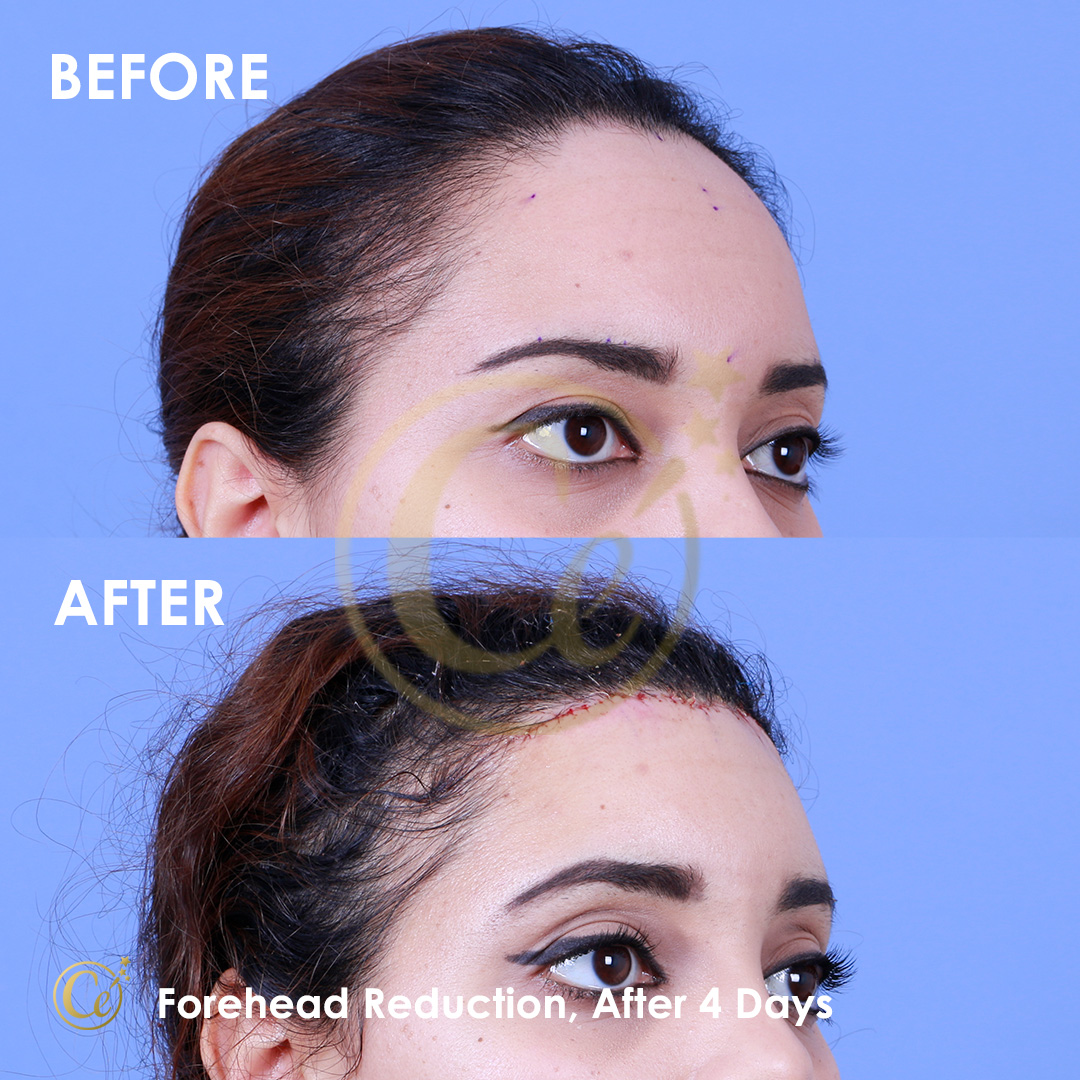
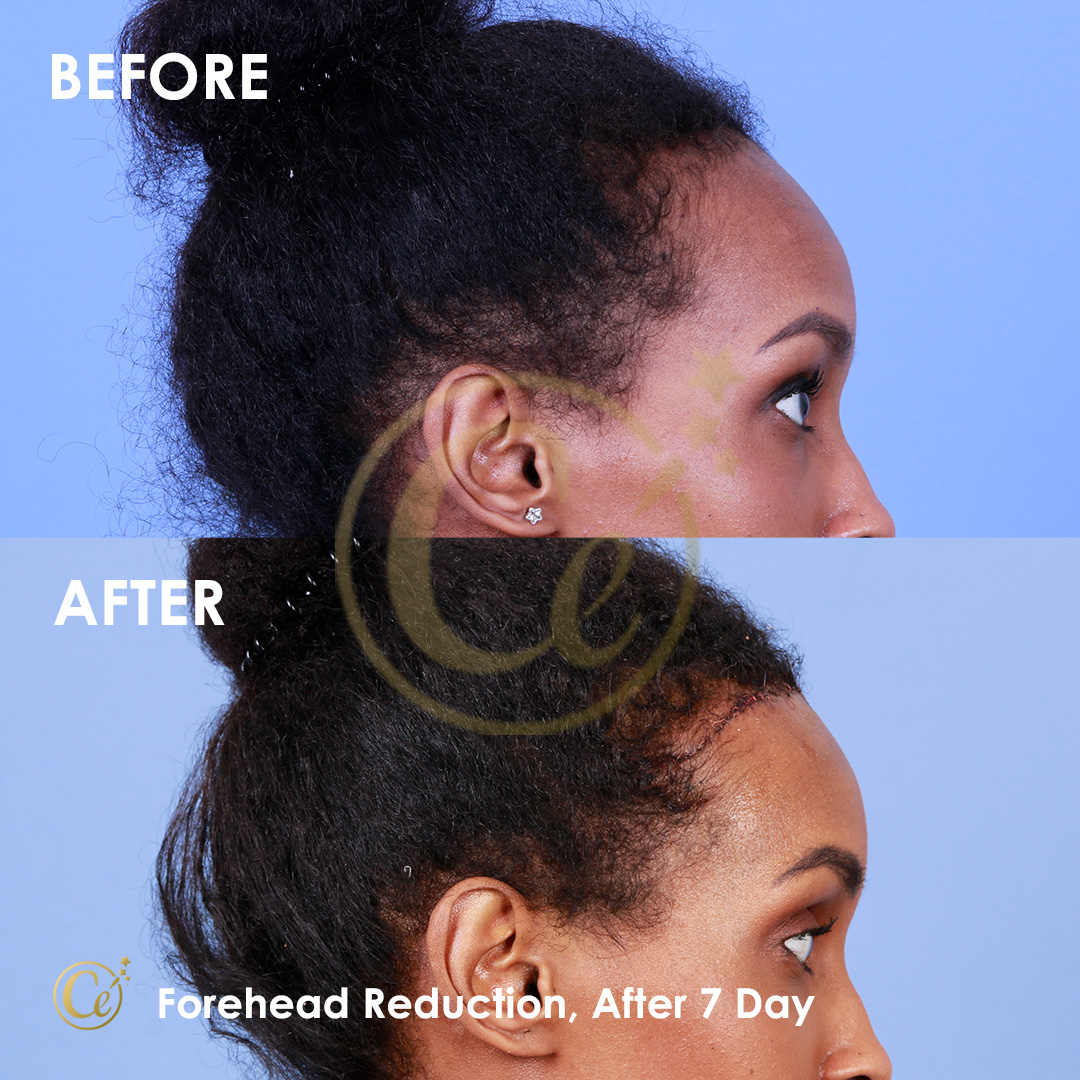
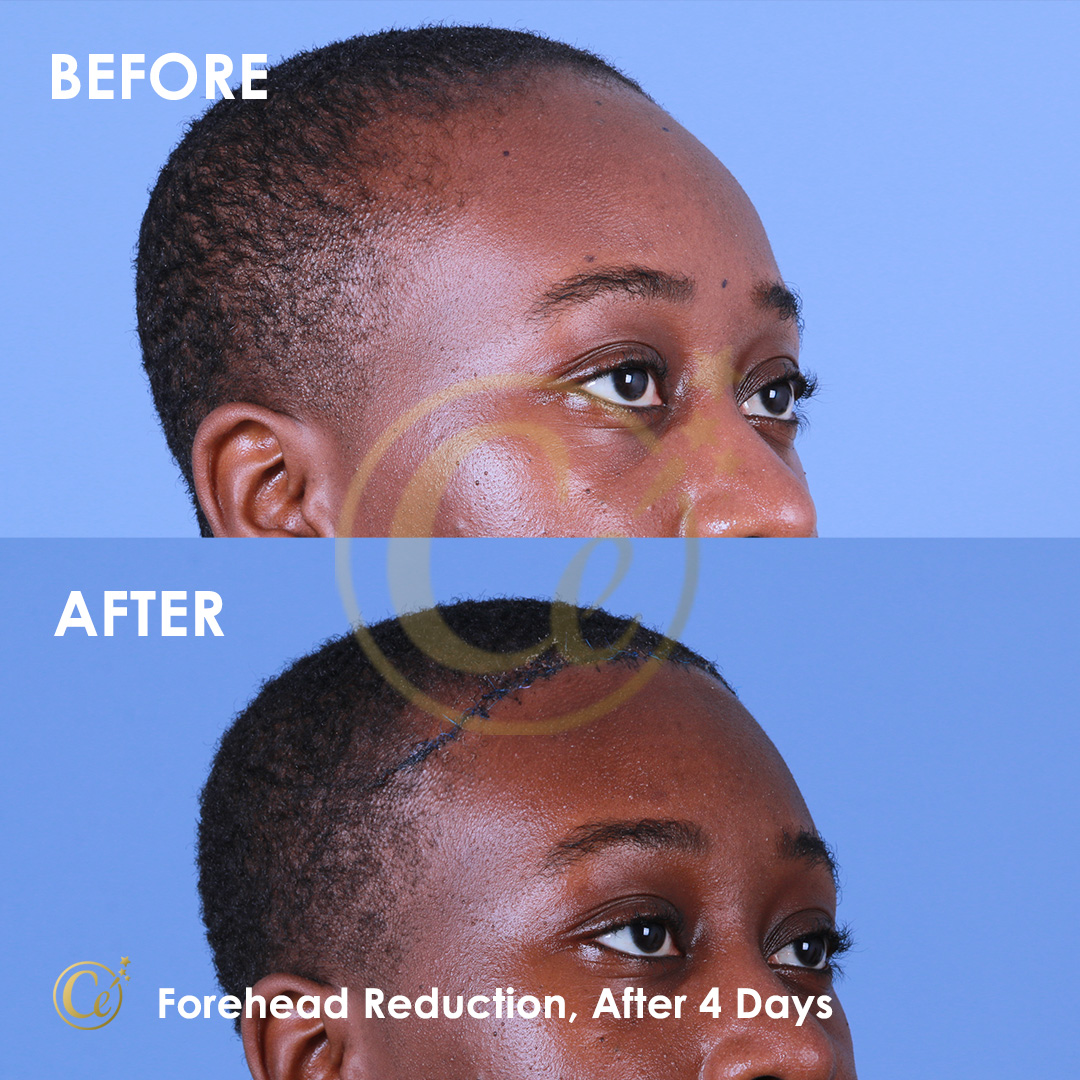
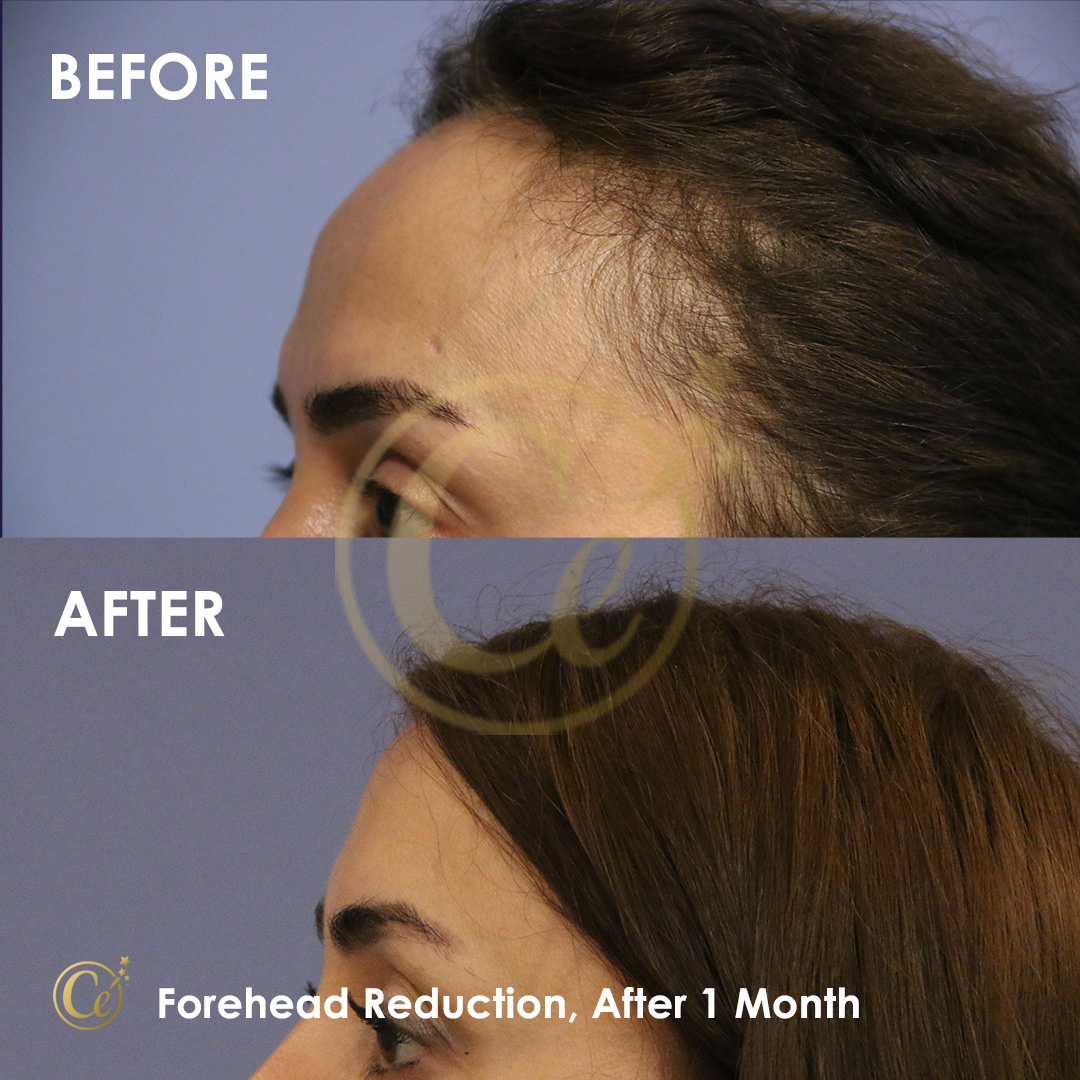
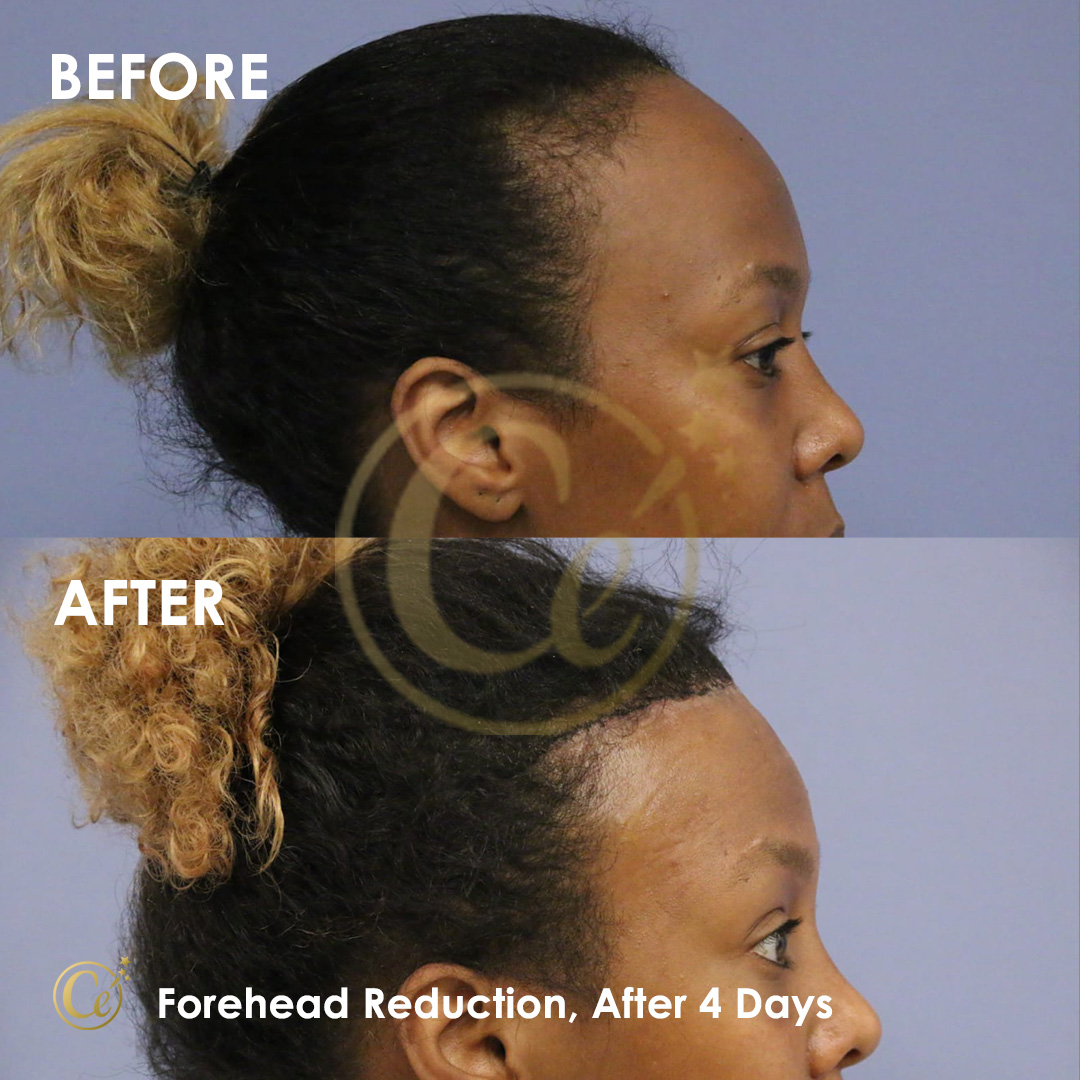
Forehead Reduction—Hairline Lowering in Turkey: Before and After (Side View)
The results are also highly visible on the side of the head. Here are some examples of what’s possible with realistic expectations:
Videos After Forehead Reduction Turkey
Check out these videos to see and hear our forehead reduction clients describe their experiences in their own words.
https://www.youtube.com/watch?v=-gDhi3otR8Ehttps://www.youtube.com/watch?v=Ofjcc4DD5iQhttps://www.youtube.com/watch?v=7asabvAMzCEhttps://www.youtube.com/watch?v=wAp2WvXzB8Ihttps://www.youtube.com/watch?v=ogqJGoPC3T8https://www.youtube.com/watch?v=j4sahenNapUhttps://www.youtube.com/watch?v=niLJfFLpS3Ehttps://www.youtube.com/watch?v=k7hn_HfSKo4https://www.youtube.com/watch?v=gy7Qb5jq45A
Dr. Cengizhan Ekizceli’s Experience in Forehead Reduction Surgery
Dr. Cengizhan Ekizceli is considered one of the most experienced doctors in forehead reduction in Turkey. Between 2019 and 2024, he performed this operation on more than 600 individuals.
Forehead reduction surgery, or hairline lowering, can be completed in a short time (around one to two hours) and provides a high level of facial balance. Compared to other plastic surgery procedures, forehead reduction surgery has fewer complications and risks.
Dr. Cengizhan Ekizceli has gained significant experience in the incision method, stitching, and accelerating healing after forehead reduction surgery.
The C Reduction name comes from Dr. Cengizhan’s name. It is an individual technique for forehead reduction surgery, featuring:
-
- Unique incision pattern (zig-zag incision)
- Cutting the skin at a 45-degree angle to preserve hair follicles and effectively hide scars
- Skin stitching using at least five different threads
To contact Dr. Cengizhan Ekizceli regarding forehead reduction surgery or other aesthetic treatments, you can reach out through our contact page.
Risks and Possible Complications
Swelling Bruising Numbness Visible scarring Temporary hair shedding Asymmetry Infection Delayed healing
No surgery is risk-free.
Individual risks should be discussed during consultation after reviewing your medical history, hairline and scalp anatomy.
Read the complete safety, risks & complications guide →
Forehead Reduction Cost in Turkey
Starting Price From €2,800. Individual pricing is confirmed after consultation.
The final price may vary depending on the surgical plan, hospital requirements, additional treatments and individual case complexity.
See full 2026 forehead reduction pricing →
What Is Included?
- Surgery: Forehead reduction procedure
- Anesthesia: General anesthesia
- Hospital: Typical overnight stay
- Aftercare: Postoperative follow-up
- Travelling to Istanbul for Forehead Reduction
01 Online Consultation
Share photographs and relevant medical information for initial assessment.
02 Arrival in Istanbul
Attend your in-person consultation and preoperative evaluation.
03 Surgery
The procedure is performed according to your personalized surgical plan.
04 Follow-Up
Postoperative checks are completed before continuing your recovery.
When can I fly home?
The appropriate travel date should be confirmed after your postoperative examination and according to your individual recovery.
Can You Reduce Forehead Size Without Surgery?
Not every patient needs forehead reduction surgery. Depending on the reason the forehead appears large, alternatives may include hair transplantation or non-surgical approaches that change the visual appearance of the forehead rather than surgically advancing the scalp.
Detailed Guide Forehead Reduction Without Surgery See the available alternatives →
Frequently Asked Questions About Forehead Reduction and Hairline Lowering Procedures
Am I a good candidate for forehead reduction surgery?
You’re a suitable candidate if your forehead length exceeds 5.7 centimeters, measured from your hairline to eyebrow. Women with stable hairlines are ideal candidates. Men with receding hairlines or a risk of hair loss may be less suitable. A consultation with Dr. Cengizhan Ekizceli will determine your candidacy based on your hairline stability and facial proportions.
Can men get forehead reduction surgery?
You’re a suitable candidate if your forehead length exceeds 5.7 centimeters, measured from your hairline to eyebrow. Women with stable hairlines are ideal candidates. Men with receding hairlines or a risk of hair loss may be less suitable. A consultation with Dr. Cengizhan Ekizceli will determine your candidacy based on your hairline stability and facial proportions.
What is the ideal forehead length?
The ideal forehead length is approximately 5.7 centimeters, which represents one-third of the average human face. This maintains proper facial proportions with the nose and mouth regions. If your forehead exceeds this measurement, you may be a suitable candidate for hairline-lowering surgery to restore balanced facial harmony.
How much skin is removed during forehead reduction?
Up to 4 centimeters of hairless skin can be removed from just below the hairline during standard forehead reduction surgery. For larger foreheads, two-stage procedures can achieve a reduction of 5 to 7 centimeters. The exact amount removed is determined through precise measurements using the golden ratio for optimal facial proportions and results.
What is the balloon technique for forehead reduction?
The balloon technique involves two surgeries for very large foreheads. In the first, a balloon is placed under hair-bearing skin without removing tissue. Over eight to 10 weeks, fluid injections expand the balloon, stretching the skin. In the second surgery, the expanded skin is removed, allowing up to 7 centimeters of reduction.
How long does forehead reduction surgery take?
Forehead reduction surgery typically takes about two hours to complete under general anesthesia. Before surgery, precise measurements are taken, and the golden ratio is calculated to ensure accurate markings. The procedure involves making a zigzag incision along the hairline, removing marked skin, and closing with aesthetic stitches while preserving hair follicles.
Can forehead reduction be combined with other procedures?
Forehead reduction can be combined with eyebrow lifting, fox eye surgery, and mid-face lift procedures. Combining procedures can enhance overall facial harmony and may reduce total recovery time. During your consultation, Dr. Cengizhan Ekizceli will discuss which combinations would best achieve your aesthetic goals and desired results.
What is the C Reduction technique?
The C Reduction is Dr. Cengizhan Ekizceli’s proprietary forehead reduction technique featuring a unique zigzag incision pattern. The skin is cut at a 45-degree angle to preserve hair follicles and effectively hide scars. The technique uses at least five different threads for stitching, ensuring optimal healing and minimal scar visibility compared to standard methods.
How long is the recovery after forehead reduction surgery?
Recovery is relatively fast compared to other surgeries. Hospital stay is typically one day. For the first two days, bandages and ice are applied. Swelling significantly decreases within one week. After one month, scars become less noticeable. Complete swelling resolution and final results are achieved approximately six months after healing.
How noticeable are forehead reduction scars?
Scars from forehead reduction are typically hidden along the hairline using a zigzag incision pattern. Hair follicles are preserved during surgery to minimize scar visibility. After one month, scars become significantly less noticeable. By six months, most scars fade considerably. Additional treatments, such as PRP or hair transplantation, can further reduce the appearance of scars if needed.
Is forehead reduction surgery permanent?
Yes, forehead reduction surgery is a cosmetic procedure that provides permanent results. The hairless skin removed below the hairline does not grow back. However, natural aging and potential future hair loss may affect the appearance over time. Results remain stable for most patients throughout their lives when performed by an experienced surgeon like Dr. Cengizhan Ekizceli.
What are the risks of forehead reduction surgery?
Forehead reduction has fewer complications and risks compared to other surgical procedures. Potential risks include infection, scarring, numbness, and asymmetry. Hair loss around the incision area is possible but rare. Choosing an experienced surgeon like Dr. Cengizhan Ekizceli significantly minimizes these risks through proper technique, precision, and comprehensive aftercare protocols.
What treatments speed up healing after forehead reduction?
Dr. Cengizhan Ekizceli offers three recovery treatments: PRP therapy using enriched blood plasma to accelerate healing, stem cell-based fat injection to enhance wound healing, and hair transplantation if needed. These treatments can be applied individually or combined. PRP can be started the day after surgery and repeated monthly for optimal results and scar reduction.
Why choose Turkey for forehead reduction surgery?
Turkey offers world-class surgeons with extensive experience creating natural-looking results at significantly lower costs than Western countries. The country has a well-established medical tourism infrastructure with excellent facilities. Dr. Cengizhan Ekizceli has performed over 1,000 forehead reduction surgeries between 2020 and 2026, demonstrating expertise and proven results for international patients.
You’re a suitable candidate if your forehead length exceeds 5.7 centimeters, measured from your hairline to eyebrow. Women with stable hairlines are ideal candidates. Men with receding hairlines or a risk of hair loss may be less suitable. A consultation with Dr. Cengizhan Ekizceli will determine your candidacy based on your hairline stability and facial proportions.
You’re a suitable candidate if your forehead length exceeds 5.7 centimeters, measured from your hairline to eyebrow. Women with stable hairlines are ideal candidates. Men with receding hairlines or a risk of hair loss may be less suitable. A consultation with Dr. Cengizhan Ekizceli will determine your candidacy based on your hairline stability and facial proportions.
The ideal forehead length is approximately 5.7 centimeters, which represents one-third of the average human face. This maintains proper facial proportions with the nose and mouth regions. If your forehead exceeds this measurement, you may be a suitable candidate for hairline-lowering surgery to restore balanced facial harmony.
Up to 4 centimeters of hairless skin can be removed from just below the hairline during standard forehead reduction surgery. For larger foreheads, two-stage procedures can achieve a reduction of 5 to 7 centimeters. The exact amount removed is determined through precise measurements using the golden ratio for optimal facial proportions and results.
The balloon technique involves two surgeries for very large foreheads. In the first, a balloon is placed under hair-bearing skin without removing tissue. Over eight to 10 weeks, fluid injections expand the balloon, stretching the skin. In the second surgery, the expanded skin is removed, allowing up to 7 centimeters of reduction.
Forehead reduction surgery typically takes about two hours to complete under general anesthesia. Before surgery, precise measurements are taken, and the golden ratio is calculated to ensure accurate markings. The procedure involves making a zigzag incision along the hairline, removing marked skin, and closing with aesthetic stitches while preserving hair follicles.
Forehead reduction can be combined with eyebrow lifting, fox eye surgery, and mid-face lift procedures. Combining procedures can enhance overall facial harmony and may reduce total recovery time. During your consultation, Dr. Cengizhan Ekizceli will discuss which combinations would best achieve your aesthetic goals and desired results.
The C Reduction is Dr. Cengizhan Ekizceli’s proprietary forehead reduction technique featuring a unique zigzag incision pattern. The skin is cut at a 45-degree angle to preserve hair follicles and effectively hide scars. The technique uses at least five different threads for stitching, ensuring optimal healing and minimal scar visibility compared to standard methods.
Recovery is relatively fast compared to other surgeries. Hospital stay is typically one day. For the first two days, bandages and ice are applied. Swelling significantly decreases within one week. After one month, scars become less noticeable. Complete swelling resolution and final results are achieved approximately six months after healing.
Scars from forehead reduction are typically hidden along the hairline using a zigzag incision pattern. Hair follicles are preserved during surgery to minimize scar visibility. After one month, scars become significantly less noticeable. By six months, most scars fade considerably. Additional treatments, such as PRP or hair transplantation, can further reduce the appearance of scars if needed.
Yes, forehead reduction surgery is a cosmetic procedure that provides permanent results. The hairless skin removed below the hairline does not grow back. However, natural aging and potential future hair loss may affect the appearance over time. Results remain stable for most patients throughout their lives when performed by an experienced surgeon like Dr. Cengizhan Ekizceli.
Forehead reduction has fewer complications and risks compared to other surgical procedures. Potential risks include infection, scarring, numbness, and asymmetry. Hair loss around the incision area is possible but rare. Choosing an experienced surgeon like Dr. Cengizhan Ekizceli significantly minimizes these risks through proper technique, precision, and comprehensive aftercare protocols.
Dr. Cengizhan Ekizceli offers three recovery treatments: PRP therapy using enriched blood plasma to accelerate healing, stem cell-based fat injection to enhance wound healing, and hair transplantation if needed. These treatments can be applied individually or combined. PRP can be started the day after surgery and repeated monthly for optimal results and scar reduction.
Turkey offers world-class surgeons with extensive experience creating natural-looking results at significantly lower costs than Western countries. The country has a well-established medical tourism infrastructure with excellent facilities. Dr. Cengizhan Ekizceli has performed over 1,000 forehead reduction surgeries between 2020 and 2026, demonstrating expertise and proven results for international patients.