

Short answer: the operation itself is similar, but candidacy and design are more conservative in men because later hair loss could reveal the incision or change the result.
Men can have forehead reduction surgery, but a stable hairline matters more than the forehead measurement alone. The plan must account for future recession, temple shape and an age-appropriate masculine frame.
Forehead reduction surgery for men—also called male hairline lowering—moves hair-bearing scalp forward after a strip of forehead skin is removed at the hairline. The key difference is not whether the technique can work. It is whether today’s hairline is likely to remain in place.
In a man with a naturally high forehead, dense frontal hair and little evidence of recession, scalp advancement may create an immediate, dense lower border. In a man whose temples are continuing to thin, the same operation may age less predictably. That distinction shapes almost every decision that follows.
Why forehead reduction is different for men
The incision for forehead reduction sits at the new leading edge of the hairline. Dense hair can help camouflage this line as it matures. If the native hair retreats later, however, the incision can become more visible and the intended proportions can change.
That is why male candidacy depends heavily on future recession. A surgeon may review personal and family hair-loss patterns, compare photographs from different ages, examine miniaturization around the front and temples, and consider whether further dermatologic assessment is appropriate.
Design also differs. A very low, perfectly rounded or ruler-straight hairline can look artificial on a male face. A convincing result usually respects facial width, brow position, temple angles, age and the degree of controlled irregularity already present.
Naturally high forehead or receding hairline?
A naturally high hairline is often visible in older photographs and remains relatively consistent through adulthood. The density immediately behind it may be even, and the temples may keep a stable shape. This pattern can make surgical advancement worth evaluating.
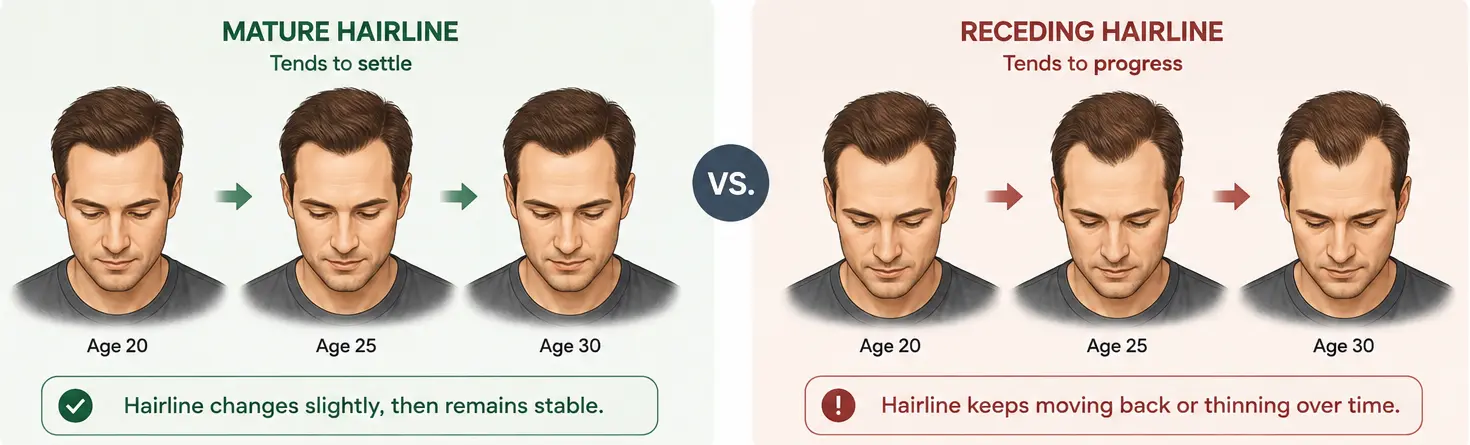
A receding hairline is changing. Clues can include progressively deeper corners, finer hairs at the leading edge, reduced density behind the front or an expanding contrast between the forelock and the temples. Men may also report close relatives with substantial androgenetic hair loss.
Older photographs
A similar position across several years supports stability more than one recent image can.
Leading-edge density
Thick, uniform hair at the front generally camouflages the incision better than miniaturized hair.
Temple pattern
Stable corners are different from an M-shaped line that continues to move backward.
Family history
Hair-loss patterns in close relatives can inform the discussion, although they do not predict the future with certainty.
This is a clinical judgment, not a reliable home test. A mature hairline can be stable and slightly angular, while early recession may still appear subtle. When the pattern is unclear, the safest plan may be to observe it or seek a hair-loss evaluation before choosing surgery.
Male candidate factors at a glance
| Factor | More favorable pattern | Reason for caution |
|---|---|---|
| Hairline history | Naturally high and similar in older photographs | Recent backward movement or progressive corner recession |
| Frontal density | Dense, healthy hair at and behind the leading edge | Miniaturization, diffuse thinning or an unstable forelock |
| Scalp mobility | Enough laxity to advance without excessive tension | Limited mobility may restrict the realistic lowering |
| Temple shape | Stable corners that fit the intended design | Deep recession may need graft-based refinement |
| Goal | Better proportion with an age-appropriate male frame | A very low or perfectly straight juvenile line |
| Long-term plan | Accepts monitoring and possible future hair care | Assumes native hair can never change after surgery |
No single row decides candidacy. The surgeon combines hair density, scalp movement, facial proportions, goals and medical history before advising whether scalp advancement, transplantation, a staged plan or no procedure is the better fit.
A natural male hairline is designed, not just lowered
The lowest possible line is rarely the best target. For men, the design often preserves a flatter central segment, restrained temporal angles and small asymmetries that belong to the face. The new border should still look credible as the patient ages.
The amount of movement is also anatomy-led. Scalp mobility and closure tension set practical limits, while existing temple recession may not advance as much as the central hairline. This can leave the corners requiring separate consideration.
During a typical operation, the incision follows the planned pretrichial border and the hair-bearing scalp is advanced. For a full procedural overview, including general steps and technique, see the clinic’s forehead reduction surgery guide.
“For a male patient, the best hairline is not simply the lowest one. It is the line that respects his face today and still looks believable if his appearance changes with age.”
— Dr. Cengizhan Ekizceli
Forehead reduction vs hair transplant for men
These procedures solve different problems. Forehead reduction removes a band of non-hair-bearing forehead skin and advances the existing dense scalp. Hair transplantation relocates individual follicles to build or reshape a hairline over time.
Scalp
advancement
A naturally high, stable frontal line; strong leading-edge density; adequate scalp mobility; and a goal of immediate central lowering.
Hair
transplantation
Temple recession, thinning, detailed corner shaping or a hairline where a frontal incision could be difficult to conceal long term.
Staged
combination
Advancement first for proportion, followed later by grafts to soften the border, support the corners or camouflage selected areas.
The choice is not based on gender alone. It depends on the cause of the high forehead, likely future loss, donor supply, scar preference and desired density. A hybrid plan may be useful, but it should be planned intentionally rather than treated as an automatic rescue.
What one large published series can—and cannot—tell you
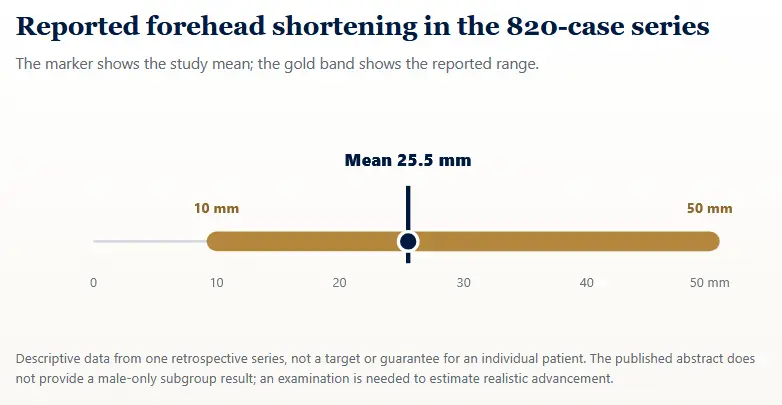
A retrospective publication by Dr. Cengizhan Ekizceli and Emre Hocaoğlu reported 820 consecutive forehead reduction cases. Across that mixed patient series, the shortened length ranged from 10 to 50 mm, with a mean of 25.5 mm. The paper is available as a PubMed-indexed study.
What men should expect from the consultation
A useful consultation begins with diagnosis: is the concern a genetically high forehead, hairline recession, temple loss or a combination? The surgeon should assess the front and corners together, because central lowering alone may not create the intended frame.
Bring photographs from your late teens, twenties and recent years if available. Share hair loss in parents and siblings, changes you have noticed, previous treatment and any scalp procedures. These details help build a more realistic ageing plan.
Your surgeon can then discuss likely movement, incision placement, the planned male shape and whether hair transplantation could be preferable or complementary. Ask what would happen aesthetically if your native hair receded later—and what signs would lead the surgeon to advise against operating now.
Once the male-specific decision is clear, use the clinic’s dedicated guides for the remaining topics: forehead reduction cost in Turkey, the full risks and safety guide, and the separate recovery and aftercare timeline.
Continue your forehead reduction research
FAQs about forehead reduction for men
Can men get forehead reduction surgery?
Yes. Some men may be suitable candidates when their frontal hairline is stable, their scalp has enough mobility and there is no strong evidence of active or likely future recession. A surgeon should assess these factors individually.
Why does hairline stability matter more for men?
The incision is placed at the leading edge of the hairline. If the native hairline later recedes, that scar may become easier to see and the new shape may become less balanced. This makes loss assessment central to male planning.
Is a mature male hairline the same as a receding hairline?
Not necessarily. A mature hairline may settle into a stable, slightly higher or more angular position. A receding hairline continues to move backward or thin. Old photographs, family history and a scalp examination help distinguish them.
Is forehead reduction or a hair transplant better for men?
Forehead reduction may suit a man with a naturally high, stable hairline and good scalp mobility who wants immediate advancement. Hair transplantation may be more appropriate when recession, thinning or detailed temple restoration is the main concern. Some cases use a staged combination.
Should a male hairline be perfectly straight after surgery?
Usually not. A natural male hairline often keeps controlled irregularity and appropriate temporal angles rather than forming a low, perfectly straight line. The design should fit the face, age and likely future hair pattern.
Can forehead reduction fix deep temple recession in men?
Scalp advancement mainly moves the frontal hair-bearing scalp forward. Deep temple recession may not move to the same degree. Hair grafting can sometimes be considered to refine the corners or blend the shape after individual assessment.
What should men bring to a forehead reduction consultation?
Bring clear photographs from several ages, details of hair loss in close relatives, a medication list and examples of preferred hairlines. This gives the surgeon better context for judging stability and creating an age-appropriate design.