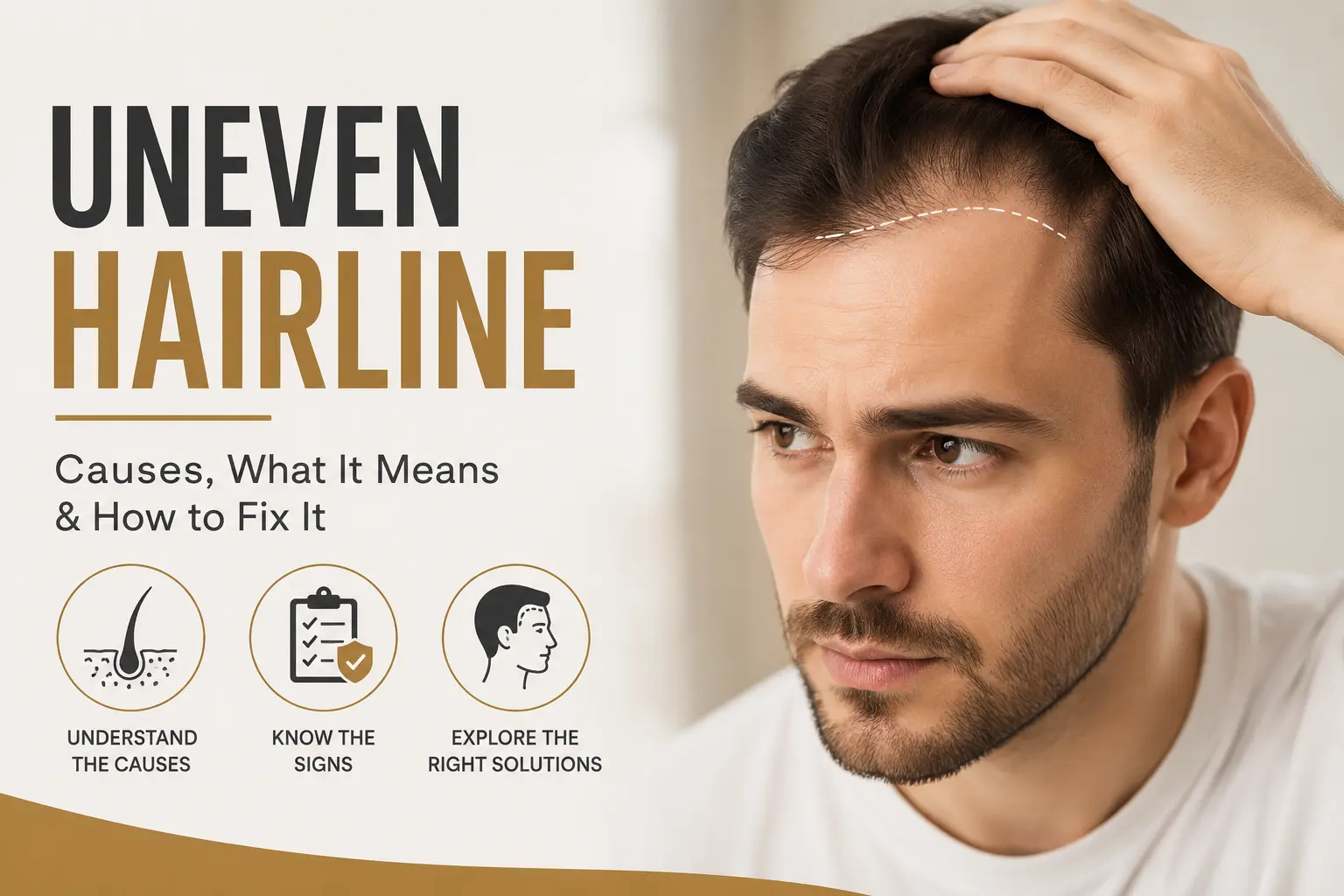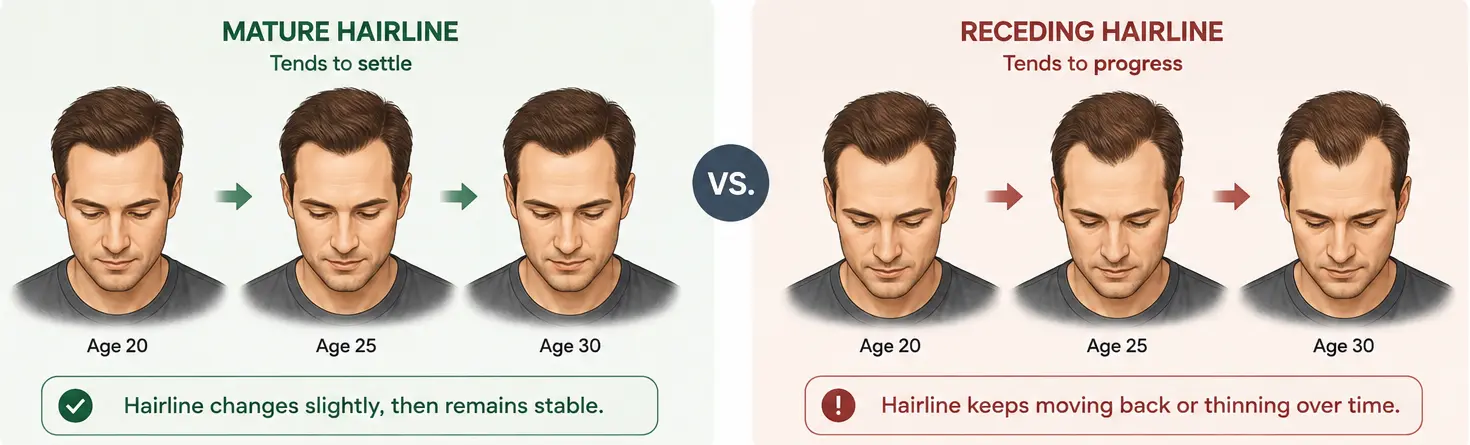


If you have ever pulled your hair back, looked in the mirror and thought “why is my forehead so big?”, you are asking a question that lands in our Istanbul clinic almost every single day. The honest answer is that a tall forehead is rarely one problem — it is usually a combination of genetics, hairline behaviour and the way your face is proportioned.
Below, Dr. Cengizhan Ekizceli breaks down the eight real causes of a large forehead, which of them are permanent, and which ones are simply an illusion created by hair and lighting.
“Patients walk into my office convinced something is wrong with them. In more than 1,000 forehead cases, I can count on one hand the times the cause was a disease. Almost always it is a hairline that simply sits a few centimetres too high — and that is an aesthetic question, not a medical one. My first job is not to operate. It is to tell people they are healthy.”
— Dr. Cengizhan Ekizceli, Plastic, Reconstructive and Aesthetic Surgeon
First: What Does a "Big Forehead" Actually Mean?
In facial aesthetics, the forehead is measured vertically from the top of the eyebrow to the front hairline. When that distance grows out of balance with the middle and lower thirds of the face, the upper third starts to visually dominate — and the face reads as top-heavy rather than proportional.
Most people who search for this topic are not dealing with a medical problem at all. They are dealing with a measurement that sits outside the average range for their face. If you want the exact numbers and averages, we cover them separately in What Is Considered a Big Forehead?
The 8 Main Causes of a Big Forehead
1. Genetics and Inherited Hairline Position
The single most common reason is simply the one you were born with. The position where your hairline sets, the height of your frontal skull and the density of the follicles along the front edge are all inherited traits, usually visible in one or both parents.
If your mother, father or grandparents have a high hairline, there is a strong chance yours will set in a similar place — often becoming obvious in the teenage years once facial growth is complete. This type is stable: it does not get worse, it was simply always there.
2. A Naturally High or Irregular Hairline
Some people have completely healthy hair and no hair loss whatsoever, yet the hairline itself is set unusually far back, or shaped with deep temporal corners. The result is a forehead that looks larger than the skull underneath it actually is.
This is the group that responds best to correction, because the issue is purely hairline position rather than bone or health. Lowering the hairline by a few centimetres restores balance without touching anything else. Our full explanation of the technique is here: Forehead Reduction Surgery in Turkey
3. Androgenetic Hair Loss (Male and Female Pattern)
This is the most common acquired cause. In men, the hairline recedes at the temples first, creating an M-shape that lifts the visual top edge of the face year after year. In women, the pattern is usually diffuse thinning across the part line, with the frontal edge becoming see-through rather than moving backwards.
The mechanism is follicle miniaturization — hairs get thinner and shorter with each growth cycle until they no longer cover the scalp. Because this cause is progressive, it is the one situation where a surgeon will usually recommend stabilising the hair medically before considering any hairline-lowering procedure. For patients in this group we often discuss hair transplant options instead.
4. Traction Alopecia and Styling Habits
Tight ponytails, braids, weaves, extensions, hijab pins and daily heat styling all pull on the same fragile front row of follicles. Over years, that constant tension damages the follicle permanently and the hairline creeps backwards — a pattern known as traction alopecia.
It is one of the few causes that is partly preventable. Caught early, the hair often recovers once the tension stops; caught late, the loss is permanent and the forehead stays taller than it was in your twenties.
5. Skull Shape and Frontal Bone Projection
Sometimes the forehead is not tall — it is forward. A prominent or convex frontal bone casts more shadow, catches more light and reads as a bigger forehead even when the hairline-to-brow measurement is completely normal.
The medical term for a markedly prominent forehead is frontal bossing. Public health resources such as MedlinePlus (U.S. National Library of Medicine) note that true frontal bossing is uncommon and generally appears alongside other signs in childhood — so a slightly convex forehead in an otherwise healthy adult is a normal anatomical variation, not a disorder.
6. Hormonal and Medical Conditions
A small minority of large foreheads are driven by an underlying medical cause rather than genetics. Growth hormone excess (acromegaly), thyroid disorders, certain anaemias, vitamin D deficiency in childhood and a number of rare congenital syndromes can all alter how the frontal skull develops.
These conditions are genuinely rare, and they almost never present as an isolated finding — there are other symptoms alongside them. If your forehead changed shape in adulthood, that is the one scenario where a physician, not a plastic surgeon, should be your first appointment.
7. Brow Position and Facial Proportion
A forehead can measure perfectly normally and still look enormous if the eyebrows sit low, the eyes are deep-set, or the middle third of the face is short. The brain does not read absolute centimetres — it reads ratios between the three facial thirds.
This is why some patients get the result they wanted from a brow procedure rather than a hairline one. Raising and reshaping the brow position shortens the perceived forehead from below instead of from above; we explain that approach in our eyebrow lift guide.
8. Age-Related Changes
The forehead does not stand still. With aging, the scalp loses elasticity, hair density drops, brow tissue descends and the frontal hairline gradually drifts backwards in both sexes. A forehead that was 5.5 cm at twenty-five can measure 7 cm at fifty without any disease being involved.
Men experience this earlier and more sharply because of androgen sensitivity, which is why the concern is often raised differently by male patients — something we address in The Man’s Guide to Forehead Reduction.
Big Forehead Causes at a Glance
| Cause | Typically Appears | Gets Worse Over Time? | Correctable? |
|---|---|---|---|
| Inherited hairline position | Teens / early 20s | No — stable | Yes, surgically |
| Naturally high hairline | Present from childhood | No | Yes, surgically |
| Androgenetic hair loss | 20s–40s | Yes | Partly — needs stabilisation first |
| Traction alopecia | After years of tension styling | Yes, if tension continues | Early: yes. Late: limited |
| Frontal bone prominence | Childhood | No | Only with bone contouring |
| Hormonal / medical causes | Any age | Depends on condition | Treat the condition first |
| Low brow position | 30s onward | Yes | Yes, brow procedures |
| Age-related hairline drift | 40s onward | Yes, slowly | Yes, case by case |
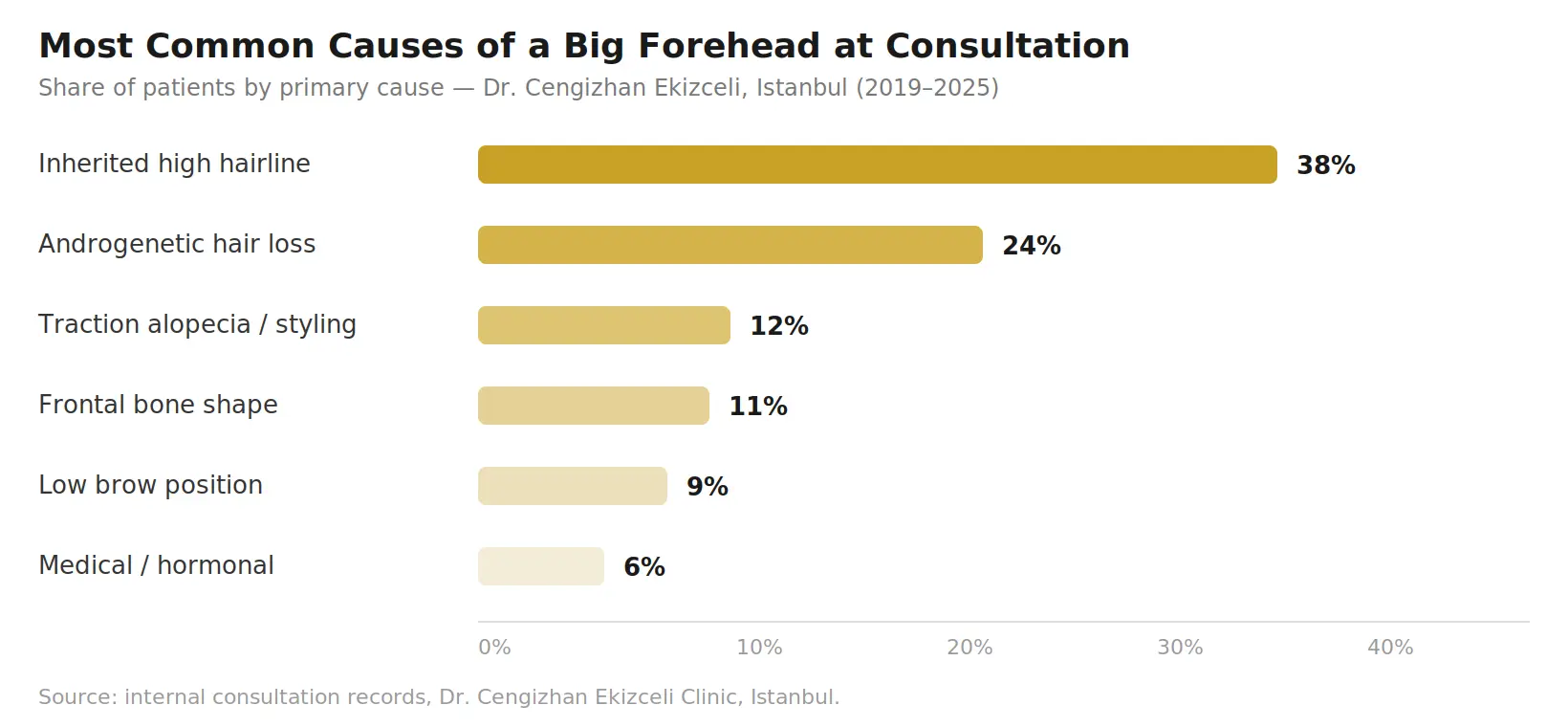
Which Causes Do We Actually See Most Often?
The chart below shows the distribution of primary causes recorded across forehead consultations at Dr. Cengizhan’s Istanbul clinic. Genetic and hairline-related causes account for roughly three quarters of all cases, while medical causes make up a very small share.
Which Causes Can Be Changed — and Which Cannot?
Causes rooted in hairline position are the most reversible in practice, because the hairline can be surgically repositioned lower while the follicles are preserved. Causes rooted in active hair loss are different: lowering a hairline that is still receding rarely holds, so the loss has to be stabilised first.
Bone-driven prominence and medical causes sit in a third category entirely, requiring either contouring or treatment of the condition itself. Which category you fall into is decided at consultation, not from a photograph — and you can see real outcomes from the first group in our before and after gallery.
When Should You See a Doctor About It?
A forehead that has always been tall is almost never a health concern. What warrants a medical opinion is a forehead that has changed — new prominence in adulthood, changes to hand, jaw or foot size alongside it, or rapid hairline loss in a short period.
For everything else, the question is aesthetic rather than clinical. If you would like to know which of these eight causes applies to you, book a free consultation with Dr. Cengizhan and bring a photo taken with your hair pulled back.
Frequently Asked Questions
Is a big forehead genetic?
In most cases, yes. Hairline position, frontal skull height and follicle density along the front edge are inherited traits, and a high hairline commonly runs through families. If both parents have a tall forehead, the odds of inheriting the same proportion are high.
Can hair loss make my forehead look bigger?
Yes — this is the most common acquired cause. As androgenetic hair loss progresses, the frontal and temporal hairline moves backwards, which increases the visible distance between the eyebrows and the hair. Nothing about the skull has changed; the frame around it has.
Does a big forehead mean something is medically wrong?
Almost never. Medical causes such as acromegaly, thyroid disease, severe anaemia or congenital syndromes are rare and normally come with other symptoms. A tall forehead you have had your whole life, with no other changes, is a normal anatomical variation.
Why does my forehead look bigger in some photos than in the mirror?
Camera lenses, angle and lighting all exaggerate the upper third of the face. Front-facing phone cameras with short focal lengths enlarge whatever is closest to the lens, and overhead lighting deepens the shadow at the hairline. This is perception, not anatomy.
Can my forehead get bigger as I get older?
The bone does not grow, but the forehead can certainly appear to grow. Hairline drift, reduced hair density and descent of the brow tissue all increase the visible forehead over the decades, in both men and women.
Do men and women get a big forehead for different reasons?
Partly. Men are more often affected by androgenetic recession at the temples, producing an M-shaped hairline. Women are more often affected by diffuse thinning and by traction from tight styling, which pushes the front edge back more evenly.
Can tight hairstyles really cause a bigger forehead?
They can. Repeated tension from ponytails, braids, extensions and pins damages the frontal follicles over time, a condition called traction alopecia. Early on the hair recovers when the tension stops, but long-standing traction causes permanent loss along the hairline.
Can a big forehead be caused by stress?
Stress can trigger temporary shedding (telogen effluvium), which thins the hair and makes the forehead look larger for a few months. It does not change the hairline permanently, and density usually returns once the trigger resolves.