

A high hairline is one of the most common concerns patients bring to our Istanbul clinic, and the first question is almost always the same: is forehead reduction possible without an operation? The honest answer has two halves. Several non-surgical treatments can make a tall forehead look shorter, softer and better balanced — but only a small number of them change the hairline itself.
This guide walks through every scalpel-free option available in 2026, what each one realistically achieves in millimetres, how long the result survives, and the point at which a non-surgical route stops being enough. If you already know you want a permanent change, our main guide to forehead reduction surgery in Turkey covers the surgical side in full.
What "Non-Surgical Forehead Reduction" Really Means
Forehead height is measured from the eyebrows to the frontal hairline. In aesthetic assessment, a proportionate upper face occupies roughly one third of total face height — around 5.5 to 6 cm in most women. Because that measurement is anchored to two fixed landmarks, any treatment that does not move the brow or the hairline position cannot mathematically shorten it.
What non-surgical treatments do instead is change perception. They alter shadow, texture, brow height, hair density and framing — the visual cues your eye actually uses to judge proportion. A brow that sits three millimetres higher, or a hairline with softer edges, genuinely reads as a shorter forehead even though the tape measure disagrees.
That distinction is the single most useful thing to understand before booking anything. It separates the treatments that manage appearance from the ones that produce a structural change, and it prevents patients from spending two years on injectables when their anatomy called for something else entirely.
Non-Surgical Forehead Reduction Options Compared
← Zum Anzeigen aller Spalten seitlich scrollen →
| Option | What it actually changes | Forehead height change | Results visible | How long it lasts | Downtime |
|---|---|---|---|---|---|
| Botulinum toxin (chemical brow lift) | Brow height, horizontal lines | 2–3 mm apparent | 3–7 days | 3–4 months | None |
| Dermal fillers (temple & contour) | Surface shape, shadowing | Visual only | Immediate | 9–18 months | 1–2 days bruising |
| Scalp micropigmentation / fibres | Hairline contrast and density | 3–5 mm apparent | Immediate | Fibres: 1 day · SMP: 3–5 years | None |
| PRP + topical therapy | Density of existing hairline | 0–5 mm regrowth zone | 4–6 months | Needs maintenance | None |
| Hair transplantation (FUE hairline) | True hairline position | 0.5–2 cm | 9–12 months | Permanent | 3–7 days |
| Forehead reduction surgery (for reference) | True hairline position | 2–5 cm | Immediate | Permanent | 10–14 days |
Every Non-Surgical Option, Explained
1. Botulinum toxin: the chemical brow lift
Small, precisely placed units of botulinum toxin relax the muscles that pull the eyebrow downward, letting the frontalis hold the brow slightly higher at rest. The lift is modest — typically two to three millimetres — but it opens the eye area and visually shortens the gap between brow and hair. According to StatPearls on the NCBI Bookshelf (NIH), a brow lift achieved this way lasts roughly three to four months before retreatment is required.
Toxin also softens deep horizontal lines, and this matters more than most patients expect: strong etched lines create shadowing that reads as extra vertical height. The catch is technique. Over-relaxing the frontalis drops the brow and makes the forehead look longer, not shorter, so injector experience outweighs product brand every time.
2. Dermal fillers for contour, not height
Hyaluronic acid placed in hollow temples or across a flat, sloping frontal bone changes how light falls on the upper face. Well-placed dermal fillers narrow the visual width of the forehead and restore a gentle convex curve, which distracts the eye from vertical length.
This is a camouflage strategy rather than a reduction. It works beautifully for patients whose real complaint is temple hollowing or a bony, angular upper third, and does essentially nothing for someone whose hairline simply sits high.
3. Hair transplantation: the closest thing to a scalpel-free hairline lowering
FUE hair transplantation is the only non-excisional method that moves the hairline itself. Individual follicular units are harvested from the donor area at the back of the scalp and placed in front of the existing hairline, building a new frontal edge one graft at a time. There is no linear incision and no scalp advancement.
Realistically, this brings the hairline down by half a centimetre to two centimetres depending on donor supply, and it demands patience: transplanted follicles shed before regrowing, so the final graft density is only visible at nine to twelve months. It is also worth noting that a transplanted hairline is usually less dense than a native one, which is why some patients ultimately combine both approaches.
4. PRP and topical therapy for hairline density
Platelet-rich plasma injections, often paired with topical minoxidil, target thinning at the frontal edge rather than forehead height. Where a high forehead is caused by miniaturised hairs or traction alopecia from tight styling, restoring density can reclaim several millimetres of visible hairline.
Results appear gradually across four to six months and stop when treatment stops. PRP will not create a hairline where no follicles exist, which is why it is best understood as a preservation and thickening tool, not a lowering one.
5. Scalp micropigmentation and hair fibres
Micropigmentation deposits pigment at follicle depth to imitate closely-cropped hairs, softening the transition between skin and hair. Because the eye judges a hairline largely by contrast, adding pigment forward of the existing edge can shave three to five millimetres off apparent height instantly.
Keratin fibres achieve a milder version of the same effect and wash out daily. Neither method adds real hair, but both are genuinely useful as a low-commitment camouflage while a patient decides on something permanent.
6. Brow shaping, fringe and styling
The least invasive option is also the most underrated. Raising the brow arch slightly, thickening the brow tail, or wearing a curtain fringe redistributes attention across the upper face — and costs nothing. Careful brow shaping alone can change perceived forehead height by an amount that surprises most patients when they see side-by-side photographs.
How Much Can Each Option Actually Change?
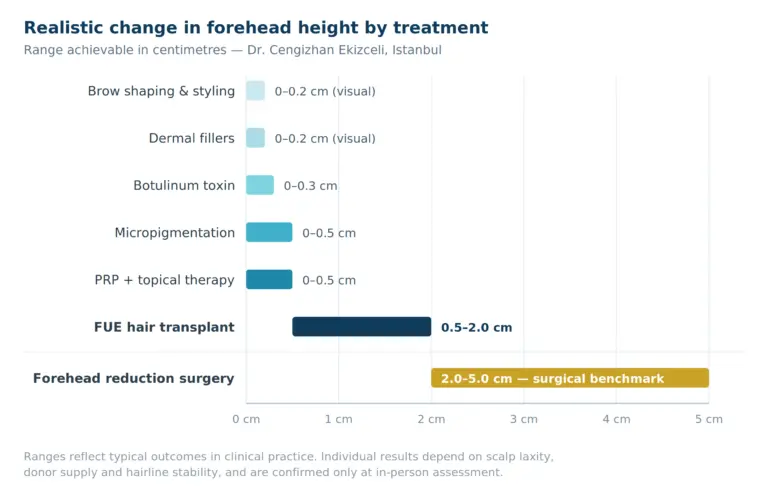
The chart below compares the realistic range of change in forehead height for every method discussed, measured in centimetres. It makes the ceiling of non-surgical treatment immediately obvious: nothing without an incision reliably exceeds two centimetres, and most options operate in the millimetre range where the change is apparent rather than measurable.
Where Non-Surgical Treatment Reaches Its Limit
Three patient groups tend to discover the ceiling quickly. The first is anyone whose forehead measures well above six centimetres with a stable, dense hairline — injectables simply cannot reach that scale of correction. The second is patients seeking a permanent result, since every option above except transplantation resets to baseline once treatment stops.
The third group is patients with generous scalp laxity. Ironically, the very anatomy that makes surgical advancement fast, safe and dramatic is wasted on treatments that never touch the scalp. For these patients, spending three years on maintenance injectables is usually a more expensive route to a smaller outcome. Our overview of forehead reduction cost in Turkey sets out how those figures compare over time.
“I never begin a consultation by recommending an operation. Roughly one patient in five who contacts us about a high forehead does not need surgery at all — their brow position, temple volume or hairline density is doing the damage, and those respond well to injectables or grafting. My job is to measure honestly and tell them which category they fall into. When the forehead is genuinely three or four centimetres too tall, non-surgical treatment will only ever buy a compromise, and patients deserve to hear that before they spend a single euro.”
— Dr. Cengizhan Ekizceli, Facial Aesthetic Surgeon, Istanbul
Choosing the Right Path for Your Anatomy
A useful rule of thumb: if your concern is how your forehead looks, start non-surgically. If your concern is how tall it measures, non-surgical options will manage the symptom rather than the cause. Accurate candidacy assessment takes about fifteen minutes and requires only photographs and two measurements.
Many patients end up with a combination approach — toxin to settle the brow, grafts to soften the temporal corners, and surgery only where the numbers justify it. You can see how these outcomes look in practice in our gallery of before and after forehead reduction results.
If You Decide Surgery Is the Better Fit
Patients who move ahead surgically are usually those who want a single, definitive change rather than an ongoing treatment schedule. Dr. Ekizceli’s C Reduction technique was developed specifically to keep the incision line irregular and follicle-preserving, so hair grows through the scar rather than around it.
Before committing, read the two guides that matter most: risks and safety in forehead reduction, and what the first fortnight of forehead reduction recovery actually involves. Understanding both is what makes the eventual decision a confident one rather than a hopeful one.
Frequently Asked Questions
Can you actually reduce forehead size without surgery?
You can reduce how large a forehead appears, but not its measured height. Botulinum toxin, fillers, micropigmentation and styling all work by changing brow position, shadowing and contrast, which typically alters perceived height by two to five millimetres. The only non-excisional treatment that moves the hairline itself is hair transplantation, which can bring it down by roughly 0.5 to 2 cm.
Does Botox make your forehead look smaller?
Yes, modestly. Relaxing the brow depressors allows the eyebrow to sit about two to three millimetres higher, which shortens the visible distance between brow and hairline. Smoothing deep horizontal lines also removes shadowing that exaggerates height. The effect lasts three to four months and must be repeated, and over-treatment of the frontalis muscle can have the opposite effect by lowering the brow.
Can a hair transplant lower the hairline instead of surgery?
It can, within limits. FUE transplantation builds a new hairline in front of the existing one using your own follicles, with no scalp advancement and no linear incision. Most patients achieve 0.5 to 2 cm depending on donor supply. The trade-offs are a nine-to-twelve month wait for final growth and a density that is usually lower than a native hairline.
How long do non-surgical forehead treatments last?
It varies widely by method. Botulinum toxin lasts three to four months, dermal fillers nine to eighteen months, scalp micropigmentation three to five years, and keratin fibres wash out the same day. PRP requires ongoing maintenance sessions. Only hair transplantation produces a result that does not need repeating.
Is there a permanent non-surgical way to lower a hairline?
Hair transplantation is the only option that produces a lasting change in hairline position without excising forehead skin, and it is best described as minimally invasive rather than truly non-surgical. Every other non-surgical treatment reverts to baseline once you stop maintaining it.
Do forehead exercises, oils or home remedies work?
No. There is no published evidence that facial exercises, massage, castor oil, onion juice or similar remedies move the hairline or shorten the forehead. Some oils may modestly support scalp condition, but none reposition a hairline. Aggressive massage or tight styling can actually worsen traction-related hairline recession.
Who is the best candidate for non-surgical forehead reduction?
The strongest candidates have a forehead only slightly above proportion, a low or heavy brow, hollow temples, or thinning at the frontal hairline rather than a genuinely high one. Patients whose forehead measures three or more centimetres above ideal proportion, or who want a single permanent correction, are generally better served surgically.
Can non-surgical options be combined?
Yes, and they frequently are. A common sequence is botulinum toxin to optimise brow position, temple filler to correct width, and micropigmentation or grafting to refine the hairline edge. Combining methods is often what allows a patient to postpone or avoid surgery, though it also means committing to a maintenance schedule.