





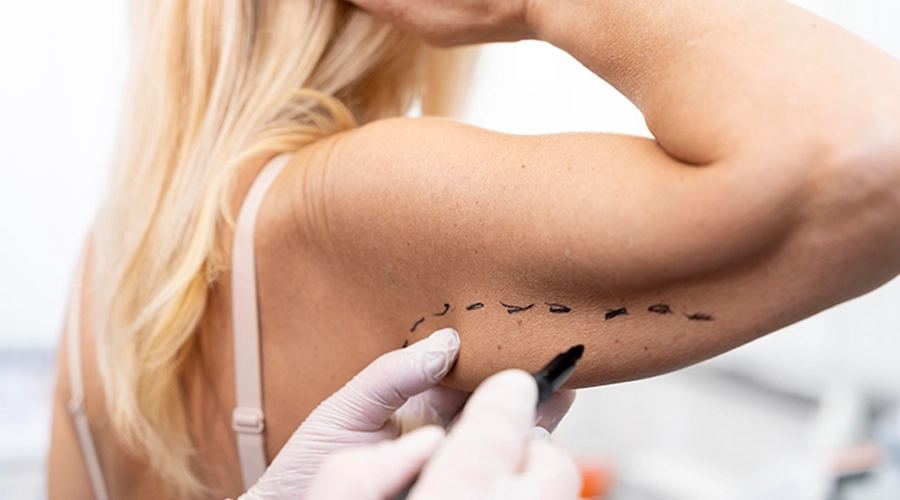
An arm lift is not simply an operation to make the arms look slimmer. Its main purpose is to reshape loose skin and, when necessary, excess fat. The technique is planned according to the degree of sagging, fat distribution and skin quality.
What Is Arm Lift Surgery (Brachioplasty)?
Arm lift surgery reshapes the upper arm between the armpit and the elbow. Excess skin is removed, and the remaining tissues are repositioned to create a more balanced contour.
If there is significant excess fat, liposuction may also be performed during surgery. However, liposuction alone cannot correct severely loose skin. The most appropriate approach therefore depends on skin elasticity and the amount of sagging.
Common causes of upper arm sagging include:
- Significant weight loss
- Repeated weight gain and loss
- Age-related loss of skin elasticity
- Genetic factors
- Excess skin and fat in the upper arms
Exercise can strengthen muscle tissue, but it cannot directly remove significantly loose excess skin.
Who Is a Good Candidate for Arm Lift Surgery?
An arm lift may be considered for people with significant excess skin on the upper arms whose weight is relatively stable. General health and realistic expectations are also important when assessing suitability.
Loose, hanging skin can develop on the upper arms after substantial weight loss. Age-related loss of elasticity can create a similar appearance.
Suitable candidates are generally assessed for the following factors:
- Significant skin laxity in the upper arms
- A stable weight maintained for a period of time
- No active or uncontrolled medical condition
- Factors that could affect wound healing have been assessed
- An understanding that the surgical scar may be permanent
- Realistic expectations about the changes surgery can achieve
Smoking and nicotine products can negatively affect wound healing. Any nicotine use should therefore be discussed with the surgeon before surgery.
Who May Not Be Suitable for Arm Lift Surgery?
An arm lift is not automatically suitable for everyone with sagging upper arms. The decision should be made after a plastic surgery consultation and medical assessment.
Some uncontrolled chronic conditions may increase surgical risk. Ongoing major weight loss can also affect the timing of surgery. If significant weight changes are expected in the near future, maintaining the result may be more difficult.
Any medications and medical conditions that may affect wound healing must be disclosed. Previous operations and circulation problems are also considered during the assessment.
Which Arm Lift Technique Is Used for Different Degrees of Sagging?
Arm lift surgery is not a single, standard technique. The length of the incision and the extent of surgery can vary according to the amount of excess skin.
For mild sagging concentrated near the armpit, a more limited approach may be considered. When excess skin is more extensive, the incision may extend from the armpit towards the elbow.
| Condition | Possible approach |
| Excess fat, good skin elasticity | Liposuction |
| Limited excess skin | Mini arm lift |
| Significant upper arm sagging | Traditional arm lift |
| Sagging with excess fat | Arm lift with liposuction |
| Extensive excess skin after weight loss | Extended brachioplasty |
This classification provides general guidance. The position and length of the incision are planned according to individual anatomy.
What Is a Mini Arm Lift?
A mini arm lift is a brachioplasty technique that may be considered when excess skin is relatively limited. The laxity generally needs to be concentrated near the armpit.
The incision can be planned shorter than with a traditional arm lift. In some cases, it is positioned close to the natural armpit crease.
A mini arm lift may not be sufficient to correct advanced sagging. A less suitable technique should not be chosen solely to achieve a shorter scar.
Can Arm Lift Surgery and Liposuction Be Combined?
Yes. In suitable patients, an arm lift and liposuction can be included in the same surgical plan. Liposuction reduces excess fat, while brachioplasty addresses loose skin.
If excess fat is the only concern in the upper arms, skin removal may not be necessary. When skin elasticity is good, the skin may contract naturally after liposuction.
If there is significant skin sagging, fat removal alone may not provide the desired result. In some patients, reducing volume can make skin laxity more noticeable.
How Is Arm Lift Surgery Performed?
During arm lift surgery, excess skin is removed and the upper-arm tissues are reshaped according to the planned contour. The details of the procedure vary with the degree of sagging.
Before surgery, the surgeon may mark the areas of skin to be removed while the patient is standing. The selected form of anesthesia is then administered.
When needed, liposuction may first be used to reduce excess fat. Excess skin is then removed through the planned incision.
The remaining skin and supporting tissues are closed with appropriate tension. Avoiding excessive tension is important for wound healing and scar quality.
In some patients, a temporary drain may be used to reduce fluid accumulation in the surgical area. A dressing or compression garment may be applied to the arms at the end of the operation.
Where Is the Incision Made for Arm Lift Surgery?
The arm lift incision is usually planned along a controlled line on the inner or back aspect of the upper arm. Its length depends on the amount of excess skin.
With limited sagging, the incision may remain close to the armpit. With more advanced sagging, it may extend from the armpit towards the elbow.
In some people who have lost a substantial amount of weight, excess skin may extend beyond the armpit. In these cases, a more extensive surgical plan may be required.
The location of the incision should be discussed in detail with the patient before surgery.
How Long Does Arm Lift Surgery Take?
Arm lift surgery typically takes around 1.5 to 3 hours in many cases. The overall scope of the procedure directly affects the operating time.
Adding liposuction or removing a larger amount of skin can lengthen the procedure. Combining the arm lift with another cosmetic operation in the same session can also change the total duration.
A more accurate estimate of surgery time can be given after an individual treatment plan has been prepared.
What Type of Anesthesia Is Used for Arm Lift Surgery?
More extensive arm lift procedures are usually performed under general anesthesia. The type of anesthesia is determined by the scope of surgery and the patient’s health.
Required blood tests and an anesthesia assessment may be carried out before surgery. It is important to provide a complete list of all medications being used.
The need for a hospital stay can also vary depending on the extent of surgery. Some patients may be discharged the same day, while others may leave after a period of observation.
How Should You Prepare for Arm Lift Surgery?
Before an arm lift, general health, current medications and factors that could affect wound healing should be assessed. Preparation is planned individually.
Your doctor may recommend changes to certain medications before surgery. Prescription medicines should not be stopped without medical advice.
Smoking and nicotine use must be disclosed. Nicotine can reduce blood flow to the tissues and negatively affect wound healing.
It may be preferable to complete any major weight changes before surgery. A stable weight helps maintain the body contour achieved after the procedure.
What Is Recovery Like After Arm Lift Surgery?
Swelling, tightness and mild bruising can be expected during the first weeks after an arm lift. Recovery speed varies from person to person.
After surgery, the incision sites may be protected with dressings. The arms may be kept in an appropriate position to help reduce swelling.
Short, controlled walks can begin when recommended by the surgeon. Heavy lifting and movements that strain the arms should be avoided during the early recovery period.
| Period | What to generally expect |
| First few days | Swelling, tightness and tenderness may occur |
| First 1–2 weeks | A gradual return to light daily activities may begin |
| First few weeks | A compression garment may be required |
| Around 6 weeks | Activity levels may be gradually increased in suitable patients |
| Following months | Swelling decreases and the arm contour becomes more defined |
| 12–18 months | The surgical scar may continue to mature |
These timelines are not exact. Your surgeon’s advice and your individual healing rate should always take priority.
How Long Should a Compression Garment Be Worn After an Arm Lift?
A compression garment may be worn for several weeks after arm lift surgery. The exact duration varies according to the surgical technique used.
A compression garment can help manage postoperative swelling and support the tissues. It should not be excessively tight.
Some clinical protocols may recommend wearing it for approximately 3 to 6 weeks. However, the duration should be adjusted according to individual healing.
When Can You Return to Work After Arm Lift Surgery?
People with desk-based jobs may be able to return to work within about one to two weeks. Those with physically demanding jobs may need more time.
Returning to work should not be based only on whether pain has improved. Arm movement, wound healing and the physical demands of the job must also be considered.
People whose work involves heavy lifting may need a longer recovery period. The exact timing should be determined at follow-up appointments.
When Can You Exercise After Arm Lift Surgery?
Strenuous exercise and movements that place significant strain on the upper body are generally avoided early in recovery. Return to exercise should be gradual.
During the first weeks, weight training and pushing or pulling movements can place stress on the incision line. Some activities may be reconsidered at around six weeks.
Returning to exercise before healing is complete can place tension on the wound. For this reason, the surgeon’s examination findings are more important than a fixed timeline.
Does Arm Lift Surgery Leave a Scar?
Yes. Because arm lift surgery requires an incision, it leaves a permanent surgical scar. The scar may fade over time, but it should not be expected to disappear completely.
The length of the scar is related to the extent of surgery. A mini arm lift may leave a more limited scar, while a traditional brachioplasty incision may extend towards the elbow.
Scars may look redder or more noticeable during the first months. As they mature, their color and firmness generally decrease.
Scar quality is influenced by factors such as individual healing, genetics and sun exposure. At the appropriate stage, the surgeon may recommend silicone-based products or other scar-care methods.
When Will Arm Lift Results Be Visible?
The new shape of the arm can be noticeable after surgery, but the final appearance becomes clearer as swelling subsides. Swelling in the first few weeks can temporarily affect the result.
The tissues may continue to settle for several months. Scar maturation can take longer than a year.
Early postoperative photographs alone should not be used to judge the final result. The arm contour continues to change through different stages of healing.
Are Arm Lift Surgery Results Permanent?
Arm lift results can be long-lasting, although aging and significant weight changes may affect the appearance over time. Surgery does not stop the natural aging process.
The skin removed during surgery does not grow back. However, the remaining skin can gradually lose elasticity over the years.
Keeping body weight as stable as possible helps preserve the result. Repeated or substantial weight fluctuations may lead to renewed laxity.
What Are the Risks of Arm Lift Surgery?
As arm lift surgery is a surgical procedure, the risk of complications cannot be eliminated completely. Potential risks should be reviewed in detail with the patient before surgery.
Possible complications can include bleeding, infection and fluid accumulation. Problems with wound healing or the development of a noticeable scar may also occur.
Some patients may experience temporary or longer-lasting changes in sensation. Additional treatment may be required if asymmetry develops or the desired contour is not fully achieved.
General surgical risks, including anesthesia-related complications and blood clots, are also considered. Individual risk varies according to the patient’s health.
Arm Lift vs Liposuction: What Is the Difference?
An arm lift primarily addresses loose skin, while liposuction mainly targets excess fat. The two procedures therefore do not serve exactly the same purpose.
| Feature | Arm Lift | Liposuction |
| Primary target | Excess and sagging skin | Localized fat |
| Is skin removed? | Yes | No |
| Incision/scar | May be longer | Small access incisions |
| Use for significant sagging | May be more appropriate | May be insufficient on its own |
| Can they be combined? | Yes | Yes |
For people with good skin elasticity whose main concern is excess fat, liposuction may be sufficient. When there is significant excess skin, brachioplasty is a more comprehensive option.
Can Non-Surgical Arm Tightening Correct Sagging Arms?
Non-surgical treatments may be considered for limited tightening in cases of mild skin laxity. They should not be expected to remove significant excess skin as effectively as surgery.
Radiofrequency, ultrasound-based systems and other energy-based devices may be used for this purpose. The degree of effect depends on the technology used and the characteristics of the skin.
When severely sagging skin needs to be physically removed, a surgical arm lift represents a different treatment option. Surgical and non-surgical approaches should not be viewed as direct substitutes for one another.
Can an Arm Lift Be Combined with Other Cosmetic Surgeries?
In suitable patients, an arm lift can be included in the same surgical plan as other body contouring procedures. Combined surgery, however, must be assessed on an individual basis.
Patients who have lost a significant amount of weight may also have excess skin on the abdomen, thighs or breasts. In such cases, procedures can be planned in the same session or at different stages.
Combining multiple operations can increase both the total surgery time and the demands of recovery. Patient safety therefore remains the priority in surgical planning.
Arm Lift Surgery Turkey Prices 2026
Arm lift surgery cost in 2026 varies according to the extent of the procedure and the individual surgical plan. It is not appropriate to set a standard price without an examination.
The degree of sagging is one of the main factors affecting cost. A limited mini arm lift and a more extensive brachioplasty do not involve the same surgical process.
Key factors that can affect the cost of arm lift surgery include:
- The arm lift technique used
- The amount and distribution of excess skin
- Whether liposuction is required
- The overall extent of the operation
- Anesthesia and hospital requirements
- Whether the procedure is combined with other surgeries
- The need for hospital observation or an overnight stay
- Individual surgical requirements
For these reasons, arm lift surgery cost should not be assessed on the basis of a single figure alone. The current fee can be confirmed after consultation and surgical planning.
Frequently Asked Questions
Is arm lift surgery painful?
Because anesthesia is used during surgery, the patient does not feel the operation itself. Tightness, tenderness and pain may occur afterwards.
The level of discomfort varies between individuals. Postoperative pain is managed with the treatment plan prescribed by the doctor.
Do you need to stay in hospital after arm lift surgery?
The need for a hospital stay depends on the extent of surgery and the patient’s condition. Some patients may require overnight observation.
The decision to discharge the patient is based on the duration of surgery, anesthesia and early recovery.
Does arm lift surgery help you lose weight?
No. An arm lift is not a weight-loss procedure. It targets excess skin on the upper arm and, when necessary, localized fat.
People who still plan to lose weight should discuss the timing of surgery with their doctor.
Can the arms sag again after arm lift surgery?
Some laxity can return over the years because of aging or significant weight changes. Maintaining a stable weight helps preserve the result.
Because surgery does not stop natural aging, gradual changes in skin quality over time are normal.
Can arm lift surgery be performed on both women and men?
Yes. Arm lift surgery can be performed on both women and men when the medical conditions are appropriate. Suitability is based primarily on anatomical need rather than sex.
Significant excess skin of the upper arms can occur in both women and men, particularly after substantial weight loss.
When can you move your arms comfortably after arm lift surgery?
Arm movement is increased gradually and in a controlled way after surgery. Movements that place strain on the incision should be avoided during the first days.
The duration of movement restrictions depends on the technique used and the individual’s healing. Different timelines may apply to daily activities and exercise.
When does swelling go down after arm lift surgery?
Swelling is usually more noticeable during the first weeks and gradually decreases over time. It may take several months to resolve fully.
A compression garment and the aftercare program recommended by the surgeon can support recovery.
Can arm lift surgery be performed in summer?
Arm lift surgery can be performed at different times of the year. The ability to follow postoperative care instructions is more important than the season itself.
Surgical scars should be protected from sun exposure in particular. Wearing a compression garment may also affect day-to-day comfort during hot weather.
Does an arm lift scar disappear completely?
No. A surgical incision scar does not disappear completely. It usually fades, softens and becomes less noticeable over time.
The appearance of the scar varies according to individual wound healing, incision length and postoperative care.
When can you shower after arm lift surgery?
The timing of showering depends on the condition of the wound, the type of dressing used and whether drains are present. The incision should not be exposed directly to water without the surgeon’s approval.
After wound healing has been assessed at a follow-up appointment, individual showering and wound-care instructions can be provided.