





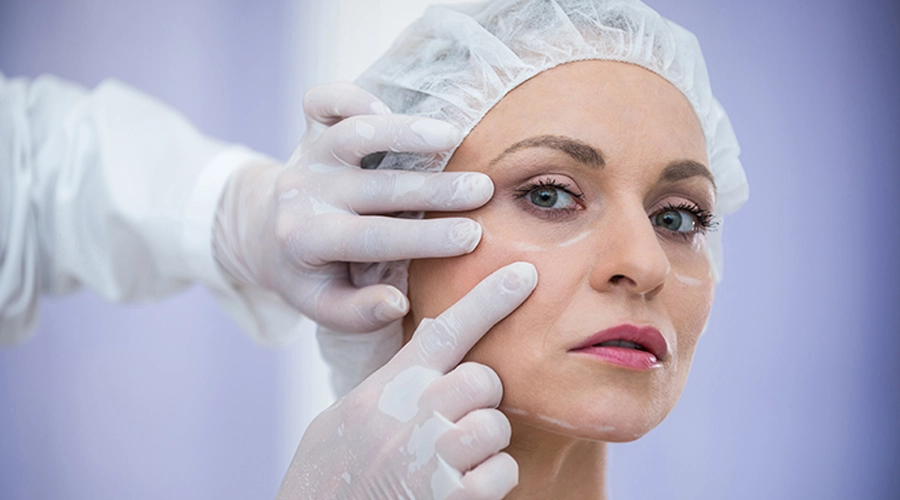
The main goal of facial aesthetics is not to create a standardised facial appearance. It is to achieve a more balanced relationship between the person’s existing facial features. For this reason, two people with similar aesthetic concerns may be advised to consider different procedures.
What Is Facial Aesthetic Surgery?
Facial aesthetic surgery includes procedures that address the appearance, proportions or age-related changes of the face. Some operations focus on a single area, while others require several facial regions to be assessed together.
The forehead and brows are key areas in the upper face. In the midface, the nose and cheek structures are important. Assessment of the lower face includes the chin, jawline and neck. The position of the ears and their proportion in relation to the face can also affect overall facial balance.
During aesthetic planning, the relationship between the area being treated and the face as a whole is more important than the area in isolation. For example, the proportions of the nose and chin can jointly influence the profile. Likewise, facial and neck tissues may be assessed together when addressing age-related changes.
What Facial Aesthetic Procedures Are Available?
Facial aesthetic surgery includes different procedures depending on the anatomical area that needs to be addressed. A single procedure or a combined surgical plan may be considered according to the existing facial structure. Available surgical options may involve the forehead, brows, ears, neck, face, chin and nose.
| Facial aesthetic procedure | Primary area treated | General aim |
| Forehead Reduction | Forehead and hairline | Reduce forehead height and move the hairline forward |
| Brow Lift | Brows and forehead | Reposition the brows |
| Otoplasty | Ears | Adjust ear shape, position or prominence |
| Neck Lift | Neck and under-chin area | Reposition lax tissues and refine the neck contour |
| Facelift | Mid and lower face | Reposition sagging facial tissues |
| Chin Augmentation | Chin and profile | Improve chin projection and facial proportions |
| Rhinoplasty | Nose | Refine nasal shape, proportions and, when necessary, function |
Each procedure differs in surgical technique, incision placement, anaesthesia and recovery. For this reason, the term “facial aesthetic surgery” does not refer to one single operation.
How Is Facial Aesthetic Surgery Planned?
Planning begins with a detailed assessment of the face from the front and in profile. Photographs taken from different angles may be used to evaluate facial proportions when needed.
Bone structure, soft tissues, skin quality and natural facial asymmetries are considered during the assessment. Hairline position, brow position and the relationship between the chin and neck may also be included in the surgical plan.
During the consultation, the areas causing concern should be identified clearly. The surgeon then evaluates whether the desired changes are anatomically achievable. Medical history, current medications and previous operations also influence surgical planning.
There is no single ideal facial proportion or standard technique in facial plastic surgery. The surgical method is selected according to the individual’s existing anatomy. Procedures such as facelift surgery may use different techniques that target different tissue layers, and no single technique provides the same advantages for every patient.
Who Is a Good Candidate for Facial Aesthetic Surgery?
Facial aesthetic surgery may be considered for people who are concerned about the appearance of a particular facial area and have realistic expectations. Age alone is not enough to determine suitability. The appropriate procedure depends on the individual anatomical concern.
General health should be suitable for surgery. Medical conditions and medications that may affect healing should also be reviewed before an operation.
Active smoking can negatively affect wound healing. For this reason, the surgeon may advise stopping smoking for a period before and after surgery.
The decision to undergo cosmetic surgery should not be based on appearance alone. The patient should understand the limitations of the procedure, the recovery period and the possible risks.
Who May Not Be Suitable for Facial Aesthetic Surgery?
Facial aesthetic surgery is not suitable for everyone under the same conditions. Surgery may need to be postponed because of a person’s health status or existing risk factors.
Uncontrolled medical conditions can affect surgical planning. Medications and certain supplements that increase bleeding risk should also be reviewed. These should not be stopped without medical advice.
Surgery should also be reconsidered when expectations are unrealistic. Cosmetic surgery is not intended to completely change a person’s fundamental facial identity.
For some people, a more limited intervention may be sufficient instead of surgery. In other cases, non-surgical treatments may not provide the desired anatomical change. The most appropriate option is determined after examination.
What Should You Consider Before Facial Aesthetic Surgery?
Before facial aesthetic surgery, overall health and surgical risk should be assessed in detail. Preparation may vary depending on the procedure being planned.
In general, the following points are reviewed before surgery:
- All prescription medications, vitamins and herbal supplements should be disclosed to the doctor.
- Required blood tests and medical assessments should be completed.
- The surgeon’s recommendations regarding smoking should be followed for the advised period.
- Medications that may increase bleeding risk should only be adjusted under medical supervision.
- If anaesthesia will be used, instructions regarding fasting and fluid intake should be followed.
- Transport and support at home should be arranged for the early postoperative period.
If several facial procedures are being considered together, the total operating time and overall health status should be assessed carefully. More procedures do not automatically mean a better result.
How Is Facial Aesthetic Surgery Performed?
The way facial aesthetic surgery is performed depends on the selected procedure. Once the surgical plan has been finalised, the necessary markings and anaesthesia preparation are completed.
Local anaesthesia or sedation may be used for some limited procedures. General anaesthesia may be preferred for more extensive operations. The type of procedure and the patient’s health determine the anaesthesia plan.
The surgeon then places incisions according to the anatomical area being treated. Whenever possible, incisions may be planned within natural creases, along the hairline or in less visible locations.
Facelift surgery is not limited to removing excess skin. Deeper soft tissues may also need to be repositioned. Chin surgery may involve an implant or procedures addressing the underlying bone structure. In rhinoplasty, the nasal bones and cartilage can be reshaped.
At the end of surgery, the incisions are closed. Dressings, splints or drains may be used when necessary. The need for a hospital stay depends on the extent of the operation.
What Is Recovery Like After Facial Aesthetic Surgery?
Recovery after facial aesthetic surgery varies according to the procedure performed and the individual’s healing characteristics. There is no single recovery timeline that applies to every facial operation.
Swelling, bruising and tightness may occur during the first few days. These are part of the expected recovery process after many facial procedures.
| Recovery period | What may generally be expected |
| First few days | Swelling, bruising, tightness and tenderness may occur |
| First 1–2 weeks | Swelling and bruising usually decrease noticeably |
| Following weeks | Tissues continue to settle and incision lines continue to heal |
| Following months | Facial contours become easier to assess as swelling subsides |
After facelift and eyelid surgery, many people may feel more comfortable in social settings after approximately 10–14 days. Complete tissue healing, however, takes longer.
Rhinoplasty has a different recovery timeline. Initial swelling may decrease within a few weeks, while full refinement of the nasal contour may continue for up to a year.
Swelling after brow and chin surgery may also take weeks or months to resolve completely. For this reason, the early appearance should not be considered the final result.
When Will the Results of Facial Aesthetic Surgery Be Visible?
Early changes can be seen soon after facial aesthetic surgery, but the final result usually becomes clearer as healing progresses. Swelling can temporarily make tissues appear different during the first few weeks.
After a facelift, the result becomes more apparent as swelling subsides. Facial tissues may take several months to feel completely natural. Brow lift results also become clearer as the tissues heal.
After chin surgery, early appearance may be misleading because of swelling. With rhinoplasty, the nasal tip and finer contours can take longer to settle.
How long the result lasts depends on the procedure. Surgically altered anatomical structures may remain changed for many years, although the natural ageing process continues.
Does Facial Aesthetic Surgery Leave Scars?
Because facial aesthetic procedures may require incisions, surgical scars can occur. Incision placement varies depending on the operation.
Facelift incisions are generally planned around the ears and near the hairline. Depending on the technique, brow lift incisions may be positioned within the scalp. In otoplasty, the incision is usually placed behind the ear.
Scar visibility is not determined by incision location alone. Genetics, smoking, sun exposure and wound care can all affect the final appearance.
It would not be accurate to say that every surgical scar will become completely invisible. The aim is to place incisions in anatomically appropriate areas where possible.
What Are the Risks of Facial Aesthetic Surgery?
Like other surgical procedures, facial aesthetic surgery carries certain risks. The type and likelihood of complications vary according to the operation being performed.
Bleeding, haematoma, infection, anaesthesia-related complications and wound-healing problems may occur with different facial procedures. Asymmetry, prolonged swelling and undesirable scarring are also possible risks.
Temporary or permanent changes in sensation may occur after some procedures. The risk of nerve injury is also considered in operations such as facelift and brow lift surgery.
Breathing problems or the need for revision may occur after rhinoplasty. Procedures involving a chin implant carry procedure-specific risks such as implant displacement.
Potential risks should be assessed individually. Before surgery, the expected benefits, limitations and possible complications should be discussed in detail with the surgeon.
What Is the Difference Between Surgical and Non-Surgical Facial Aesthetic Treatments?
Surgical and non-surgical facial aesthetic treatments do not produce the same anatomical changes. The most appropriate approach depends on the underlying concern.
Treatments such as dermal fillers may provide volume or contour changes in selected areas. Treatments targeting the skin surface may be used to address tissue quality.
A surgical facelift physically repositions lax facial tissues. Non-surgical treatments cannot reposition tissues to the same extent. However, for some people, more limited changes that do not require surgery may be sufficient.
There is therefore no single answer to the question “surgery or non-surgical treatment?” Excess skin, tissue laxity, bone structure and the patient’s goals should be assessed together.
Can Multiple Facial Aesthetic Procedures Be Performed at the Same Time?
More than one facial aesthetic procedure can be combined within the same surgical plan in suitable patients. However, the decision to combine procedures is not based on aesthetic goals alone.
A facelift may be considered together with a neck lift or brow lift. Nose and chin proportions may also be assessed together when planning the facial profile.
Combined surgery can address several areas during one recovery period, but it may also increase operating time and the overall surgical burden.
For this reason, the number of procedures, general health and duration of anaesthesia should be considered together. In some cases, separating procedures into different stages may be more appropriate.
Facial Aesthetic Surgery Turkey Prices 2026
Facial aesthetic surgery costs in 2026 vary according to the type and extent of the operation. Because “facial aesthetics” covers many different procedures, there is no single standard price.
Forehead reduction, rhinoplasty, facelift and chin augmentation involve different surgical processes. The technique used can also affect the overall cost.
When pricing is determined, the extent of surgery, type of anaesthesia and hospital requirements are considered. The use of implants or combining several procedures can also change the total cost.
The patient’s anatomical needs and previous operations can influence the surgical plan. Revision cases may require a different scope of treatment.
For this reason, an exact facial aesthetic surgery cost can only be established after the appropriate procedure has been determined. A personalised treatment plan and cost details can be clarified during the consultation or preliminary assessment.
Frequently Asked Questions
What Age Can You Have Facial Aesthetic Surgery?
There is no single age limit that applies to every facial aesthetic procedure. The appropriate timing depends on the planned operation and the individual’s anatomical development.
A facelift for age-related changes and correction of a congenital ear shape are not procedures aimed at the same age group. The decision should therefore be based on surgical need rather than age alone.
Are the Results of Facial Aesthetic Surgery Permanent?
How long facial aesthetic results last depends on the operation performed. Surgical changes involving bone or cartilage may remain stable for many years.
However, the face continues to age naturally. Skin elasticity, weight changes, sun exposure and lifestyle can all affect appearance over time.
Is Facial Aesthetic Surgery Painful?
The level of pain after facial aesthetic surgery varies according to the procedure. Tenderness, tightness and discomfort may occur during the first few days.
Postoperative pain relief is planned by the doctor. If pain is more severe than expected or continues to increase, the healthcare team should be contacted.
When Can You Return to Work After Facial Aesthetic Surgery?
The time needed to return to work depends on the extent of surgery and the type of job. Desk-based work and physically demanding work do not have the same recovery requirements.
After some facial procedures, social appearance may improve significantly within about two weeks. More extensive operations may require a longer period of rest.
Are Facial Aesthetic Surgery Results Visible Immediately?
Early changes can be seen after surgery, but swelling may temporarily conceal the final result. The tissues may take weeks or months to settle.
After rhinoplasty in particular, fine details may continue to refine for up to a year.
Can Men Have Facial Aesthetic Surgery?
Yes. Facial aesthetic surgery can also be performed on men. The surgical plan is based on facial anatomy and individual expectations.
Planning aims to preserve the natural bone structure and characteristic features of the face. The same technique is not applied with identical proportions to every patient.
Can Multiple Facial Procedures Be Performed During the Same Operation?
Several facial procedures may be planned during the same operation in suitable patients. However, combining every procedure may not be necessary or safe.
The surgeon evaluates operating time, the patient’s health and the overall recovery burden. When appropriate, procedures may be divided into separate stages.
Can Non-Surgical Facial Aesthetic Treatments Replace a Facelift?
Non-surgical treatments do not create the same anatomical effect as a surgical facelift, because facelift surgery physically repositions lax facial tissues.
Non-surgical options may be considered for limited concerns involving volume, contour or skin quality. The most appropriate method should be determined after a facial assessment.
Can Facial Aesthetic Surgery Look Natural?
A natural-looking result is pursued by planning the procedure around the patient’s existing facial proportions. Maximising change in every facial area is not an appropriate approach.
The surgical plan should remain harmonious with the face as a whole. The degree of change depends on the person’s anatomy, the selected technique and the healing process.