



What Is a Sapphire Hair Transplant?
One approach, known as a sapphire hair transplant, uses blades made from synthetic sapphire to create small recipient channels before harvested follicular units are implanted. It is generally performed as a variation of follicular unit extraction, commonly called FUE.
The term sapphire refers to the material used for the channel-opening instrument rather than a completely different method of harvesting hair follicles. The quality of the results depends on surgical planning, donor hair availability, graft handling, and the experience of the medical team.
Although sapphire blades are marketed for their precision, current evidence does not establish that they consistently produce better hair growth or faster recovery than well-performed conventional FUE.
How Is a Sapphire Hair Transplant Performed?
The procedure begins with an assessment of the scalp, donor hair density, and the extent of hair loss. The surgeon designs the recipient area while considering the patient’s natural hairline, hair direction, and future hair loss.
After local anesthesia is administered, follicular units are extracted individually from the donor area, usually at the back or sides of the scalp. A small punch instrument is used to harvest the grafts.
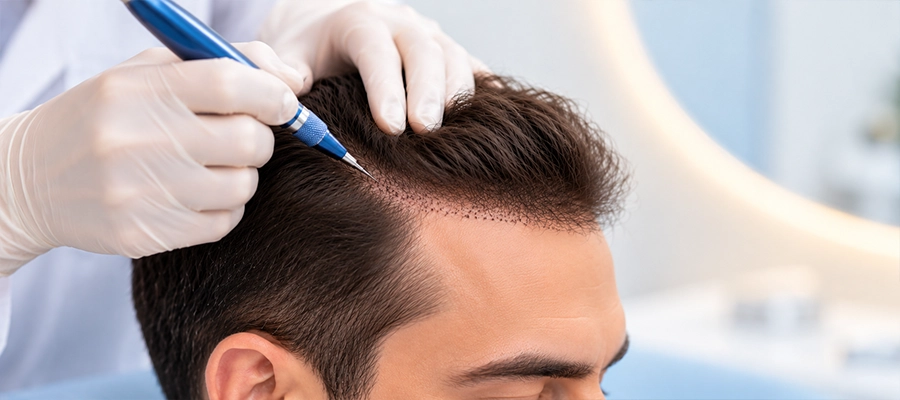
The medical team then prepares recipient channels using sapphire blades. These channels are created according to the intended angle, direction, and distribution of the transplanted hair.
The harvested grafts are placed into the prepared channels. Their survival depends on factors such as careful handling, appropriate storage, and adequate blood supply in the recipient area.
Following implantation, the scalp is assessed and the patient receives instructions for wound care and recovery.
What Is Sapphire FUE Hair Transplantation?
Sapphire FUE is a variation of follicular unit extraction in which sapphire blades are used during the recipient-channel creation stage.
The harvesting process generally follows the same principles as conventional FUE. Individual follicular units are removed using specialized punches rather than a long strip incision.
The main distinction lies in the instrument used to prepare the recipient sites.
Sapphire blades may allow surgeons to create channels with specific shapes and dimensions, depending on the blade design.
However, the use of sapphire does not automatically improve graft survival or eliminate the possibility of scarring.
The surgeon’s technique and the overall quality of the procedure remain more important than the blade material alone.
Who Is a Good Candidate for a Sapphire Hair Transplant?
Adults with stable patterns of permanent hair loss and sufficient donor hair may be suitable candidates.
The procedure is commonly considered for androgenetic alopecia, which causes progressive hair thinning in genetically susceptible individuals.
A suitable candidate should have enough healthy donor follicles to provide coverage without excessively thinning the donor area.
Scalp health is another important factor. Active infections, uncontrolled inflammatory conditions, and certain scarring alopecias may require treatment before transplantation is considered.
The patient’s age, medical history, expectations, and likely future hair loss should also be assessed.
A consultation helps determine whether transplantation is appropriate and whether sapphire-channel FUE offers any practical advantage for the individual.
What Are the Benefits of a Sapphire Hair Transplant?
Sapphire blades provide an alternative instrument for creating recipient channels during FUE transplantation.
Their manufactured shape and sharpness may help the surgeon prepare channels with controlled dimensions.
The technique also avoids the long linear donor scar associated with strip harvesting, although FUE still leaves multiple small extraction scars.
When the procedure is planned carefully, transplanted hair can follow the natural direction and distribution of surrounding hair.
The approach may be suitable for different recipient areas, including the frontal hairline and crown.
However, these potential benefits are not exclusive to sapphire instruments. Similar outcomes may be achieved with other properly selected surgical tools.
What Are the Disadvantages of a Sapphire Hair Transplant?
The procedure is invasive and carries the general risks associated with hair transplantation.
Temporary swelling, bleeding, discomfort, infection, and changes in scalp sensation may occur.
Improper channel placement can cause unnatural hair direction, irregular density, or damage to nearby existing follicles.
Excessive harvesting may permanently reduce donor-area density and create visible scarring.
Some transplanted grafts may fail to grow, and patients with progressive genetic hair loss may require further treatment.
Sapphire blades also do not guarantee superior healing or higher graft survival compared with conventional instruments.
What Is the Difference Between Sapphire FUE and Traditional FUE?
Both techniques generally use follicular unit extraction to harvest individual hair grafts from the donor area.
The main difference concerns the instruments used to create recipient channels.
Sapphire FUE uses blades made from synthetic sapphire, while traditional FUE procedures commonly use steel blades or other surgical instruments.
The choice of instrument can affect the surgeon’s approach to channel design and incision dimensions.
However, both techniques depend on correct graft placement, suitable donor hair, and careful surgical execution.
Current clinical evidence does not consistently demonstrate that sapphire blades produce superior long-term results.
What Is the Difference Between Sapphire FUE and DHI Hair Transplantation?
Sapphire FUE and DHI differ primarily in how recipient sites are prepared and how grafts are implanted.
In sapphire FUE, the surgeon generally creates recipient channels before placing the harvested follicular units into them.
Direct Hair Implantation, or DHI, typically uses an implanter pen that can create an opening and insert a graft during the same movement.
Both approaches commonly rely on FUE-style graft harvesting.
DHI may be useful in selected situations where implantation among existing hair requires careful planning, but it is not automatically superior.
The most appropriate technique depends on hair characteristics, the recipient area, and the experience of the surgical team.
How Long Does a Sapphire Hair Transplant Take?
The duration of the procedure depends on the number of grafts, the size of the recipient area, and the complexity of the hairline design.
Many sessions take approximately six to eight hours, although smaller procedures may be shorter and extensive sessions may take longer.
The process includes anesthesia, graft extraction, recipient-channel preparation, and implantation.
Breaks may also be scheduled during the procedure.
Patients requiring extensive coverage may need treatment across more than one session.
The planned duration should prioritize graft quality and patient safety rather than the fastest possible completion.
Is a Sapphire Hair Transplant Painful?
Local anesthesia is typically used to reduce discomfort during graft harvesting and implantation.
Patients may feel brief stinging or pressure while the anesthetic is administered.
Once the area is numb, significant pain is generally not expected, although some sensations may remain.
Mild soreness, tightness, or tenderness can develop after the anesthetic wears off.
These symptoms usually improve during the early recovery period.
Severe or worsening pain, especially when accompanied by increasing redness, fever, or discharge, requires prompt medical assessment.
What Is the Recovery Process Like After a Sapphire Hair Transplant?
During the first few days, mild swelling, redness, and small crusts may develop around the transplanted follicles.
The donor area may also feel tender while the extraction sites heal.
Many patients notice that the visible crusts gradually clear within approximately seven to fourteen days.
Temporary numbness or sensitivity changes can last longer in some individuals.
The scalp’s appearance generally improves over the following weeks, although residual redness may persist.
Complete cosmetic recovery and new hair growth take considerably longer than the initial wound-healing period.
What Should You Avoid During the First 10 Days After a Sapphire Hair Transplant?
The early recovery period is important because newly implanted grafts and healing skin can be disturbed by unnecessary friction or pressure.
Patients should avoid scratching, rubbing, or picking at crusts around the recipient area.
Strenuous exercise, heavy lifting, and activities that cause excessive sweating may need to be postponed according to the surgeon’s instructions.
Swimming pools, saunas, and activities that expose the scalp to contaminated water should also be avoided during early healing.
Direct sun exposure, tight headwear, and sleeping positions that place pressure on the transplanted area may increase irritation.
Hair washing should follow the clinic’s specific instructions rather than using vigorous rubbing or high-pressure water.
When Does Hair Start Growing After a Sapphire Hair Transplant?
Transplanted hair commonly enters a temporary shedding phase during the first several weeks after surgery.
This process, often called shock loss, does not necessarily mean the transplanted follicles have failed.
New hair growth usually becomes noticeable after approximately three to four months.
Hair density and thickness often improve progressively between six and twelve months.
Crown-area results may take longer to mature, sometimes reaching their fuller appearance after twelve to eighteen months.
The exact timeline varies according to individual healing, graft characteristics, and the condition of the scalp.
Sapphire Hair Transplant Turkey Prices 2026
In 2026, sapphire hair transplant prices vary according to the number of grafts, the complexity of the procedure, and the medical team’s experience
Frequently Asked Questions
Is Sapphire Hair Transplant the Same as Sapphire FUE?
Yes, the terms are commonly used interchangeably. Both generally describe FUE hair transplantation in which sapphire blades are used to create recipient channels. The sapphire component refers to the channel-opening instrument, not the graft extraction method.
How Many Grafts Are Needed for a Sapphire Hair Transplant?
The number of grafts depends on the size of the thinning area, existing hair density, and available donor follicles. Some patients require relatively small sessions, while others need several thousand grafts. A scalp assessment is necessary to estimate an appropriate number without overharvesting the donor area.
Does Shock Loss Occur After a Sapphire Hair Transplant?
Yes, temporary shedding can occur after sapphire FUE, just as it can after other hair transplantation techniques. Transplanted hair shafts commonly shed before new growth begins, and nearby existing hair may also experience temporary shedding. The extent of shock loss varies between patients.
When Can You Wash Your Hair After a Sapphire Hair Transplant?
Gentle washing is often introduced within the first few days, depending on the surgeon’s protocol. The scalp should be cleaned without rubbing, scratching, or applying strong water pressure to the transplanted area. Patients should follow their surgical team’s specific instructions.
When Can You Return to Work After a Sapphire Hair Transplant?
Many people with desk-based jobs can return within a few days, depending on swelling and personal comfort. Patients who prefer to wait until visible crusting improves may need approximately one to two weeks. Physically demanding jobs can require a longer recovery period.
When Can You Exercise After a Sapphire Hair Transplant?
Light walking may be possible relatively soon after surgery, provided it does not cause excessive sweating or discomfort. Strenuous workouts and heavy lifting are often restricted for approximately one to two weeks or longer, depending on healing. Contact sports may require additional recovery time.
Is Sapphire Hair Transplantation Suitable for Women?
Yes, selected women with stable hair loss and adequate donor density may be candidates. However, diffuse thinning can affect donor hair quality and make transplantation unsuitable in some cases. A dermatological evaluation is important to identify the underlying cause before surgery.
Does a Sapphire Hair Transplant Look Natural?
Natural-looking results are possible when the hairline, graft angles, density, and hair distribution are planned appropriately. The surgeon must also consider the patient’s age, facial proportions, and potential future hair loss. Sapphire blades alone do not guarantee a natural appearance, and final results depend on the overall surgical technique.