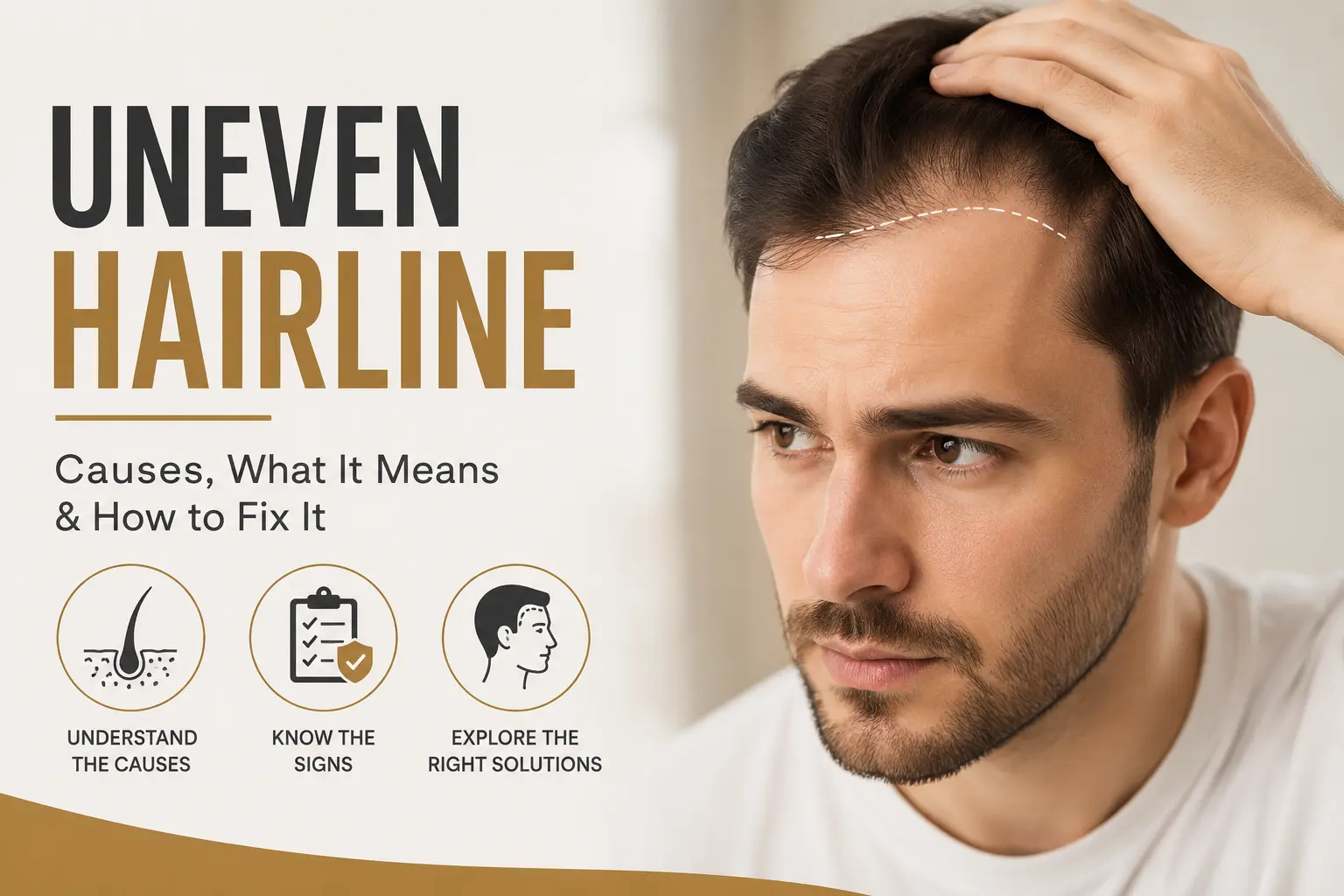

A slightly higher hairline does not automatically mean you are going bald. The key difference between a mature hairline and a receding hairline is usually stability versus progression. This guide explains the signs to watch, how the patterns differ, and when a professional hair-loss assessment is worthwhile.
A slightly higher hairline does not automatically mean you are going bald. The key difference between a mature hairline and a receding hairline is usually stability versus progression. This guide explains the signs to watch, how the patterns differ, and when a professional hair-loss assessment is worthwhile.
Mature Hairline vs. Receding Hairline: What Is the Main Difference?
The simplest way to think about the difference is this: a mature hairline tends to settle, while a receding hairline tends to progress.
Many men notice that the very low, rounded hairline they had as teenagers becomes slightly higher or more angular in early adulthood. In everyday hair-restoration language, this is often called a mature hairline. Mild recession at the temples can occur without obvious ongoing loss.
A receding hairline is different because the frontal or temporal hairline continues moving backward. In male pattern hair loss, this may gradually create a deeper M-shaped pattern and can occur together with thinning on the top or crown of the scalp. The American Academy of Dermatology and Cleveland Clinic both describe a receding hairline as a common sign of male pattern hair loss.
One photograph cannot always tell you which pattern you have. Change over time is often more informative than the exact shape you see today.
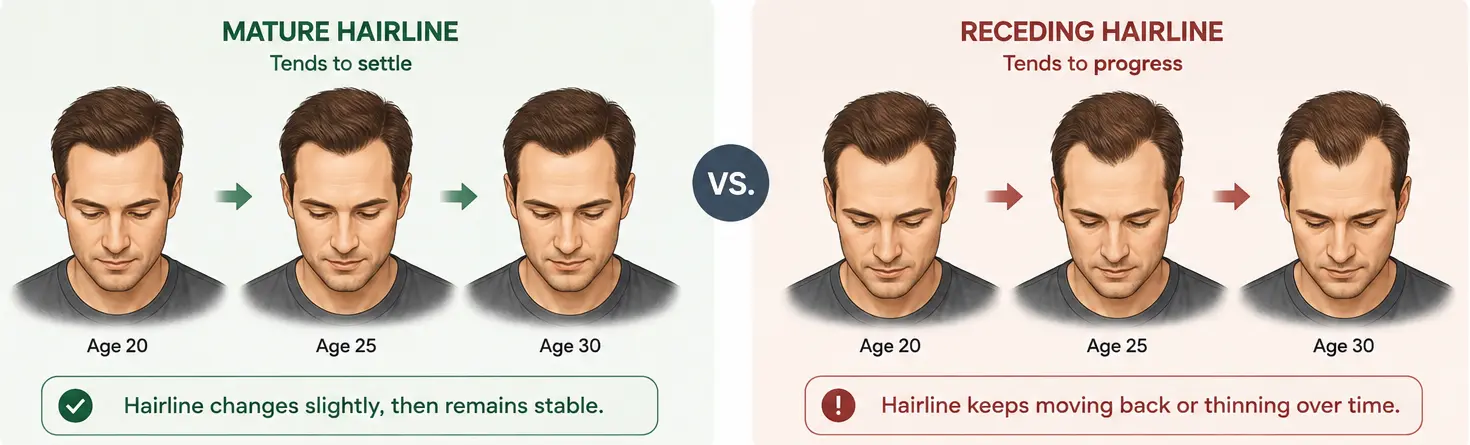
Mature Hairline vs. Receding Hairline Comparison
| Feature | Mature Hairline | Receding Hairline |
|---|---|---|
| Change over time | Mild change followed by relative stability | Continues to move backward or thin |
| Temple shape | May become slightly more angular | Recession often becomes deeper and more obvious |
| Hair density behind the line | Usually remains fairly consistent | May gradually become thinner |
| Miniaturized hairs | Not a defining feature | Can appear along the advancing edge in pattern hair loss |
| Crown thinning | Not expected simply because the hairline has matured | May occur together with frontal recession |
| Typical concern | Hairline looks higher but does not keep changing | Old photos show a steadily increasing forehead or deeper temples |
| Next step | Monitor if you are unsure; treatment is optional | Consider a professional hair-loss assessment, especially if progression is visible |
7 Signs That Help Tell a Mature Hairline From a Receding Hairline
1.Look at old photos, not just today’s mirror
The strongest clue is whether your hairline is still changing. Compare clear front-facing photographs taken under similar lighting over 6 to 12 months. A mature hairline tends to look broadly similar once it has settled. A receding hairline tends to show increasing temple depth, a higher frontal line, or both.
2. Check whether the temples are becoming progressively deeper
A slightly more angular adult hairline can be normal. What matters is whether the corners continue moving backward. Progressive frontotemporal recession is a classic feature of male pattern hair loss and often becomes more obvious when you compare photos rather than checking daily.
3. Look for reduced density behind the hairline
A hairline can be high while the hair behind it remains dense. That is different from a hairline that is not only moving backward but also becoming more see-through. Increasing scalp visibility, especially near the front or temples, is more suggestive of active thinning.
4. Notice fine, short or miniaturized hairs
In androgenetic alopecia, affected follicles can gradually produce finer, shorter hairs. A clinician may use magnification or trichoscopy to assess this more accurately. A few fine hairs at the front are normal; the pattern and progression matter more than any single strand.
5. Check the crown as well as the front
Male pattern hair loss can affect both the frontal hairline and the crown. A stable mature hairline should not, by itself, cause a thinning spot on the vertex. If the temples are moving back while the crown is also becoming thinner, progressive pattern hair loss becomes more likely.
6. Consider your family history — but do not treat it as destiny
Hereditary hair loss often runs in families, but inheritance is complex. A family history of early recession can raise suspicion when your own hairline is changing, yet it cannot confirm a diagnosis by itself.
7. Pay attention to symptoms that do not fit a simple mature hairline
Rapid shedding, patchy loss, scalp redness, scale, pain, significant itching, eyebrow loss, or a quickly changing frontal hairline deserves medical attention. Several hair-loss conditions can mimic ordinary recession and need a different treatment approach.
How to Monitor Your Hairline at Home
If you are unsure whether your hairline is simply mature or actively receding, consistency is more useful than frequent mirror checks. Try this simple tracking method:
- Take a front photo and two 45-degree temple photos.
- Use the same room, camera distance and lighting each time.
- Keep your hair dry and styled away from the hairline.
- Repeat every 2 to 3 months rather than every day.
- Compare the temples, frontal midpoint and density behind the hairline.
Avoid drawing conclusions from one unusually harsh photo. Wet hair, overhead lighting, short haircuts and phone-camera distortion can make the scalp look more visible than it really is.
Important: A home photo series can show whether something appears to be changing, but it cannot identify the cause of hair loss. If you see clear progression, a dermatologist or hair-restoration specialist can examine follicle density, miniaturization and the overall loss pattern.
High Hairline, Mature Hairline or Receding Hairline?
These terms are often mixed together, but they describe different ideas.
A naturally high hairline is usually present from adolescence or early adulthood and can make the forehead look taller even when there is no active hair loss. If you are mainly concerned about forehead proportions, our guide to what is considered a big forehead explains how forehead height and facial proportions are assessed.
If your forehead seems to have become larger over time, the cause may be hairline movement rather than forehead anatomy. Our article on why your forehead may look bigger covers inherited hairline position, androgenetic hair loss, traction and other contributors.
A high but stable hairline can be an aesthetic concern without being a medical problem. A receding hairline is different because the change itself is the issue.
What Can You Do About a Mature or Receding Hairline?
If your hairline is mature and stable
No medical treatment is required simply because a hairline sits slightly higher than it did in adolescence. If the concern is cosmetic rather than medical, options depend on the cause, forehead height and hair density.
For people with a naturally high, stable hairline, forehead reduction surgery can physically shorten the forehead by advancing the hair-bearing scalp. You can also review forehead reduction before-and-after results to understand the type of change the procedure is designed to create.
Another option is to reshape the frontal hairline with transplanted follicles. Our guide to reducing forehead size with a hair transplant explains how transplantation can be used to create the appearance of a lower hairline without excising forehead skin.
If your hairline is actively receding
The first priority is usually identifying and managing the underlying hair-loss process rather than immediately lowering the hairline. In androgenetic alopecia, evidence-based medical treatments may help slow further loss, and some patients later become candidates for hair transplantation.
Hair restoration planning should take future loss into account. Building an aggressively low hairline while surrounding native hair continues to thin can produce an unnatural pattern later. This is why donor density, age, family history, miniaturization and expected future recession all matter before surgery.
Forehead reduction or hair transplant?
If your hairline is stable but simply too high for your facial proportions, forehead reduction may create a more immediate change. If there is recession, thinning or a need to redesign specific corners and temples, transplantation may be more appropriate. The differences are explained in detail in our guide to forehead reduction vs. hair transplant.
If surgery is being considered, recovery and scar placement are also important. See our guides to forehead reduction recovery and forehead reduction scars.
When Should You See a Doctor About a Receding Hairline?
Consider a professional assessment if your hairline has clearly moved backward over a period of months, your density is decreasing, you are also thinning at the crown, or you are worried about the speed of change.
You should seek medical evaluation sooner if hair loss is sudden, patchy, painful, itchy or inflamed, or if it occurs with eyebrow loss. These features can point to causes other than ordinary male pattern hair loss.
For women, a distinctly receding frontal hairline is also worth assessing because female pattern hair loss often presents more as diffuse thinning than classic male-style temple recession. Other conditions, including frontal fibrosing alopecia and traction alopecia, can affect the frontal hairline and require a different approach.
Can a Mature Hairline Turn Into a Receding Hairline Later?
Yes. Having a stable adult hairline at one point does not guarantee that pattern hair loss will never develop later. The useful question is not whether your hairline fits a perfect label, but whether it is currently stable.
If a hairline looked unchanged for years and then begins moving backward, the new progression matters more than what it was called previously. This is another reason why a few standardized photos taken over time can be more useful than trying to classify the shape from memory.
Is a Mature Hairline the Same as Balding?
No. “Mature hairline” and “balding” are not interchangeable terms. A mildly higher adult hairline can remain stable for years. Balding describes ongoing hair loss.
However, the early stages can look similar. A person with the beginning of androgenetic alopecia may initially see only subtle temple recession. That is why stability, density and progression are more useful than relying on a single visual rule.
Not Sure Whether Your Hairline Is High or Receding?
A professional assessment can help distinguish a naturally high or mature hairline from active hair loss and determine whether treatment, monitoring, hair transplantation or forehead reduction is appropriate.
Contact Dr. Cengizhan Ekizceli or explore the full guide to forehead reduction surgery.
Frequently Asked Questions
What is a mature hairline?
A mature hairline is a commonly used, non-diagnostic term for a hairline that has shifted slightly from its youthful position and then stays relatively stable. It may sit a little higher or have slightly more pronounced temple corners.
How can I tell a mature hairline from a receding hairline?
Look for progression. A mature hairline tends to stabilize. A receding hairline continues moving backward and may show increasing temple recession, reduced density, finer hairs at the edge or thinning at the crown.
Does a mature hairline mean I am going bald?
No. A stable higher hairline does not by itself prove pattern hair loss. Ongoing change over time is more important than the shape of a single snapshot.
At what age does a mature hairline develop?
Hairline position can change from the late teenage years into adulthood, but there is no single age or measurement that proves a hairline is “mature.” If recession continues rather than stabilizing, it should be assessed as possible hair loss.
Can a receding hairline be treated?
Yes. Treatment depends on the cause. Pattern hair loss may be managed medically, and selected patients may later be candidates for hair transplantation. Earlier assessment can be useful because preserving existing hair is often an important part of treatment planning.
Is forehead reduction suitable for a receding hairline?
Forehead reduction is generally best suited to a naturally high, stable hairline. Active recession requires careful evaluation because future hair loss can alter the long-term appearance of the result.