
Nine practical questions that reveal more than rankings, reviews or a polished social feed—and help you compare credentials, healed results, technique and safety with confidence.
Searching for the best forehead reduction surgeon can quickly become confusing. Clinic websites use similar language, social feeds tend to show only their strongest results, and a five-star review rarely tells you whether the reviewer had your hairline, scalp mobility or risk of future hair loss.
Forehead reduction—also called hairline lowering or scalp advancement surgery—is highly dependent on planning and execution. The surgeon must decide how far the scalp can move safely, design a natural hairline, protect follicles and sensory structures, control tension, and close the incision so the scar matures within the hairline. Choosing well therefore requires more than finding the nearest clinic or the lowest quote.
Selection principle
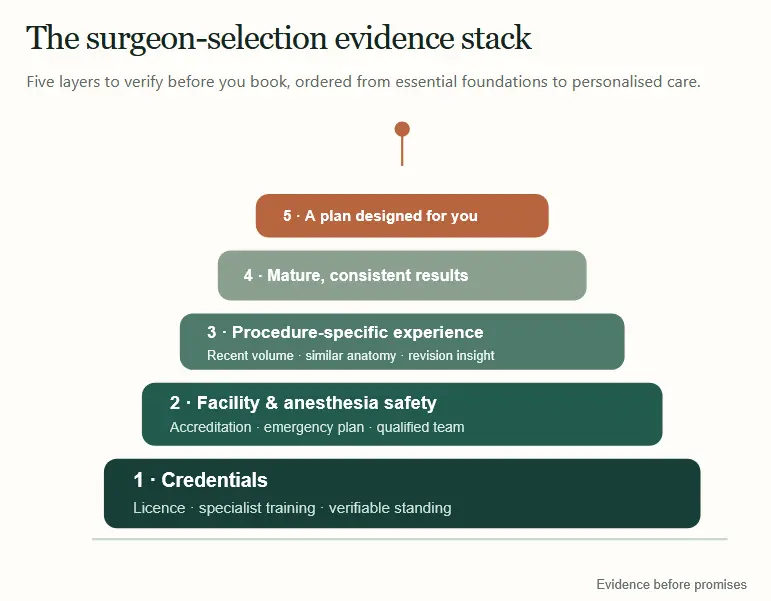
Credentials establish permission to practise. Procedure-specific experience, healed outcomes and a reliable safety system establish whether a surgeon is a convincing choice for your case.
What does “best forehead reduction surgeon” actually mean?
There is no universal league table that identifies one surgeon as best for every patient. A technically experienced surgeon may still be a poor match if they recommend an unsuitable hairline, dismiss progressive hair loss or cannot provide safe follow-up after you travel home.
A more useful definition combines five kinds of evidence: recognised qualifications, meaningful forehead-reduction volume, mature and relevant results, a robust surgical system, and a consultation that protects you from an operation you do not need. Think of these as a stack. A weakness at the bottom cannot be repaired by attractive photographs at the top.
1. Are the surgeon’s credentials independently verifiable?
Start with the medical register and specialist body for the country in which the surgery will take place. Titles and certification systems differ internationally, so do not assume that a phrase such as “cosmetic surgeon” has the same legal or training meaning everywhere.
In the United States, the American Society of Plastic Surgeons advises patients to look for certification by the American Board of Plastic Surgery and surgery in an accredited or state-licensed facility. In other countries, use the relevant government medical register and recognised plastic-surgery specialty organisation. Verification should take place on the regulator’s website—not through a badge copied onto a clinic page.
Ask directly“Which medical regulator and specialist body recognise your plastic-surgery training, and where can I verify your current registration?”
Also confirm who will actually perform the operation. A clinic brand, coordinator or social-media account is not the surgeon. Your consultation, consent form and surgical plan should name the operating doctor.
2. How much forehead-reduction experience do they have?
General plastic-surgery experience matters, but it is not a substitute for performing hairline-lowering surgery regularly. This is a relatively specialised operation involving the interaction of scalp mobility, hairline design, incision placement and wound tension.
There is no evidence-based minimum number of cases that guarantees a good result. Instead, request three numbers: the surgeon’s approximate lifetime forehead-reduction volume, their recent annual volume and how often they manage revision or technically difficult cases. A consistent recent practice is generally more informative than a large career total that includes few current procedures.
Large clinical series can also show that a surgeon documents outcomes systematically. For example, Dr. Cengizhan Ekizceli and colleagues published a retrospective study of 820 consecutive forehead-reduction operations performed with a consistent technique. Publication does not eliminate risk or prove that one approach is right for everyone, but it provides more inspectable evidence than an unsupported marketing claim.
Ask directly
“How many forehead reductions did you personally perform in the last 12 months, and can I see healed cases with hairline density and scalp characteristics similar to mine?”
3. Do their before-and-after photographs show healed results?
Early photographs can demonstrate immediate lowering, but they cannot show the mature scar, settled hairline or long-term density. Prioritise examples taken six to twelve months after surgery, with consistent lighting, distance, head position and hair placement.
When reviewing a forehead reduction before-and-after gallery, look beyond the change in centimetres:
- Does the hairline suit the person’s forehead shape, temples and facial proportions?
- Is the line softly irregular rather than unnaturally straight?
- Does hair density remain convincing at the leading edge?
- Can you see close, unobscured views of the mature incision?
- Are there results for patients with a comparable sex, age, hair texture, skin type and degree of lowering?
Ask whether the images show the surgeon’s own patients, whether the same person performed every case, and whether any additional hair transplant, brow procedure or scar treatment contributed to the result.
4. Can the surgeon explain their incision and closure technique?
You do not need to become a surgeon before your consultation, but you should receive a clear explanation of the plan. Forehead reduction generally involves removing a strip of non-hair-bearing skin at the hairline and advancing the hair-bearing scalp. Details of incision design, tissue handling, fixation and closure influence the final contour and scar.
Ask how the surgeon plans to preserve follicles at the edge, avoid a ruler-straight hairline and reduce tension across the closure. Terms such as “trichophytic” or “bevelled” incision can be relevant, but terminology alone is not proof of execution. The best evidence is a coherent explanation supported by healed close-up results.
No responsible surgeon should promise an entirely scar-free operation. A better conversation describes where the incision will sit, how it usually changes over time and what options exist if healing is less discreet than expected. Our detailed guide explains the forehead reduction scar timeline and aftercare.
5. Does the consultation test whether you should have surgery?
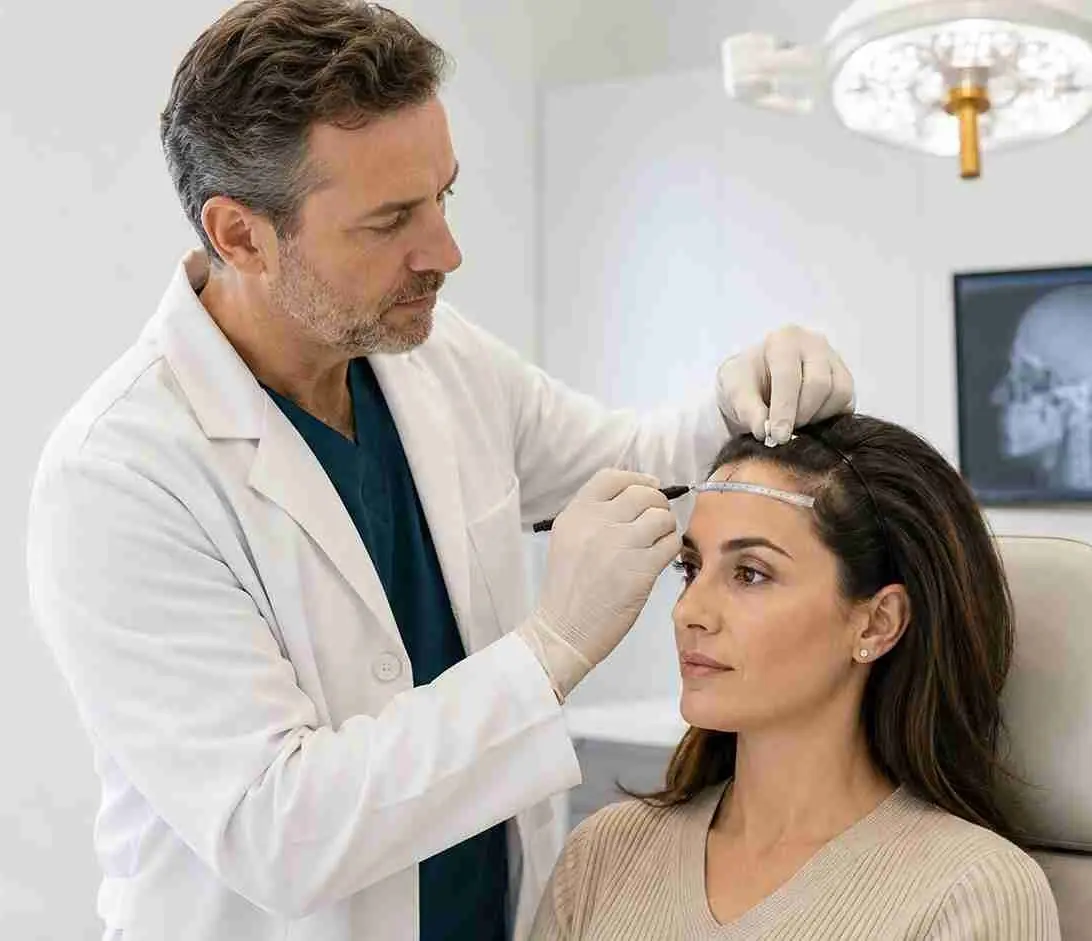
A strong consultation is not a sales presentation. It should examine scalp laxity, hair density, hairline stability, temple shape, previous surgery, scarring tendency, smoking, medication, health history and the amount of movement that can be achieved without excessive tension.
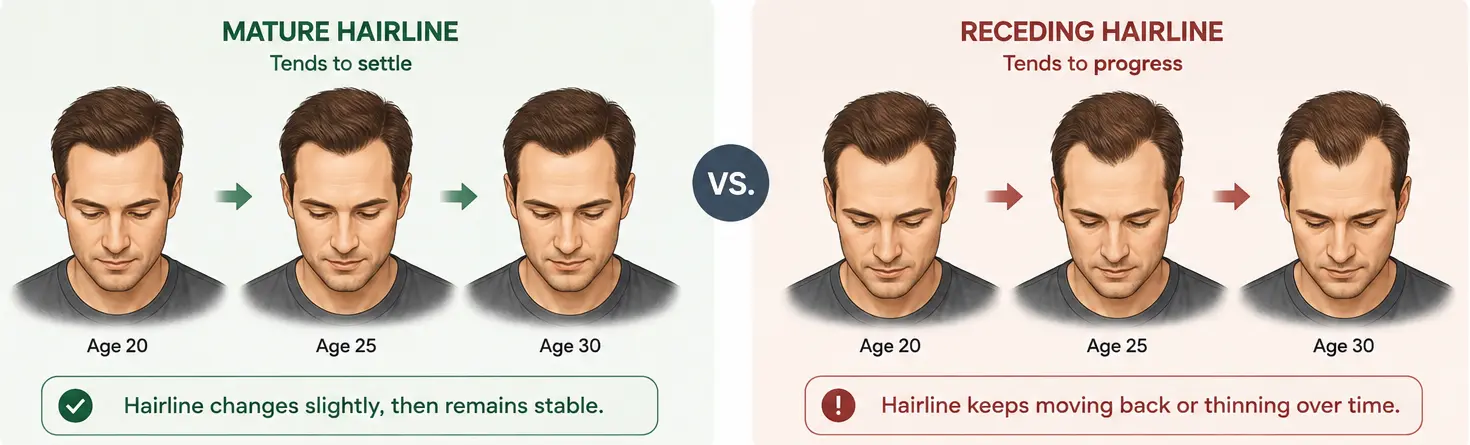
Hair loss deserves particular attention. Advancing an actively receding hairline can produce an unstable long-term result. Some patients are better suited to a hair transplant, medical hair-loss management or no surgery. Others may benefit from staged tissue expansion when a large reduction is requested and scalp mobility is limited. Read our comparison of forehead reduction versus hair transplant if the distinction is unclear.
“A surgeon who sometimes says no may be safer than one who can turn every enquiry into the same operation.”
You should leave the consultation knowing the proposed hairline, realistic lowering range, incision length, anesthesia plan, alternatives, expected recovery and the reasons that the plan suits your anatomy.
6. Where will the surgery and anesthesia take place?
The surgeon is only one part of the safety system. Verify the hospital or surgical facility, its current licence or accreditation, the credentials of the anesthesia professional and the emergency-transfer process. An accredited facility is expected to meet standards relating to equipment, personnel, operating-room safety and clinician credentials.
Ask whether you will meet the anesthesia clinician before the operation, what preoperative tests are required, who monitors you during recovery and whether an overnight stay is planned. If you are travelling internationally, confirm how long the clinic requires you to remain nearby.
Ask directly“Which hospital or accredited facility will be used, who provides anesthesia, and what is the emergency and overnight-care plan?”
7. How openly do they discuss risks and revision care?
All surgery has risk. Possible forehead-reduction concerns include visible or widened scarring, temporary or persistent altered sensation, hair shedding, follicle injury, asymmetry, infection, delayed healing and dissatisfaction with the hairline position. Their likelihood and significance vary by patient, plan and technique.
A systematic review reported a low pooled complication rate, but the evidence base is composed largely of observational surgical studies, and individual risk cannot be reduced to one headline percentage. Read the full forehead reduction risks and safety guide before treating any statistic as a personal prediction.
A trustworthy surgeon should distinguish expected healing from a genuine complication, explain how problems are managed and state the financial and clinical terms for revision. Ask who will assess you if healing changes after you return home.
| What to check | Reassuring evidence | Question to ask | Warning sign |
|---|---|---|---|
| Credentials | Current registration and recognised specialty training you can verify independently | Where can I check your status? | Vague titles or badges with no registry record |
| Experience | Recent, procedure-specific volume and similar cases | How many did you personally perform last year? | Only general cosmetic-surgery totals |
| Results | Standardised, healed close-ups from multiple patients | May I see 6–12 month hairlines like mine? | Only fresh results, heavy styling or filters |
| Planning | Scalp, hair-loss and scar-risk assessment with alternatives | What could make me a poor candidate? | Quote and booking offered before medical review |
| Facility | Named, licensed or accredited facility and qualified anesthesia team | Who provides anesthesia and handles emergencies? | Location or team withheld until arrival |
| Aftercare | Written schedule, urgent contact route and revision policy | Who manages me after I fly home? | Coordinator-only contact and no escalation plan |
8. Is the aftercare plan specific and continuous?
Ask for a written schedule covering dressing care, washing, sleep position, medication, suture or staple removal, exercise, sun exposure and warning signs. Confirm when photographs or video reviews are required and who answers urgent questions outside office hours.
For international patients, aftercare should bridge two countries. Clarify your minimum stay, fitness-to-fly decision, documents provided to your local doctor and the process if treatment is needed after departure. Our week-by-week forehead reduction recovery guide can help you compare a clinic’s plan with the usual healing stages.
9. Are you comparing total value rather than headline price?
A written quote should specify surgeon, hospital, anesthesia, tests, medications, accommodation or transport if relevant, scheduled reviews and any items that remain your responsibility. Ask what happens financially if surgery is postponed, your plan changes after examination, or a revision is recommended.
Price differences between countries can reflect operating costs and exchange rates, but a low quote does not compensate for unverifiable training, a weak facility or missing follow-up. Use our current forehead reduction cost guide to understand typical inclusions and price factors without turning cost into the only selection criterion.
Should you choose a forehead reduction surgeon near you or travel to Turkey?
A search for a “forehead reduction surgeon near me” may produce the most convenient follow-up, but distance alone does not establish experience. Travelling can widen your choice of specialists; it also adds flights, accommodation, time away from work and a cross-border aftercare plan to the decision.
If you are comparing a local clinic with the best forehead reduction surgeon in Turkey for your needs, use the same evidence standard for both. Verify the doctor and hospital independently, compare mature results, insist on a surgeon-led consultation and calculate the entire episode of care. The correct choice is the strongest complete system you can verify—not the closest pin on a map or the most persuasive destination package.
Red flags when choosing a forehead reduction surgeon
Guaranteed perfection
Promises of no scar, no risk or a precise result before examining you.
Pressure to book
Short-lived discounts or deposits requested before a medical consultation.
Hidden operator
You cannot confirm which surgeon will plan and perform the procedure.
Fresh photos only
No clear examples of mature scars, settled hairlines or comparable anatomy.
No hair-loss assessment
A receding or thinning hairline is treated as irrelevant to long-term planning.
Coordinator-led consent
Risks and alternatives are explained only by sales or administrative staff.
Unclear facility
The operation location and anesthesia team remain unnamed before payment.
Aftercare ends at departure
No named clinician or written plan manages problems once you return home.
A consultation checklist you can copy
- Which regulator and specialist body recognise your training?
- How many forehead reductions did you personally perform last year?
- Can I see healed, unfiltered cases with anatomy similar to mine?
- How stable is my hairline, and could future hair loss change my result?
- How much lowering is realistic for my scalp mobility?
- How will you design the incision, preserve follicles and manage tension?
- Which facility and anesthesia professional will be involved?
- What complications have you managed, and what is your revision policy?
- Who follows me after surgery, especially once I return home?
Compare the answers in writing. A surgeon who explains trade-offs precisely, shows relevant long-term work and is prepared to recommend an alternative has given you more useful evidence than one who simply calls themselves the best.
Frequently asked questions
What qualifications should a forehead reduction surgeon have?
Look for a licensed plastic surgeon with specialty training recognised in the country where they practise, substantial procedure-specific experience and access to an appropriately accredited hospital or surgical facility. Verify the information through the medical regulator rather than relying on clinic badges alone.
How many forehead reduction cases should a surgeon have performed?
There is no universal minimum that guarantees quality. Ask for recent annual and approximate lifetime volume, how much of the surgeon’s current practice involves hairline lowering, and whether they can show healed cases involving anatomy similar to yours.
What should I look for in before-and-after photos?
Prioritise standardised photographs with the same angles and lighting, including close views of the hairline at least six to twelve months after surgery. Assess hairline contour, symmetry, density and scar maturity—not just the number of centimetres lowered.
Is it safe to travel abroad for forehead reduction?
It may be appropriate when the surgeon, facility, anesthesia arrangements and follow-up plan are independently verifiable. Know how long you must remain near the clinic, who makes the fitness-to-fly decision and who manages urgent concerns after you return home.
Should I choose forehead reduction or a hair transplant?
A naturally high, stable hairline with adequate scalp mobility may suit forehead reduction. Thinning, active recession, temple refinement or the need to add follicles may favour transplantation. A proper consultation should assess hairline stability, donor density and scalp laxity before recommending either.