

The most common question patients ask before forehead reduction surgery is not about the operation itself — it is about the scar. Where will it be? How visible is it? And how long until nobody can see it? This guide answers every scar-related question in detail, so you know exactly what a forehead reduction scar looks like at each stage of healing.
Does Forehead Reduction Surgery Leave a Scar?
Yes — every surgical incision leaves a scar, and anyone who promises a completely scarless result is not being honest. The real question is how well the scar can be hidden. In forehead reduction, the incision is placed directly at the hairline using a pretrichial incision, which means the final scar sits exactly where forehead skin meets hair-bearing skin. Once healed, it is naturally camouflaged by the hair that grows in front of and through it.
The technique used to close the incision matters just as much as its placement. A trichophytic closure bevels the edge of the wound so hair follicles are preserved under the scar line. Over the following months, new hairs grow directly through the healed skin, breaking up the line and making it extremely difficult to spot — even with the hair pulled back.
“A forehead reduction scar is not something you hide for life — it is something we design to disappear. With my C Reduction technique, I follow a zigzag line along the hairline, cut at a 45-degree angle to protect the follicles, and close the wound in five layers. When hair starts growing through the scar around the third month, most of my patients honestly cannot find it in the mirror anymore.”
— Dr. Cengizhan Ekizceli, Plastic Surgeon, Istanbul
What Does the Scar Look Like Right After Surgery?
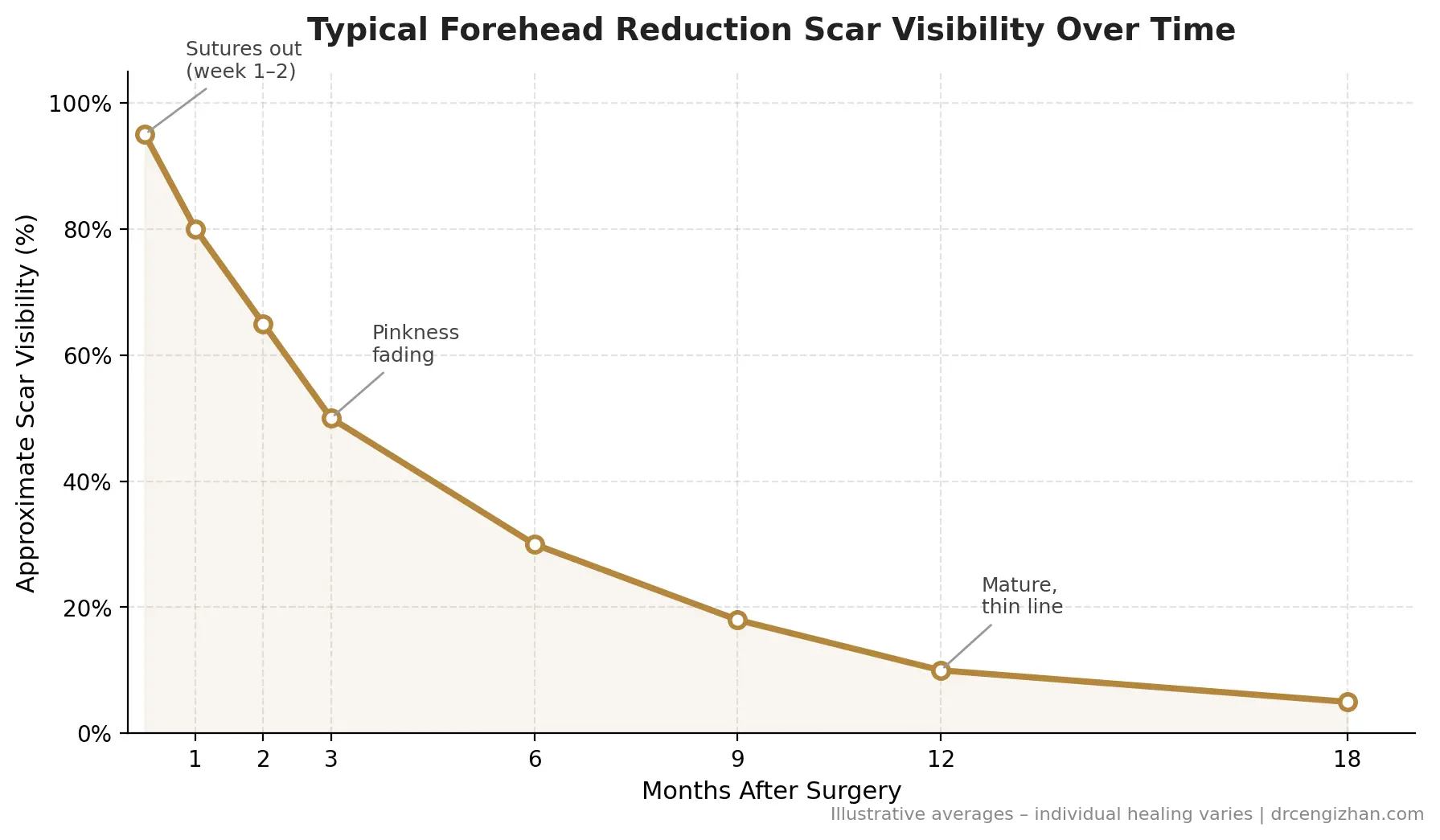
In the first two weeks, the incision line is clearly visible: a thin, slightly raised line running along the hairline, often with mild redness, crusting, and swelling around it. This is completely normal wound behavior, not a sign of poor healing. Sutures are typically removed or dissolve within 10–14 days, and any temporary numbness around the incision usually improves gradually as the small sensory nerves recover.
Between weeks two and eight, the scar enters its most “visible” phase. Fresh scar tissue is rich in blood vessels, so the line can look pink or slightly red — especially in fair-skinned patients. Do not judge your final result during this period. What you see at week four has very little to do with what you will see at month twelve, because collagen remodeling continues silently under the skin for a full year.
Forehead Reduction Scar Healing Timeline
The table below summarizes what most patients can expect month by month. Individual healing varies with skin type, genetics, and aftercare quality, but the overall pattern is remarkably consistent.
| Healing Stage | Timeframe | What the Scar Looks Like | What You Should Do |
|---|---|---|---|
| Fresh incision | Week 1–2 | Thin raised line, redness, light crusting, sutures in place | Keep the area clean and dry; sleep with head elevated |
| Early healing | Week 2–8 | Pink or red line, occasionally itchy; swelling resolves | Start silicone gel once fully closed; avoid direct sun |
| Active fading | Month 2–6 | Pinkness fades to light pink; hairs begin growing through the line | Continue silicone + SPF 50; gentle scalp massage if approved |
| Maturation | Month 6–12 | Pale, flat, thin line blending into the hairline | Maintain sun protection; styling completely unrestricted |
| Mature scar | Month 12–18 | Faint white line hidden by hair; usually undetectable in daily life | No special care needed |
Individual healing varies with skin type, genetics, and aftercare quality.
The same pattern is easy to see when plotted as a curve — visibility drops sharply in the first three months, then continues fading slowly until the scar fully matures:
How Surgeons Keep the Scar Nearly Invisible
Scar quality is decided in the operating room long before aftercare begins. Four surgical details make the difference between a scar you forget about and one you keep covering with bangs:
Zigzag incision design. A perfectly straight line catches light and reads as “scar” to the human eye. An irregular, wave-like incision scatters light and mimics the natural irregularity of a hairline, which is why Dr. Cengizhan’s signature C Reduction follows a zigzag path rather than a straight cut.
Angled cutting to protect follicles. Cutting at 45 degrees instead of straight down spares the hair roots at the wound edge. Those preserved follicles later push new hairs through the scar itself — the single most powerful camouflage mechanism available.
Tension-free closure in multiple layers. Scars stretch and widen when skin is pulled tight at the surface. Closing the wound in five layers distributes tension deep in the tissue, so the visible skin edges meet without strain and heal as a fine line rather than a wide band.
Fine suturing at the skin surface. The last layer is closed with delicate aesthetic sutures that leave no track marks. Combined with careful wound-edge alignment, this determines how crisp and thin the final line becomes. You can judge the outcome yourself in our before-and-after gallery, where most healed hairlines show no trace of the incision.
Scar Aftercare: What Actually Works
Aftercare cannot fix a poorly executed closure, but it meaningfully improves a good one. According to the American Society of Plastic Surgeons, surgical scars heal best when patients avoid physical strain on the wound, use silicone-based products, and shield the area from the sun during the maturation year.
In practice, three habits deliver most of the benefit. First, apply silicone gel or sheets daily from roughly week three until month six — silicone is the best-evidenced topical treatment for flattening and softening scars. Second, protect the line with SPF 50 whenever it is exposed, because UV light permanently darkens immature scar tissue. Third, be patient: picking at crusts, aggressive scrubbing, or early hair coloring along the line can all set healing back. A full week-by-week aftercare plan is covered in our forehead reduction recovery guide.
When a Scar Doesn't Heal as Expected
A small minority of patients develop a scar that stays red, raised, or wider than expected. Genetics play the biggest role — people prone to hypertrophic scarring or keloids should mention this at consultation so the surgeon can plan accordingly. Poor aftercare, smoking, sun exposure, and wound tension are the other usual culprits. These outcomes are uncommon and are discussed alongside other considerations in our overview of forehead reduction risks and safety.
The good news: even a suboptimal scar is treatable. Options range from steroid injections and laser treatment for redness or thickness, to a small scar revision procedure or a strip of hair transplantation to reinforce coverage along the line. If you are unhappy with a scar from a previous operation elsewhere, you can contact the clinic for an assessment — revision cases are evaluated individually.
The Bottom Line
A forehead reduction scar is real, but with correct incision design, follicle-preserving technique, layered closure, and disciplined aftercare, it matures into a faint line hidden inside the hairline — one that neither you nor anyone else will notice in everyday life. Choose your surgeon based on healed hairline photos, not promises, and give the scar the twelve months it needs to reach its final form.
FAQs About Forehead Reduction Scars
Does forehead reduction surgery leave a scar?
Yes, like any surgery it leaves a scar, but it is placed exactly along the hairline in an irregular zigzag pattern. Because preserved follicles grow hair through the healed line, the mature scar is usually undetectable in normal social distance.
When does a hairline lowering scar go away?
It never disappears completely, but it fades dramatically. Redness typically resolves within 3–6 months, and by 12–18 months the scar matures into a thin, pale line concealed by the hairline.
Can hair grow through the forehead reduction scar?
Yes — this is the key advantage of a trichophytic, angled incision. Hair follicles preserved at the wound edge push new hairs directly through the scar starting around month two to three, which is the main reason the line becomes so hard to see.
How can I hide the scar while it is still healing?
Most patients simply style their hair forward for the first few weeks. Once the incision is fully closed and your surgeon approves, scar-safe concealer or mineral makeup can cover any residual pinkness for special occasions.
What if my scar becomes raised or red instead of fading?
Persistent redness or thickening beyond month three should be shown to your surgeon. Early treatment with silicone therapy, steroid injections, or laser sessions is very effective at flattening and lightening an overactive scar.
Can a visible forehead reduction scar from a previous surgery be corrected?
In most cases, yes. Depending on the scar, options include surgical scar revision with a follicle-preserving closure, laser resurfacing, or grafting hair into the scar line to camouflage it permanently.