

Have you ever looked in the mirror and wondered, “Do I have a big forehead — or is it completely normal?” You are not alone. Every month, thousands of people search for the answer to this exact question, and the truth is more reassuring than most expect: forehead size varies enormously, and what looks “big” in a selfie is often well within the average range.
Still, there are objective ways to answer the question. Facial plastic surgeons use specific measurements and proportions to define forehead height, and those numbers give you a reliable benchmark. In this guide, you will learn exactly what is considered a big forehead, the average forehead size for men and women, how to measure your own at home, and what options exist if your forehead genuinely bothers you.
What Is Considered a Big Forehead?
The forehead is measured as the vertical distance between two landmarks: the trichion (the midpoint of your hairline) and the glabella (the smooth area between your eyebrows). This distance is called the forehead height.
As a general rule based on measurements used in facial aesthetic surgery:
- A forehead height above approximately 7 cm (2.8 inches) is typically considered large in women.
- A forehead height above approximately 8.5 cm (3.3 inches) is typically considered large in men.
These are guidelines, not strict medical definitions. Whether a forehead reads as “big” also depends on the overall size of your face, your hairline shape, brow position, and even your hairstyle. A 7 cm forehead on a long, narrow face can look perfectly balanced, while the same measurement on a smaller face may appear more prominent.
Average Forehead Size: How Big Is the Average Forehead?
So how big is the average forehead? Anthropometric studies and clinical experience in hairline lowering surgery point to fairly consistent ranges. Men naturally have taller foreheads than women, partly because the male hairline sits higher and is often shaped with slight temple recession, while the typical female hairline is lower and more rounded.
The table below summarizes the commonly cited averages:
| Measurement | Women | Men |
|---|---|---|
| Average forehead height (hairline to brows) | 5.0 – 6.5 cm (2.0 – 2.6 in) | 6.0 – 8.0 cm (2.4 – 3.1 in) |
| Typically considered large | Above ~7 cm (2.8 in) | Above ~8.5 cm (3.3 in) |
| Ideal proportion of total face height | ~1/3 of the face | ~1/3 of the face |
| Average forehead width (temple to temple) | ~11 – 12.5 cm | ~12 – 13.5 cm |
Keep in mind that averages differ slightly between ethnic groups and individual studies. The most useful takeaway is the range: if your forehead height falls between roughly 5 and 8 cm, you are within normal territory for your sex.
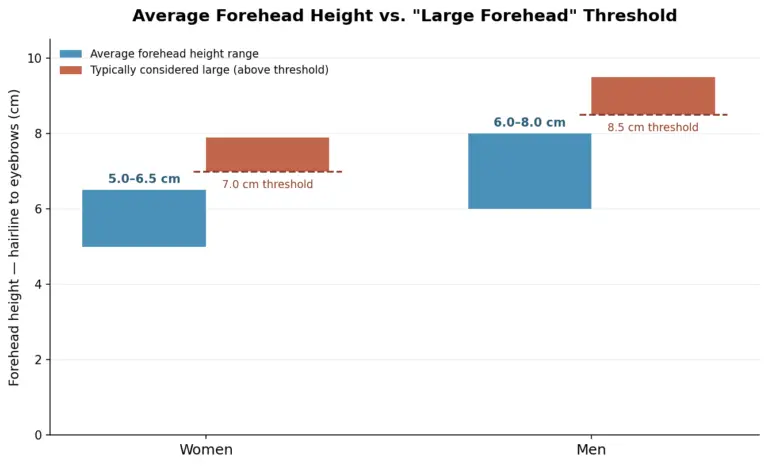
The chart above visualizes the key numbers: the blue bars show the average range for women and men, and the dashed lines mark the height at which a forehead is generally perceived as large.
How to Measure Your Forehead at Home
You do not need a clinic to find out where you stand. All you need is a soft measuring tape or a ruler and a mirror. Follow these steps:
- Relax your face. Raised eyebrows shorten the apparent distance and skew the result.
- Find your hairline midpoint (trichion). If your hairline has receded, use the point where dense, permanent hair begins — not fine baby hairs.
- Find your glabella. This is the flat point between your eyebrows, level with their upper edge.
- Measure the vertical distance between the two points, keeping the tape straight rather than following the curve of your forehead.
- Compare with the table above.
For a second opinion, take a front-facing photo in neutral lighting and check your facial thirds, which brings us to the most reliable test of all.
The Rule of Thirds: Proportion Matters More Than Centimeters
Aesthetic medicine rarely judges a feature in isolation. The classic rule of thirds divides the face into three horizontal sections:
- Hairline to eyebrows (the forehead)
- Eyebrows to the base of the nose
- Base of the nose to the chin
In a face that is perceived as harmonious, each third occupies roughly one third of the total facial height. If your forehead clearly takes up more than a third — say 38 to 40 percent or more — it will tend to look large regardless of its absolute measurement in centimeters. Conversely, a tall forehead on a proportionally long face may not stand out at all.
This is why two people with identical forehead measurements can look completely different, and why proportion, not a single number, is the standard surgeons actually use when planning hairline procedures.
How to Tell If You Have a Big Forehead: 4 Visual Signs
Beyond the tape measure, there are visual cues that people — consciously or not — use when judging forehead size. If you want a quick self-check before measuring, look for these signs in a neutral, front-facing photo:
- Your forehead dominates the frame. When the upper third of your face is the first thing you notice in a photo, it usually occupies more than a third of your facial height.
- A high or receding hairline. If the distance between your brows and hairline looks noticeably longer than the distance between your brows and the tip of your nose, your forehead is on the taller side.
- Hairstyles feel limiting. People with tall foreheads often avoid slicked-back styles, tight buns, or center parts because these expose the full height of the forehead.
- The four-finger test overflows. If you can stack four fingers on your forehead with clear room to spare, it is likely above average — though, as explained in the FAQ below, this test is only a rough shortcut.
None of these signs is a problem in itself. Plenty of models and actors are known for striking large foreheads, and a taller upper third can photograph beautifully. They are simply indicators worth confirming with an actual measurement.
Why Is My Forehead So Big? Common Causes
If your measurement came back on the higher side, the next natural question is why. Large foreheads usually come down to one or more of the following factors:
Genetics. By far the most common cause. A naturally high hairline runs in families, and many people with tall foreheads have a parent or sibling with the same trait. It is present from childhood and stable over time.
Hairline recession. In men, androgenetic alopecia typically begins at the temples and frontal hairline, gradually increasing forehead height over the years. What was once a 6.5 cm forehead can become 9 cm or more.
Traction alopecia. Tight ponytails, buns, braids, and extensions can pull the hairline backward over time — a frequent, often overlooked cause of an increasingly tall forehead in women.
Brow position and bone structure. Low-set or heavy brows make a forehead look shorter; elevated brows or a flat frontal bone can make the same forehead appear taller.
Big Forehead Male vs. Female: Why the Standards Differ
Beauty norms treat forehead height differently by sex. A taller forehead on a big forehead male is often read as neutral or even distinguished, because a higher, slightly M-shaped hairline is a normal masculine trait. For women, however, a lower, rounded hairline is a strongly feminine feature, which is why women tend to notice — and mind — extra forehead height at smaller measurements than men do.
This also explains the numbers in our table: the threshold for a “large” forehead is set roughly 1.5 cm lower for women than for men. It is not that female foreheads are judged more harshly in absolute terms; the baseline is simply different.
What You Can Do About a Large Forehead
First, the honest answer: a big forehead is a normal anatomical variation, not a flaw that needs fixing. Many people soften its appearance with simple styling choices — bangs and curtain fringes, side parts, added volume at the crown, or brow shaping that visually lifts the lower face.
If your forehead height genuinely affects your confidence, there are permanent medical options. Forehead reduction surgery (hairline lowering) can shorten the forehead by 1.5 to 3 cm in a single procedure by advancing the hairline forward, restoring the balanced one-third proportion described above. For patients with hair loss along the hairline, a hair transplant to the frontal hairline is an alternative or complementary approach. A consultation with an experienced surgeon will clarify which technique suits your hairline, scalp laxity, and goals.
Frequently Asked Questions
What is considered a big forehead in inches?
For women, a forehead taller than about 2.8 inches (7 cm) from hairline to brows is generally considered large; for men, the threshold is around 3.3 inches (8.5 cm).
Do I have a big forehead if I can fit four fingers on it?
The “four finger test” is a popular social media shortcut, but it is unreliable because finger width varies from person to person. Four average fingers span roughly 6 to 7 cm, so fitting four fingers usually means your forehead is normal to slightly tall — measure in centimeters for a real answer.
Is a big forehead a sign of intelligence?
No. The idea that large foreheads indicate higher intelligence comes from phrenology, a pseudoscience discredited long ago. Forehead size has no proven link to IQ.
Can a big forehead get smaller naturally?
Forehead height itself does not shrink, and a receding hairline only increases it. However, styling changes offer an immediate visual fix, and surgical hairline lowering offers a permanent one.